What Is a Compound Word? Types, Rules, and Examples
A compound word is a word formed by joining two or more smaller words to create a new meaning.
For example:
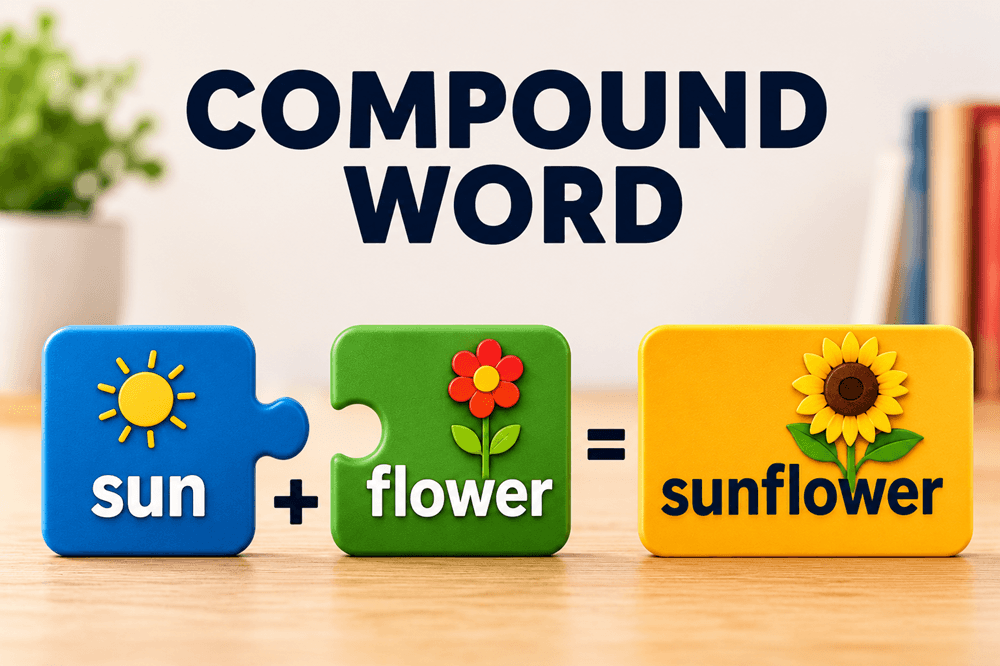
- sun + flower = sunflower
- rain + coat = raincoat
- tooth + brush = toothbrush
Each smaller word has its own meaning, but when they are combined, they form a new word with a more specific meaning.
Quick Answer
A compound word is created when two words work together as one unit.
Compound words can be written in three main ways:
- Closed compound: notebook
- Hyphenated compound: well-known
- Open compound: ice cream
The spelling may differ, but all three forms function as compound words.
What Does Compound Word Mean?
The word compound means something made from two or more parts.
In grammar, a compound word combines separate words to create one new idea.
For example:
- bed is a piece of furniture.
- room is an area inside a building.
- bedroom is a room used for sleeping.
The meaning of a compound word is often connected to the meanings of its parts. However, the combined word may have a more specialized meaning.
For example:
- butterfly is not a type of butter or a type of fly.
- deadline is not always a literal line.
- breakfast originally referred to breaking a period of fasting.
This means you cannot always understand a compound word by interpreting each part literally.
What Are the Three Types of Compound Words?
Compound words are usually divided into three categories:
- Closed compound words
- Hyphenated compound words
- Open compound words
The category depends on how the words are written.
Closed Compound Words
A closed compound word is written as one word without a space or hyphen.
Examples include:
- bedroom
- football
- toothpaste
- haircut
- keyboard
- moonlight
- classroom
- grandmother
- newspaper
- sunflower
Closed compounds often begin as two separate words. As people use them more frequently, the words may eventually become joined.
For example, a term that was once written as two words may become familiar enough to be accepted as one word.
Examples in sentences:
- I left my keys in the bedroom.
- She planted a sunflower near the fence.
- He bought a new keyboard.
- The children returned to the classroom.
Hyphenated Compound Words
A hyphenated compound word joins words with one or more hyphens.
Examples include:
- mother-in-law
- well-known
- part-time
- long-term
- six-year-old
- check-in
- self-control
- up-to-date
Hyphens help readers understand that the words work together as one unit.
Examples in sentences:
- She has a part-time job.
- He is a well-known author.
- We need a long-term solution.
- Their six-year-old daughter started school.
Hyphen rules can change depending on how a compound is used in a sentence.
For example:
- She has a full-time position.
- She works full time.
Before a noun, full-time is usually hyphenated because it acts as a compound adjective. After the verb, full time is commonly written as two words.
Open Compound Words
An open compound word is written as two separate words, but the words work together to express one meaning.
Examples include:
- ice cream
- post office
- high school
- living room
- peanut butter
- real estate
- swimming pool
- dining room
Although these compounds contain a space, they still function as established units.
Examples in sentences:
- We stopped at the post office.
- She attends high school.
- They painted the living room.
- He ordered chocolate ice cream.
The space does not mean the words are unrelated. Together, they name one object, place, idea, or activity.
How Are Compound Words Formed?
Compound words can combine different types of words.
Noun + noun
Two nouns can form a new noun.
Examples:
- rain + coat = raincoat
- foot + ball = football
- tooth + paste = toothpaste
- book + shelf = bookshelf
Adjective + noun
An adjective and a noun may form a compound.
Examples:
- black + board = blackboard
- green + house = greenhouse
- soft + ware = software
Verb + noun
A verb and a noun can work together.
Examples:
- washing machine
- swimming pool
- breakfast
- playground
Noun + verb
A noun may combine with a verb.
Examples:
- sunrise
- rainfall
- haircut
- snowfall
Adverb + verb
An adverb and a verb may form a compound.
Examples:
- overtake
- underestimate
- upgrade
- download
Compound words can be formed in several ways, but the important feature is that the parts create one recognized meaning.
Compound Words for Kids
Compound words are often taught by showing how two familiar words create a new word.
Examples:
- cup + cake = cupcake
- snow + man = snowman
- star + fish = starfish
- door + bell = doorbell
- play + ground = playground
- house + boat = houseboat
- fire + fly = firefly
- rain + bow = rainbow
A simple activity is to separate each compound into its two smaller words.
For example:
basketball
- basket
- ball
Then explain the new meaning:
A basketball is a ball used in the game of basketball.
This method helps learners recognize spelling patterns and understand how words are built.
Is Every Long Word a Compound Word?
No. A long word is not automatically a compound word.
A compound must contain two or more recognizable word parts that can usually stand alone.
For example:
- toothbrush = tooth + brush
- snowball = snow + ball
- mailbox = mail + box
However, a word such as beautiful is not a compound word. It contains a base word and a suffix:
- beauty + ful
The ending -ful is not normally used as an independent word in this structure. Therefore, beautiful is a derived word rather than a compound word.
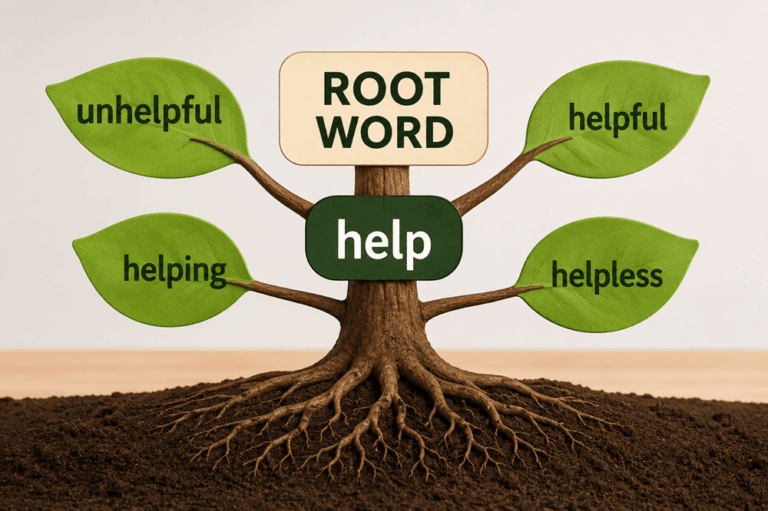
Compound Words vs. Words With Prefixes
Compound words are different from words formed with prefixes.
A prefix is added to the beginning of a word.
Examples:
- unhappy
- rewrite
- disconnect
- impossible
In unhappy, the prefix un- changes the meaning of happy. However, un is not functioning as a separate word.
Compare:
- raincoat = rain + coat
- unhappy = un- + happy
Rain and coat can both stand alone, so raincoat is a compound word.
Compound Words vs. Contractions
Compound words should not be confused with contractions.
A contraction shortens two words by removing letters and usually adding an apostrophe.
Examples:
- do not → don’t
- cannot → can’t
- I am → I’m
- they are → they’re
A compound word combines words to create a new meaning:
- tooth + brush = toothbrush
- class + room = classroom
A contraction shortens a phrase but does not create the same kind of new vocabulary word.
Why Do Some Compound Words Have Hyphens?
Hyphens are often used to make meaning clearer.
Compare:
- a small-business owner
- a small business owner
The first phrase clearly describes someone who owns a small business. Without careful punctuation, some phrases may be briefly confusing.
Hyphens are especially common in compound adjectives placed before nouns:
- a last-minute decision
- a high-speed train
- a well-written article
- a five-minute break
However, not every multiword adjective needs a hyphen. Dictionary and style-guide recommendations can differ.
Can Compound Word Spelling Change?
Yes. Compound word spelling often changes over time.
A compound may begin as two open words, later become hyphenated, and eventually be written as one closed word.
A simplified pattern may look like this:
- web site
- web-site
- website
Not every compound follows all three stages, but language tends to close frequently used combinations over time.
This is why older texts may use a different spelling from modern dictionaries.
How Do You Know Whether a Compound Is One Word?
There is no single rule that works for every compound word.
The safest method is to check a current dictionary.
For example:
- notebook is one word.
- ice cream is two words.
- mother-in-law is hyphenated.
All three are compounds, but their spelling must be learned individually.
When a dictionary lists more than one form, follow the style preferred for your region or publication.
Common Compound Word Mistakes
A frequent mistake is assuming that all compounds must be written as one word.
Incorrect assumption:
- If two words create one meaning, they must be joined.
In reality:
- toothbrush is closed.
- ice cream is open.
- father-in-law is hyphenated.
Another mistake is adding unnecessary hyphens.
Incorrect:
- living-room
- post-office
- basket-ball
Correct:
- living room
- post office
- basketball
The correct spelling depends on established usage, not personal preference.
How to Remember the Types of Compound Words
Use this simple pattern:
Closed, connected. Hyphenated, linked. Open, spaced.
- Closed compounds have no gap: football
- Hyphenated compounds use a link: well-known
- Open compounds keep a space: ice cream
You can also remember that the appearance changes, but the principle remains the same:
Two words combine to create one idea.
Examples of Common Compound Words
Here are more examples organized by type.
Closed compounds
- airport
- backpack
- bathroom
- birthday
- downtown
- flashlight
- homework
- lifetime
- weekend
- watermelon
Hyphenated compounds
- editor-in-chief
- dry-cleaning
- half-time
- merry-go-round
- one-sided
- runner-up
- sister-in-law
- two-year-old
Open compounds
- coffee shop
- first aid
- full moon
- middle school
- parking lot
- science fiction
- traffic light
- video game
Final Answer
A compound word is formed when two or more words combine to create one meaning.
There are three main types:
- Closed: sunflower
- Hyphenated: well-known
- Open: ice cream
Some compound words are written together, some use hyphens, and some keep a space. The spelling varies, but each compound functions as a single idea.
Remember:
A compound word combines smaller words to create a new word or meaning.