What Is a Root Word? Meaning, Types, and Examples
A root word is the basic part of a word that carries its main meaning. Prefixes and suffixes can be added to the root to create new words.
For example:
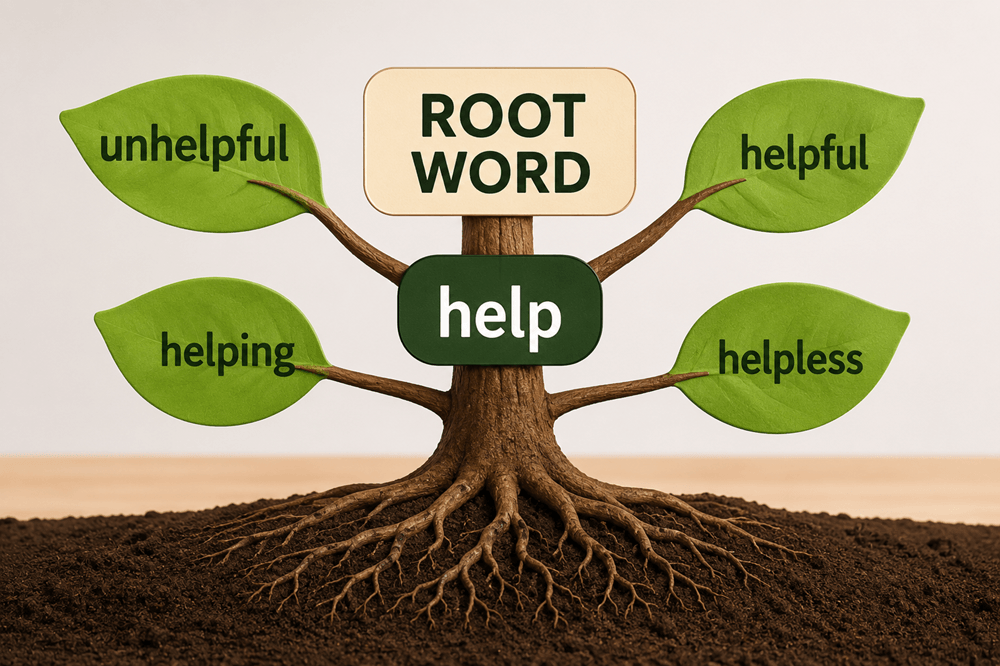
- help → helpful, helpless, unhelpful
- play → replay, playful, player
- act → action, active, react
The root connects these related words and helps explain what they mean.
Quick Answer
A root word is the central part of a word.
It may appear by itself as a complete word:
- kind
- read
- use
- care
It may also come from Greek or Latin and not normally stand alone in English:
- bio means life.
- port means carry.
- scrib means write.
- dict means say or speak.
Learning common roots makes unfamiliar words easier to understand and spell.
What Does Root Word Mean?
A root gives a word its core meaning.
Consider the word unhelpful:
- un- means not.
- help is the root word.
- -ful means full of or having.
The word unhelpful therefore describes something or someone that is not helpful.
The root help remains connected to the main meaning, even after a prefix and suffix are added.
Another example is carelessness:
- care: root
- -less: without
- -ness: state or condition
Carelessness means the state of being without enough care.
Root Word Examples
Many common English words can act as roots.
| Root word | Related words |
|---|---|
| Help | helpful, helpless, helping |
| Play | player, playful, replay |
| Care | careful, careless, caring |
| Use | useful, useless, reuse |
| Read | reader, reading, reread |
| Kind | kindness, unkind, kindly |
| Move | movement, remove, movable |
| Agree | agreement, disagree, agreeable |
The spelling of the root may sometimes change slightly when an ending is added.
For example:
- happy → happiness
- beauty → beautiful
- decide → decision
Even when the spelling changes, the words remain related in meaning.
Root Words, Prefixes, and Suffixes
A root may be combined with a prefix, a suffix, or both.
Prefix
A prefix is added to the beginning of a root.
Examples:
- re- + write = rewrite
- un- + kind = unkind
- dis- + agree = disagree
- pre- + view = preview
The prefix changes or adds to the meaning of the root.
Suffix
A suffix is added to the end of a root.
Examples:
- care + -ful = careful
- help + -less = helpless
- teach + -er = teacher
- kind + -ness = kindness
A suffix may change the meaning or grammatical role of a word.
Prefix and suffix together
Some words have both.
Examples:
- un + help + ful = unhelpful
- dis + respect + ful = disrespectful
- re + use + able = reusable
- un + comfort + able = uncomfortable
Finding the root first makes these longer words easier to analyze.
Can a Root Word Stand Alone?
Sometimes it can.
Words such as help, play, read, and kind are complete English words. They can stand alone while also serving as roots for longer words.
For example:
- She offered to help.
- He was very helpful.
- The instructions were unhelpful.
The word help works independently and remains the root of the related forms.
However, some roots cannot normally stand alone in English.
For example:
- scrib means write.
- ject means throw.
- aud means hear.
- vis means see.
These roots generally appear as parts of longer words.
Greek and Latin Roots
Many English words contain roots borrowed from Greek or Latin.
Understanding these roots can help you work out the meanings of unfamiliar words.
Bio: life
Examples:
- biology
- biography
- biodegradable
The root bio relates to life or living things.
Port: carry
Examples:
- transport
- import
- export
- portable
The root port relates to carrying or moving something.
Scrib or script: write
Examples:
- describe
- manuscript
- inscription
- script
These roots relate to writing.
Dict: say or speak
Examples:
- predict
- dictionary
- contradict
- dictate
The root dict relates to speaking, saying, or stating.
Aud: hear
Examples:
- audio
- audience
- audible
- auditorium
The root aud relates to hearing.
Vis or vid: see
Examples:
- vision
- visible
- video
- revise
These roots relate to seeing or looking.
Root Word vs. Base Word
The terms root word and base word are often used in similar ways, especially in elementary education. However, they can have slightly different meanings.
A base word is a complete word that can accept prefixes or suffixes.
Examples:
- happy → unhappy
- teach → teacher
- read → reread
A root is the most basic meaningful element in a word. It may not be able to stand alone.
Examples:
- struct in construction
- spect in inspect
- rupt in interrupt
Therefore:
- Every base word can function as the foundation of a longer word.
- Some roots are not complete English words.
For everyday learning, calling words such as help, play, and care root words is common and acceptable.
Root Word vs. Compound Word
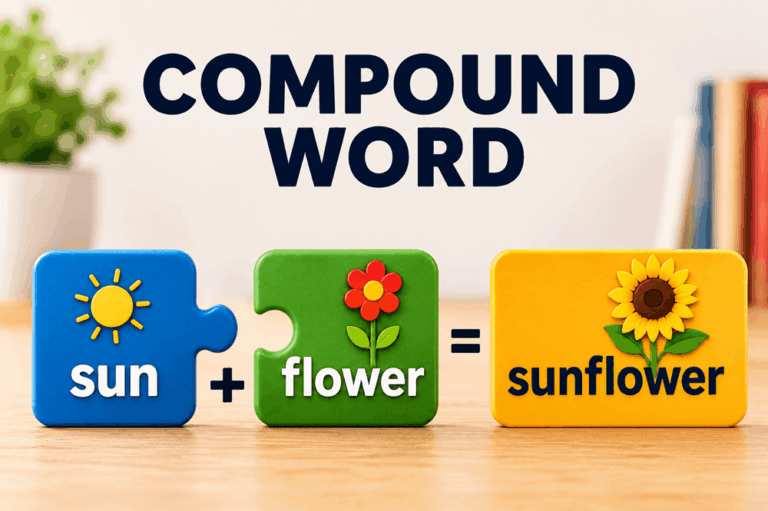
A root word is not the same as a compound word.
A compound word combines two complete words:
- sun + flower = sunflower
- rain + coat = raincoat
- tooth + brush = toothbrush
A word built from a root may include a prefix or suffix:
- un + happy = unhappy
- care + less = careless
- re + write = rewrite
In sunflower, both sun and flower are complete words.
In unhappy, un- is a prefix rather than a complete word.
How Root Words Help With Meaning
Roots provide clues about unfamiliar vocabulary.
Consider the word portable.
The root port means carry, and the suffix -able means capable of being.
Therefore, portable means capable of being carried.
Now consider transport:
- trans- means across.
- port means carry.
To transport something is to carry or move it from one place to another.
Even without knowing the complete definition, the root helps you make a reasonable prediction.
How Root Words Help With Spelling
Finding a root can also make spelling easier.
For example:
- hope → hopeful
- care → careful
- use → useful
- help → helpful
Recognizing the root prevents you from treating every related word as a completely new spelling.
It can also reveal why certain letters appear.
Consider sign and signature. The pronunciation changes, but the shared spelling points to their related meaning.
Other examples include:
- magic → magician
- music → musician
- define → definition
- compete → competition
The root may change slightly, but identifying the word family still supports correct spelling.
How to Find the Root of a Word
Start by looking for familiar prefixes and suffixes.
Consider disagreement.
Remove the prefix:
- dis-
Remove the suffix:
- -ment
The remaining word is:
- agree
Therefore, agree is the base or root word.
Try the same process with carelessness:
- care + less + ness
The central word is care.
For a word such as predict, the structure is different:
- pre- means before.
- dict means say.
The root is dict, even though it is not usually used alone as an English word.
Common Prefixes
Learning common prefixes makes roots easier to identify.
| Prefix | Meaning | Example |
|---|---|---|
| un- | not | unhappy |
| re- | again | rewrite |
| dis- | not or opposite | disagree |
| pre- | before | preview |
| mis- | wrongly | misunderstand |
| sub- | under | submarine |
| inter- | between | international |
| trans- | across | transport |
Once the prefix is removed, the root often becomes clearer.
Common Suffixes
Suffixes can also be separated from the root.
| Suffix | Meaning or function | Example |
|---|---|---|
| -ful | full of | helpful |
| -less | without | careless |
| -ness | state or quality | kindness |
| -er | person who | teacher |
| -able | capable of | washable |
| -ment | result or process | movement |
| -tion | act or process | creation |
| -ly | in a certain way | quickly |
For example, in washable, the root is wash, and -able means capable of being.
Root Word Examples for Kids
Simple examples can show children how one root creates a family of words.
Play
- play
- player
- playful
- replay
- playing
Help
- help
- helper
- helpful
- helpless
- helping
Kind
- kind
- kindly
- kindness
- unkind
Read
- read
- reader
- reading
- reread
A useful activity is to write the root in the center of a page and place related words around it.
This creates a word family map and helps learners see the shared meaning.
Common Mistakes
One mistake is assuming that every word can be divided into a prefix, root, and suffix.
Some words have only a root:
- book
- chair
- dog
Some have a root and suffix:
- teacher
- kindness
Some have a prefix and root:
- rewrite
- dislike
Others have several meaningful parts:
- misunderstandings
- irresponsibility
Another mistake is identifying any group of letters as a root. A true root must carry meaning and connect related words.
How to Remember What a Root Word Is
Think of a word as a plant.
The root is the central part that supports everything else. Prefixes and suffixes grow around it, but the root holds the main meaning.
For example:
- help
- helpful
- helpless
- unhelpful
The added letters change the word, but help remains at the center.
A simple memory sentence is:
The root is the part from which related words grow.
Final Answer
A root word is the main part of a word that carries its central meaning.
Prefixes and suffixes can be added to it:
- help → helpful
- kind → unkindness
- use → reusable
Some roots are complete words, while Greek and Latin roots such as bio, dict, and scrib usually appear inside longer words.
Remember:
A root gives a word its basic meaning and connects it to a family of related words.