Is 67 a Bad Word? Meaning of the “Six Seven” Slang
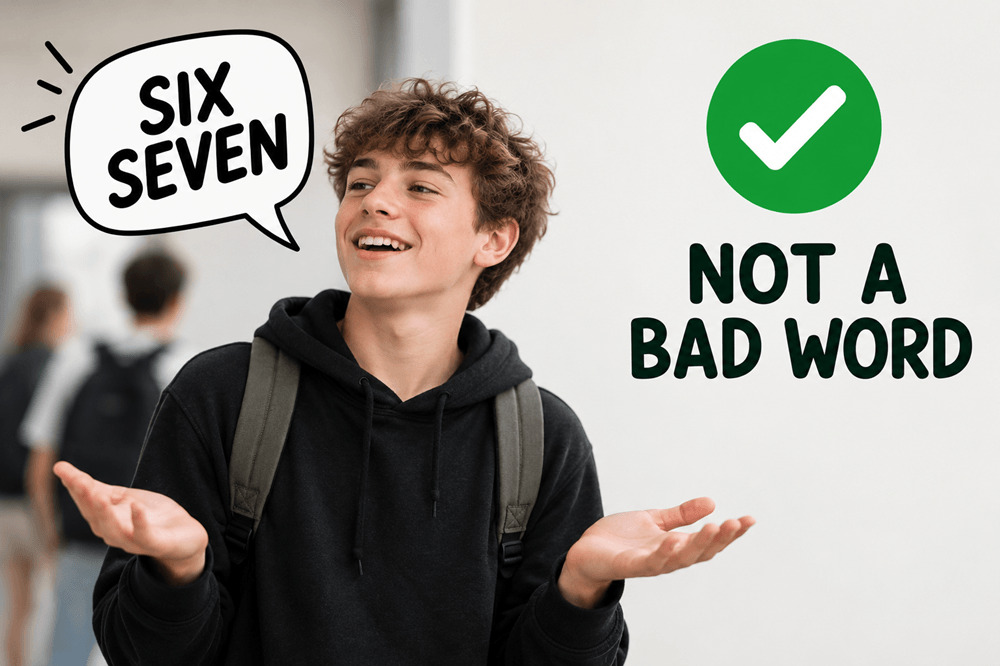
67 is not a bad word or swear word.
When children and teenagers say “67”—usually pronounced “six seven,” not “sixty-seven”—they are generally repeating a viral internet meme. The expression does not have one fixed meaning and is often used simply because it sounds funny or lets someone join an inside joke.
It can become distracting or annoying when repeated constantly, but the phrase itself is not normally offensive.
Quick Answer
67 is not a curse word, slur, or inherently inappropriate expression.
In current slang, six seven is usually:
- a viral meme
- a playful response
- a mostly meaningless interjection
- an inside joke among children and teenagers
- a reference to a song and basketball-related videos
People may shout it randomly, use it when the numbers six and seven appear together, or accompany it with a hand gesture.
The meaning depends on context, but it usually does not communicate anything harmful.
What Does 67 Mean in Slang?
In modern online slang, 67 has no single agreed-upon definition.
It may be used to mean:
- maybe
- so-so
- somewhere in the middle
- nothing in particular
- a random humorous response
In many situations, it does not mean anything at all. Its lack of a clear meaning is part of the joke.
For example:
- “How was the movie?”
“Six seven.” - “What score did you get?”
“67!” - “What comes after 66?”
“SIX SEVEN!”
The person may not be giving a serious answer. They are probably referencing the meme.
The phrase became widely associated with Gen Alpha and spread through TikTok, Instagram Reels, basketball videos, classrooms, and school playgrounds.
Is 67 a Swear Word?
No. 67 is not a swear word.
Swear words are generally considered profane, vulgar, or socially taboo. The viral use of 67 does not fall into those categories.
It is not normally used to describe:
- sexual activity
- bodily functions
- religion in a profane way
- a racial or ethnic group
- a person with a disability
- another protected group
Therefore, the phrase is not profanity or a slur.
However, almost any harmless word can be used rudely depending on the speaker’s tone and behavior. For example, repeatedly shouting 67 while a teacher is talking may be disrespectful, even though the phrase itself is not offensive.
Is 67 Inappropriate for Children?
The expression itself is generally safe for children.
Most children who say it are repeating a meme they heard from:
- classmates
- social media
- online videos
- sports clips
- older siblings
- gaming communities
Parents do not usually need to treat 67 like a forbidden swear word.
A child may still need guidance if they use it:
- to interrupt lessons
- to annoy other people
- during serious conversations
- after being asked to stop
- in place of answering respectfully
The problem in those situations is the behavior, not the number.
One parenting publication describes the phrase as nonoffensive and mostly meaningless, while noting that adults may find its constant repetition irritating.
Where Did the 67 Meme Come From?
The meme is commonly connected to the song “Doot Doot (6 7)” by the rapper Skrilla.
The repeated “6-7” lyric began appearing in short videos and basketball edits. The phrase also became associated with basketball because Charlotte Hornets player LaMelo Ball is listed at 6 feet 7 inches tall.
Additional viral clips helped the phrase spread. A young basketball spectator became known online as the “67 Kid” after enthusiastically yelling the phrase and making an animated hand gesture during a game.
As more people copied the sound and gesture, 67 moved beyond its original references and became a general internet joke.
Why Do Kids Keep Saying 67?
Children and teenagers may say 67 because it creates a sense of shared humor.
Someone who recognizes the phrase understands the reference. Someone unfamiliar with the meme may be confused, which can make the joke even funnier to the people using it.
This type of expression can work as a social signal. It tells others:
- I know the meme.
- I understand the joke.
- I belong to this online culture.
- I am being intentionally random.
Some commentators describe it as “brainrot slang,” meaning an expression spread through repetitive, absurd online content. Others argue that meaningless chants and inside jokes help young people bond socially.
Does 67 Have a Secret Dirty Meaning?
The popular six seven meme does not generally have a secret sexual or obscene meaning.
Rumors often develop around viral hand gestures, numbers, and slang terms because adults are unsure what children are referencing. However, the mainstream meme is usually understood as intentionally vague or meaningless.
There may be unrelated definitions of 67 in obscure slang communities or other languages. User-submitted slang websites can list many contradictory meanings for almost any number.
Those unrelated definitions should not automatically be applied to a child repeating the viral TikTok or basketball meme.
Context matters.
If someone says “six seven” while copying the familiar hand motion or reacting to the numbers six and seven, they are probably referencing the harmless meme.
What Is the 67 Hand Gesture?
The phrase is sometimes accompanied by a gesture in which a person holds both palms upward and moves the hands alternately, as though weighing two options.
This motion may reinforce interpretations such as:
- so-so
- maybe
- this or that
- somewhere in between
However, the gesture does not have one precise definition either.
Like the phrase, it is often performed mainly because people recognize it as part of the meme.
Is 67 Gang-Related?
The mainstream 67 meme is not automatically a gang reference.
The original song may contain references connected to the artist’s personal environment, and numbers can have different meanings in particular neighborhoods or groups. However, most children saying six seven online or at school are copying the viral trend rather than making a serious gang-related statement.
It would be inaccurate to assume that anyone saying 67 is involved with gangs.
The speaker’s age, location, tone, accompanying gestures, and surrounding conversation provide better clues.
Can Schools Ban the Phrase?
A school or teacher may restrict students from repeatedly shouting 67 during class.
This does not mean the expression is a bad word. Schools regularly limit harmless behaviors that disrupt learning, including:
- making sound effects
- repeating jokes
- shouting answers
- using phones
- interrupting lessons
Reports about the trend have described teachers trying various methods to reduce repeated 67 interruptions in classrooms.
A teacher may therefore say, “Do not say 67 during class,” even though the term itself is not offensive.
Is 67 an Insult?
Usually, no.
The phrase does not typically identify a negative quality or target a particular person.
However, it could become insulting in a specific context.
For example, if someone uses 67 to mock another person’s test score, height, appearance, or misunderstanding of the meme, the surrounding behavior could be unkind.
Compare:
- “The next number is 67!”
Harmless meme reference. - “You only got a 67 because you’re stupid.”
Insulting because of the full statement, not because 67 is a bad word.
The number itself remains neutral.
Is 67 a Real Word?
Technically, 67 is a number, not a traditional word.
It is written as:
- 67
- sixty-seven, when naming the number
- six seven, when referring to the meme
In the meme, people normally pronounce each digit separately:
six seven
They usually do not say:
sixty-seven
Dictionary.com selected 67 as its 2025 Word of the Year, treating it as a culturally significant expression despite its being a number and having no fixed meaning.
Is It Written 67, 6-7, or Six Seven?
All of these forms may appear:
- 67
- 6-7
- six seven
- six-seven
For the actual number, use:
sixty-seven
Example:
- There are sixty-seven students.
For the meme, 67, 6-7, and six seven are all understandable.
Example:
- The students kept shouting “six seven.”
When writing formally about the trend, introduce it clearly:
- The viral expression “67,” pronounced “six seven,” became popular online.
Should Parents Be Worried About 67?
Usually, no.
A child saying 67 is most likely participating in a temporary internet trend.
Parents may calmly ask:
- Where did you hear that?
- What does it mean to you?
- Why do you think it is funny?
- Is anyone using it to tease someone?
These questions provide more useful information than immediately assuming the phrase is dangerous.
Reasonable boundaries may still be appropriate:
- Do not interrupt people with it.
- Stop when someone asks you to stop.
- Do not use it to mock classmates.
- Avoid repeatedly shouting it in public places.
This treats the real issue—respectful behavior—without falsely labeling the number as profanity.
Why Does 67 Seem Meaningless?
Many memes are funny because they are unexpected rather than because they communicate a clear idea.
Repeated sounds, phrases, and gestures can become humorous through familiarity. People enjoy recognizing the reference and performing it together.
In that sense, 67 functions less like a vocabulary word and more like:
- a catchphrase
- a chant
- a reaction sound
- an inside joke
- a shared social signal
Its ambiguity allows people to insert it into almost any situation.
Common Misunderstandings
“67 must be a dirty code”
There is no strong evidence that the mainstream meme is normally used as an obscene code.
“Children saying it are swearing”
They are usually repeating a harmless viral joke.
“It has one exact definition”
The meme has no universally accepted meaning.
“It is always harmless behavior”
The phrase is harmless, but constantly interrupting or annoying others with it can still be inappropriate.
“It is pronounced sixty-seven”
The meme is generally pronounced six seven.
How to Explain 67 to an Adult
A simple explanation is:
“67” is a mostly meaningless internet meme that children and teenagers repeat as an inside joke. It is usually pronounced “six seven” and is not a swear word.
You can also explain that it developed from a song, basketball videos, and viral social media clips.
Final Answer
67 is not a bad word.
The viral expression “six seven” is a mostly meaningless meme popular among children and teenagers. It is connected to a song, basketball-related videos, and social media trends.
It is not normally:
- a swear word
- a slur
- a dirty expression
- an insult
- a dangerous code
It may become annoying or disruptive when repeated constantly, but that is a matter of behavior rather than offensive language.
Remember:
67 may be a confusing meme, but it is not generally a bad word.