Truely or Truly: Correct Spelling, Meaning, Usage, and Easy Examples Explained Clearly
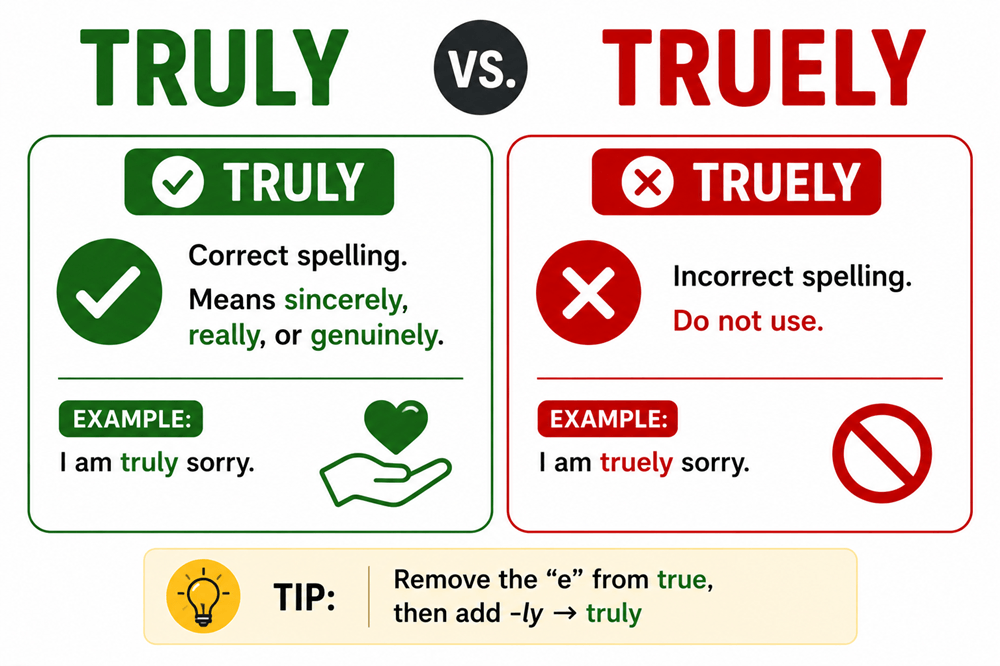
The correct spelling is truly. Truely is a common misspelling and should not be used in standard English. Even though the adjective is true, the adverb drops the final e before adding -ly. Use truly when you mean honestly, sincerely, really, accurately, or genuinely.
Quick Answer
Use truly, not truely.
- Correct: I am truly sorry.
- Incorrect: I am truely sorry.
Truly is the standard spelling. Truely is a spelling mistake.
Truely or Truly: Which One Is Correct?
Truly is correct. Truely is incorrect in standard English.
This mistake happens because the base word is true. Many writers assume that adding -ly should create truely. But English changes the spelling here. The final e in true disappears, and the correct adverb becomes truly.
| Word | Correct? | Meaning |
|---|---|---|
| Truly | Yes | Honestly, sincerely, really, genuinely, or accurately |
| Truely | No | A common misspelling of truly |
If you are writing an apology, compliment, formal message, personal note, essay, email, article, or business document, the word you want is truly.
What Does Truly Mean?
Truly is an adverb. It describes something done or felt in a real, honest, sincere, accurate, or genuine way.
Examples:
- I am truly grateful for your help.
- She truly believes in the project.
- That was a truly beautiful performance.
- He answered the question truly.
- They were truly happy together.
In these sentences, truly adds sincerity, honesty, or emphasis. It tells the reader that something is not fake, exaggerated, or only partly true.
Why Truely Is Incorrect
Truely is incorrect because the word true does not simply keep its final e when -ly is added. The spelling changes from true to truly.
The correct pattern is:
- true + -ly = truly
The incorrect pattern is:
- true + -ly = truely
Because true ends in e, truely may look reasonable at first. But the accepted spelling is truly, with no e after u.
True vs Truly
True and truly are related, but they do different jobs in a sentence.
True is usually an adjective. It describes a noun or pronoun.
- That story is true.
- She is a true friend.
- The answer is true.
Truly is an adverb. It describes a verb, adjective, or whole idea.
- She truly cares.
- That was truly kind.
- I truly understand your concern.
Use true when describing what something is. Use truly when describing how something is felt, said, done, or understood.
Examples of Truly in Sentences
Here are natural examples of truly used correctly:
- I truly appreciate your support.
- She was truly surprised by the gift.
- He is truly one of the best teachers I have had.
- The view from the mountain was truly amazing.
- I am truly sorry for the mistake.
- They truly wanted to make things right.
- The story was truly inspiring.
- You never truly know someone until you see how they handle pressure.
In each sentence, truly gives the sentence a stronger feeling of sincerity, reality, or emphasis.
Truly in Apologies
Truly is often used in apologies because it makes the apology sound sincere.
Examples:
- I am truly sorry for what happened.
- We are truly sorry for the delay.
- She was truly sorry for hurting his feelings.
- I truly regret my words.
In these examples, truly means sincerely or honestly. Do not write truely sorry. The correct phrase is truly sorry.
Truly in Compliments
Truly can also make a compliment sound stronger and more genuine.
Examples:
- That was a truly thoughtful gift.
- You are truly talented.
- She gave a truly moving speech.
- It was a truly memorable evening.
Here, truly means really or genuinely. It helps show that the compliment is heartfelt, not casual or empty.
Truly in Formal Writing
Truly is also common in formal writing, especially when the writer wants to sound sincere, respectful, or exact.
Examples:
- We are truly grateful for your continued support.
- The results are truly significant.
- This is a truly important issue.
- Her leadership was truly valuable to the organization.
The phrase Yours truly may also appear as a closing in letters, though it can sound old-fashioned depending on the context.
- Yours truly,
- Very truly yours,
Even in these formal phrases, the correct spelling is truly, not truely.
Common Mistakes to Avoid
The main mistake is spelling truly as truely.
Incorrect:
- I am truely thankful.
- She was truely happy.
- That was a truely special moment.
Correct:
- I am truly thankful.
- She was truly happy.
- That was a truly special moment.
Another mistake is using true when the sentence needs truly.
Incorrect:
- I true believe you.
Correct:
- I truly believe you.
True describes a noun or idea. Truly describes the action or feeling.
How to Remember Truly
Here is an easy way to remember the spelling:
True loses the e before becoming truly.
You can think of it this way:
- true → drop the e → truly
You can also remember this sentence:
Truly has no e.
That short reminder can help you avoid the common misspelling truely.
Final Answer
Truly is the correct spelling. Truely is a common misspelling and should not be used. Although the base word is true, the adverb drops the final e before adding -ly. Use truly when you mean honestly, sincerely, really, genuinely, or accurately.