Gluing or Glueing: Correct Spelling, Meaning, and Simple Ways to Remember
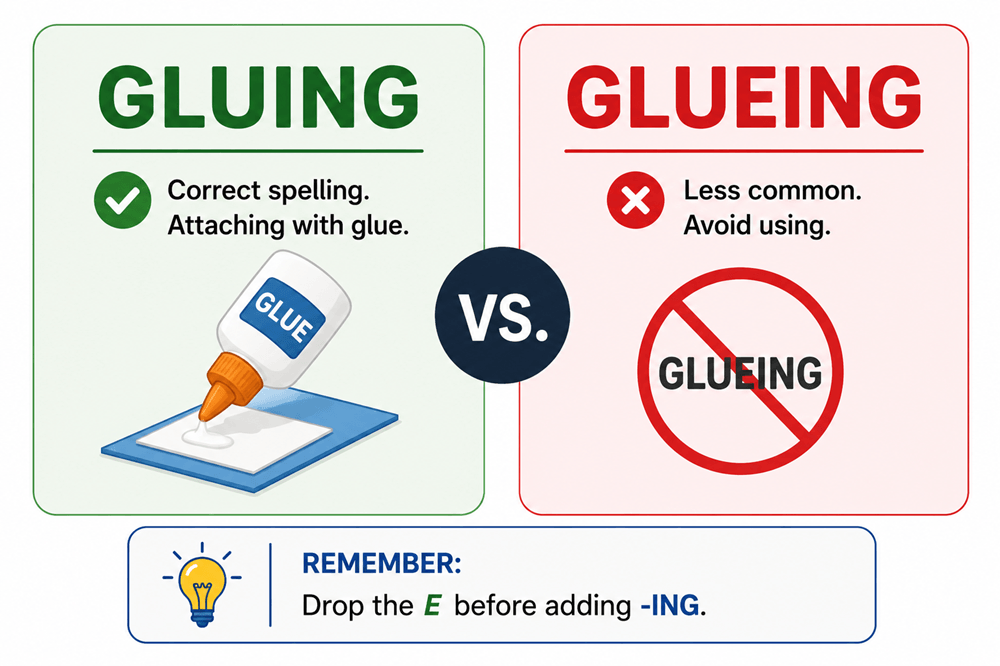
If you are choosing between gluing or glueing, the standard spelling is gluing. It means attaching, sticking, or fastening something with glue. Glueing may look logical because it keeps the full word glue, but in modern English, gluing is the cleaner and more accepted spelling.
Gluing or Glueing: Which Spelling Is Correct?
The usual correct spelling is gluing.
Glueing is sometimes seen as a less common variant, but it is not the form most readers expect. In schoolwork, instructions, craft guides, product labels, emails, articles, and professional writing, gluing is the safer choice.
You should write:
Correct: You are gluing the paper to the cardboard.
Less common: You are glueing the paper to the cardboard.
The word comes from the verb glue. When you add -ing, the silent e is usually dropped. That gives you gluing, not glueing.
What Does Gluing Mean?
Gluing is the present participle of glue. It describes the action of using glue to attach one thing to another.
For example:
You are gluing the broken handle back onto the mug.
This means you are using glue to make the handle stick to the mug again.
You might also write:
The children were gluing pictures onto their art projects.
Here, gluing means attaching pictures with glue.
The word can be used for crafts, repairs, school projects, woodworking, packaging, decorations, model-building, bookbinding, and many other tasks. Whenever something is being attached with glue, gluing is the word you need.
Why Glueing Looks Like It Could Be Right
The spelling glueing looks reasonable because it keeps the full word glue. If you are thinking of the base word first, you may naturally expect:
glue + ing = glueing
That seems simple, but English often changes words slightly before adding endings. When a word ends in a silent e, that e is usually dropped before a suffix beginning with a vowel. Since -ing begins with i, the final e in glue disappears.
That gives you:
glue – e + ing = gluing
The spelling may look shorter than expected, but it is the standard form. The pronunciation stays clear because the u still keeps the sound of glue.
The Simple Spelling Rule for Gluing
The basic rule is:
Drop the silent E before adding -ing.
That rule gives you:
glue → gluing
This pattern appears in many English words:
make → making
take → taking
move → moving
use → using
glue → gluing
In each case, the final silent e is removed before -ing is added. That is why gluing looks different from the base word glue.
A Simple Way to Remember Gluing
The easiest memory trick is:
Gluing drops the E from glue.
Start with the base word:
glue
Remove the final e:
glu
Add -ing:
gluing
You can also remember this phrase:
When glue gets moving, the E leaves.
That may sound playful, but it helps. Since gluing describes an action in progress, the silent e drops away before -ing.
Another useful comparison is:
use → using
glue → gluing
You would not normally write useing. You write using. In the same way, you do not need glueing. You write gluing.
Common Examples With Gluing
Seeing gluing in natural sentences can help the spelling feel familiar.
You are gluing the label onto the jar.
This means you are attaching the label with glue.
The student was gluing magazine pictures onto a poster board.
This describes a school or craft project.
She spent the afternoon gluing beads to the picture frame.
This means she decorated the frame by attaching beads with glue.
The carpenter is gluing the wooden pieces together before clamping them.
This sentence uses gluing in a woodworking context.
You should wait until the surface is clean before gluing anything down.
This gives a practical instruction.
In every sentence, gluing is the standard spelling.
Gluing vs Glueing in Side-by-Side Examples
Side-by-side examples make the difference easier to see:
Correct: You are gluing the torn page back into the book.
Less common: You are glueing the torn page back into the book.
Correct: The kids are gluing paper stars onto the banner.
Less common: The kids are glueing paper stars onto the banner.
Correct: He is gluing the loose tile before it cracks further.
Less common: He is glueing the loose tile before it cracks further.
Correct: The craft requires cutting, folding, and gluing.
Less common: The craft requires cutting, folding, and glueing.
Correct: You should finish gluing the pieces before painting them.
Less common: You should finish glueing the pieces before painting them.
The meaning is understandable either way, but gluing is the spelling that looks more natural in modern English.
Is Glueing Ever Correct?
Glueing may appear occasionally, especially when someone wants to preserve the full base word glue. Some readers may understand it without trouble, and a few dictionaries may list it as a variant. Still, it is not the spelling most people expect.
For everyday writing, gluing is better. It is shorter, cleaner, and more standard. If you are writing instructions, an article, a school assignment, a product guide, or a professional message, gluing will almost always be the right choice.
The practical rule is simple: even if glueing can be understood, gluing is the form that avoids distraction.
What About Gluey?
The word gluey can make this spelling question more confusing. Gluey is an adjective meaning sticky, thick, or like glue.
For example:
The mixture became gluey after it cooled.
In gluey, the e stays because the word would look awkward as gluy. This is one reason English spelling can feel inconsistent. But gluey and gluing are different forms.
Use gluey when describing texture.
Use gluing when describing the action of attaching something with glue.
For example:
The gluey paste stuck to your fingers.
You are gluing the poster to the wall.
The difference is meaning and function. Gluey describes. Gluing shows action.
How to Check Yourself Before Writing Gluing
Before writing the word, ask whether you mean the action of using glue. If yes, choose gluing.
You can use this quick spelling check:
Start with glue.
Drop the silent E.
Add -ing.
Write gluing.
This gives you the correct form every time.
You can also compare it with using. Since use becomes using, glue becomes gluing. Both words drop the silent e before -ing.
The Final Answer on Gluing or Glueing
The standard spelling is gluing. It means attaching, fastening, repairing, or sticking something with glue. Glueing is a much less common variant and can look awkward or nonstandard to many readers.
To remember the spelling, use this rule: gluing drops the E from glue. Think of the pattern glue – e + ing = gluing. You can also compare it with use → using, which follows the same idea.
So when you are writing about craft projects, repairs, decorations, labels, paper, wood, or anything being attached with glue, choose gluing. It is the clean, standard, and reliable spelling.