Accidently or Accidentally: Which Spelling Is Correct?
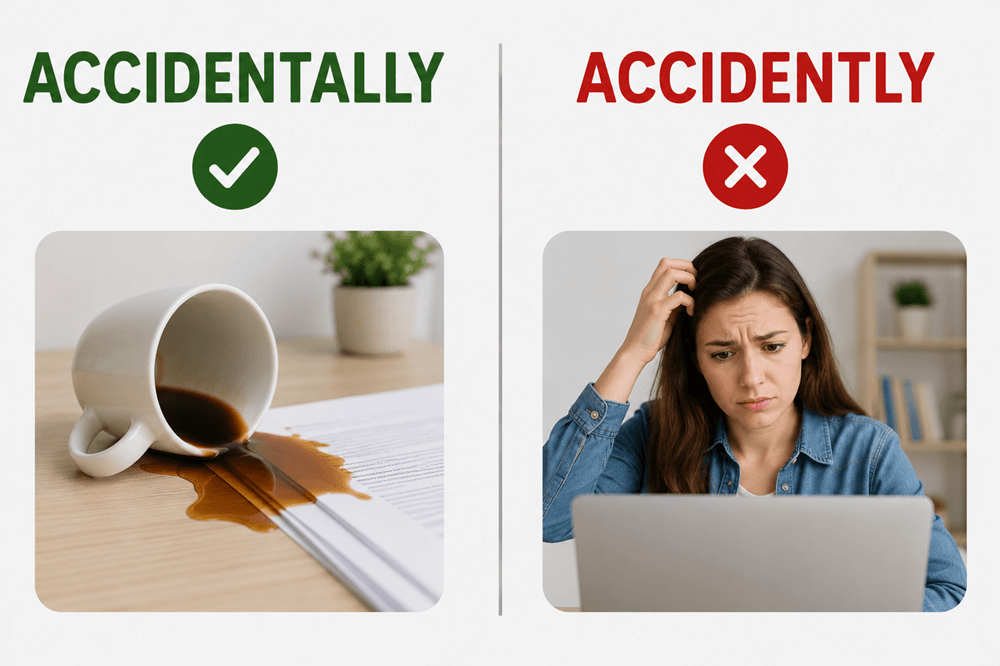
Accidentally is the correct spelling.
Accidently is a common misspelling.
Examples:
Correct: I accidentally deleted the file.
Incorrect: I accidently deleted the file.
Correct: She accidentally spilled her drink.
Incorrect: She accidently spilled her drink.
If you mean something happened by mistake or without planning, use accidentally with -ally at the end.
What Does Accidentally Mean?
Accidentally means by accident, unintentionally, or without meaning to do something.
Examples:
He accidentally dropped his phone.
I accidentally sent the message too early.
The child accidentally broke the vase.
She accidentally left her keys at home.
In each sentence, the action was not planned. It happened by mistake.
Is Accidently a Word?
Accidently is sometimes seen in informal writing, but it is not the standard spelling. In most situations, it should be treated as a misspelling of accidentally.
The correct word is:
accidentally
Not:
accidently
If you are writing for school, work, a blog post, an email, or any polished setting, always use accidentally.
Accidently vs Accidentally
The difference is simple:
Accidentally = correct spelling
Accidently = common misspelling
Examples:
Correct: He accidentally called the wrong number.
Incorrect: He accidently called the wrong number.
Correct: I accidentally clicked the button.
Incorrect: I accidently clicked the button.
Correct: They accidentally walked into the wrong room.
Incorrect: They accidently walked into the wrong room.
The correct spelling may feel long, but it follows the spelling of accidental.
Why Is Accidentally Spelled With -ally?
The word accidentally comes from accidental.
The spelling pattern is:
accident → accidental → accidentally
Because accidental ends in -al, the adverb becomes accidentally with -ally.
This is the same pattern used in many English words:
normal → normally
natural → naturally
personal → personally
accidental → accidentally
So the ending is not just -ly. It is -ally because the adjective is accidental.
How to Spell Accidentally
The correct spelling is:
A-C-C-I-D-E-N-T-A-L-L-Y
Break it into parts:
accident + al + ly
Or:
accidental + ly
The tricky part is the ending:
Correct: accidentally
Incorrect: accidently
Remember that accidentally has all near the end:
accident + ally
That can help you remember the double l.
Examples With Accidentally
Here are more examples using accidentally correctly:
I accidentally locked myself out.
She accidentally stepped on his foot.
He accidentally opened the wrong email.
The dog accidentally knocked over the lamp.
We accidentally took the wrong exit.
I accidentally muted the call.
The baby accidentally hit the button.
In each example, the action happened by mistake.
Common Phrases With Accidentally
Accidentally deleted
Example: I accidentally deleted the document.
Accidentally sent
Example: She accidentally sent the text to the wrong person.
Accidentally clicked
Example: He accidentally clicked the wrong link.
Accidentally broke
Example: They accidentally broke the glass.
Accidentally left
Example: I accidentally left my wallet at home.
These phrases are common in everyday writing, especially when explaining mistakes.
Accidentally vs Accidentally On Purpose
The phrase accidentally on purpose is used when someone pretends something was an accident, but it may have been intentional.
Example:
He “accidentally on purpose” sat next to her.
This phrase is informal and often playful. It suggests the action looked accidental, but the person may have planned it.
In normal writing, accidentally means the action was not planned.
Accidentally vs Unintentionally
Accidentally and unintentionally are very close in meaning.
Accidentally often sounds more natural in everyday speech.
Unintentionally sounds more formal.
Examples:
Everyday: I accidentally interrupted her.
Formal: I unintentionally interrupted her.
Everyday: He accidentally damaged the door.
Formal: He unintentionally damaged the door.
Use accidentally for normal writing and conversation. Use unintentionally when you want a more formal tone.
Accidentally vs Mistakenly
Accidentally means something happened by accident.
Mistakenly means something happened because of a mistake, misunderstanding, or wrong belief.
Examples:
I accidentally dropped the cup.
I mistakenly thought the meeting was at 3 p.m.
The first sentence describes an unplanned action. The second describes an incorrect belief.
Sometimes both words can work, but the meaning may be slightly different.
Example:
I accidentally sent the email to Mark.
I mistakenly sent the email to Mark.
Both are possible. Accidentally focuses on the action being unintentional. Mistakenly focuses on the error.
Common Mistakes
The most common mistake is leaving out the -al- before -ly.
Incorrect:
I accidently closed the tab.
Correct:
I accidentally closed the tab.
Another mistake is spelling it with only one l at the end.
Incorrect:
accidentaly
Correct:
accidentally
The correct ending is -ally, with two l’s.
Also avoid writing accidently in professional or published writing. Even if readers understand it, it looks like a spelling error.
Memory Trick
Here is an easy way to remember the spelling:
Accidentally comes from accidental.
So think:
accidental + ly = accidentally
You can also remember that accidentally has ally at the end.
Correct:
accident + ally
If you remember the word ally, you can remember the correct ending:
accidentally
Not:
accidently
Quick Test
Choose the correct spelling:
I ___ deleted the photo.
Answer: accidentally
She ___ called the wrong person.
Answer: accidentally
The word ___ is missing letters.
Answer: accidently
He ___ spilled coffee on the desk.
Answer: accidentally
The correct spelling ends in ___.
Answer: -ally
Final Answer
Accidentally is the correct spelling.
Accidently is a common misspelling.
Correct: I accidentally deleted the file.
Incorrect: I accidently deleted the file.
Use accidentally when something happens by mistake, without planning, or unintentionally.
The easiest way to remember the spelling is: accidental + ly = accidentally. The correct word ends in -ally, not just -ly.