Began or Begun: Correct Past Tense Usage and Simple Memory Tricks Explained
If you are choosing between began or begun, the difference depends on grammar. Began is the simple past tense of begin. Begun is the past participle, which means it usually needs a helping verb like has, have, or had. You can say the class began, but you should say the class has begun.
Began or Begun: What Is the Difference?
Began and begun both come from the verb begin, but they are used in different sentence structures.
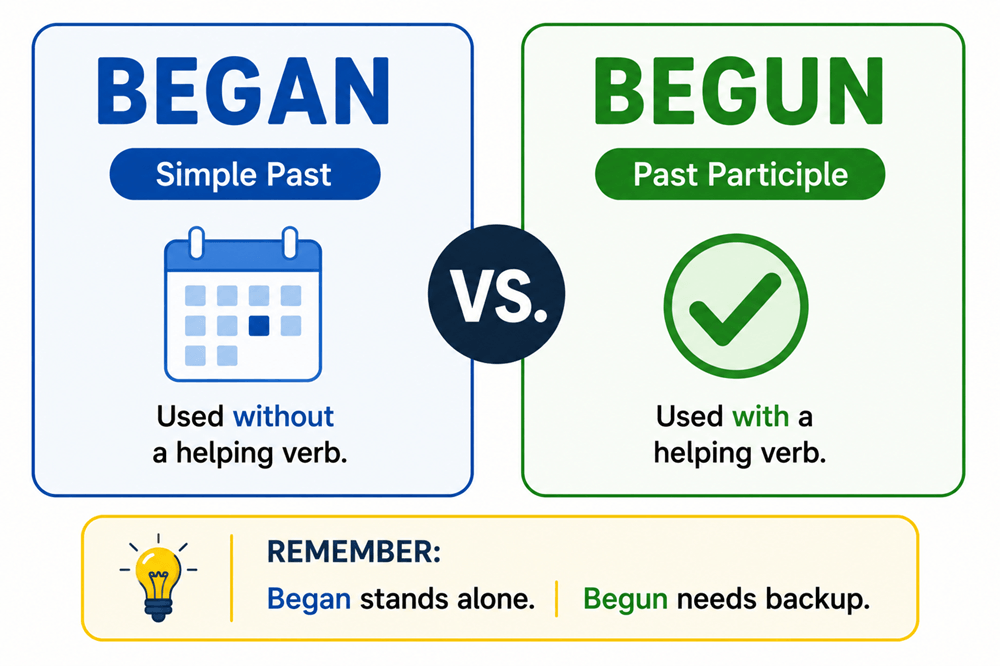
Began is the simple past tense. Use it when something started in the past and there is no helping verb before it.
Begun is the past participle. Use it with helping verbs such as has, have, or had.
You should write:
Correct: The meeting began at noon.
Incorrect: The meeting begun at noon.
You should also write:
Correct: The meeting has begun.
Incorrect: The meeting has began.
The simplest rule is this: began stands alone, but begun needs help.
What Does Began Mean?
Began is the simple past tense of begin. It means something started at an earlier time. You use began when the action happened in the past and the sentence does not include a helping verb.
For example:
The movie began after the previews.
This means the movie started in the past. There is no has, have, or had before began, so the sentence is correct.
Here are more examples:
You began reading the book last night.
She began her new job in March.
The storm began just before sunset.
They began working on the project together.
In each sentence, began works by itself as the main past-tense verb.
What Does Begun Mean?
Begun is the past participle of begin. A past participle usually works with a helping verb. The most common helping verbs with begun are has, have, and had.
For example:
The movie has begun.
Here, has is the helping verb, and begun is the past participle.
More examples include:
You have begun to understand the rule.
She has begun a new chapter in her life.
They had begun the work before you arrived.
The ceremony had already begun when the guests entered.
In each example, begun does not stand alone. It needs a helping verb to complete the structure.
The Simple Rule for Began and Begun
The easiest rule is:
Use began without a helping verb.
Use begun with a helping verb.
Think of the verb forms this way:
Begin = present tense
Began = simple past tense
Begun = past participle
You can remember the pattern with this sentence:
Today you begin, yesterday you began, and by now you have begun.
This sentence gives you the three main forms in order. Begin is for the present. Began is for a completed past start. Begun appears after a helping verb like have.
Why Began and Begun Are Easy to Confuse
Began and begun are easy to confuse because both refer to past time in some way. Unlike regular verbs, begin does not become begined. It changes its vowel:
begin → began → begun
This is an irregular verb pattern. You see a similar pattern in verbs like:
sing → sang → sung
drink → drank → drunk
ring → rang → rung
Because these forms sound similar, it is easy to use the wrong one. The best way to choose correctly is not by sound alone. Look at the sentence structure. If there is a helping verb before the word, use begun. If there is no helping verb, use began.
A Simple Way to Remember Began
To remember began, connect it with a past event that started and is being described directly.
Yesterday, it began.
That short sentence is a useful memory trick because began stands alone. It does not need has, have, or had.
You can also remember:
Began stands alone in the past.
For example:
The lesson began.
The show began.
The journey began.
The argument began.
Each sentence is complete without a helping verb. That is your clue to use began.
A Simple Way to Remember Begun
To remember begun, look for a helper.
Has begun
Have begun
Had begun
If one of these phrases appears in your sentence, begun is usually correct.
You can remember this phrase:
Begun needs backup.
The “backup” is the helping verb. Without it, begun usually sounds unfinished or incorrect.
For example:
The test has begun.
You have begun well.
They had begun early.
In each sentence, begun has support from a helping verb.
Began vs Begun in Side-by-Side Examples
Side-by-side examples make the difference clearer:
Correct: The concert began at eight.
Incorrect: The concert begun at eight.
Correct: The concert has begun.
Incorrect: The concert has began.
Correct: You began the assignment yesterday.
Incorrect: You begun the assignment yesterday.
Correct: You have begun the assignment already.
Incorrect: You have began the assignment already.
Correct: The rain began before lunch.
Incorrect: The rain begun before lunch.
Correct: The rain had begun before lunch.
Incorrect: The rain had began before lunch.
The pattern stays the same. Began is simple past. Begun works with a helping verb.
Common Phrases With Began
Use began when you are describing when something started in the past.
The story began with a strange letter.
Your interest in music began when you were young.
The meeting began ten minutes late.
The problem began after the update.
She began to feel more confident.
These sentences do not need a helping verb. The action started in the past, so began is correct.
Common Phrases With Begun
Use begun when the sentence includes a helping verb.
Has begun is used with singular subjects.
The season has begun.
Have begun is used with I, you, we, and they.
You have begun to see the pattern.
Had begun shows that one past action started before another past action.
The show had begun before you found your seat.
In each phrase, begun follows a helping verb. That is the key signal.
How to Check Which Word You Need
Before choosing between began and begun, look at the words before it.
If there is no helping verb, use began.
The class began.
The game began.
The work began.
If there is a helping verb, use begun.
The class has begun.
The game had begun.
The work has begun.
This quick check is more reliable than guessing. The sentence itself tells you which word belongs.
The Final Answer on Began or Begun
Began is the simple past tense of begin. Use it when something started in the past and there is no helping verb.
Begun is the past participle of begin. Use it with helping verbs like has, have, or had.
To remember the difference, use these two phrases: began stands alone and begun needs backup. If the word stands by itself, choose began. If another verb helps it, choose begun.
So you should write the event began yesterday, but the event has begun. Once you learn that simple structure, choosing between began and begun becomes much easier.