Gases or Gasses: Correct Plural, Verb Meaning, Usage, and Examples Explained
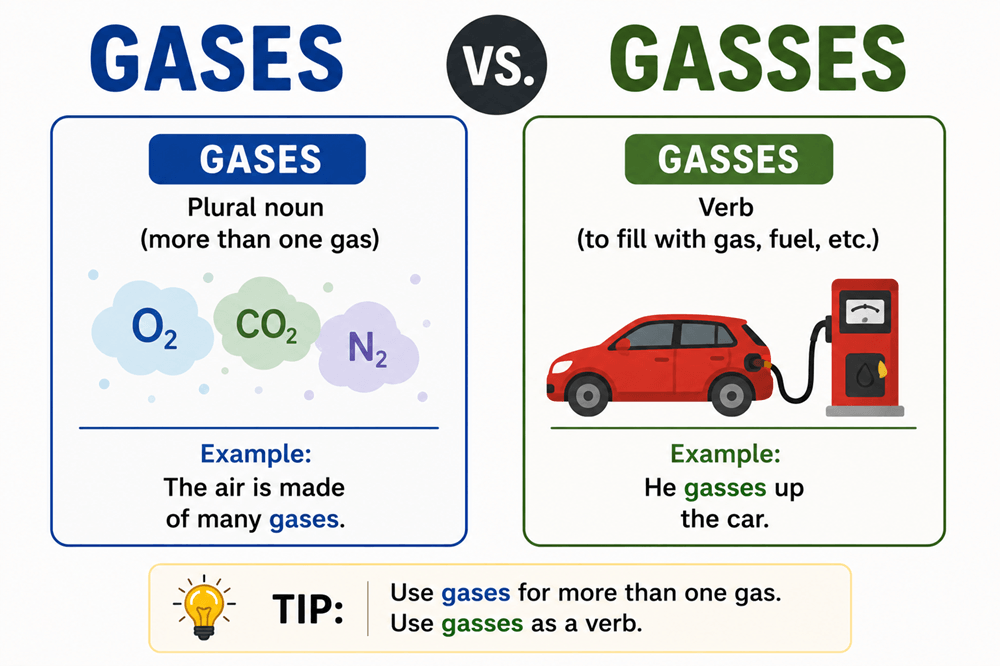
Gases is the standard plural of gas when you mean more than one type or amount of gas. Use gases in science, schoolwork, formal writing, and everyday writing about oxygen, carbon dioxide, natural gas, or other substances. Gasses is usually a verb form, as in he gasses up the car, though it can sometimes appear as a less common plural spelling.
Quick Answer
Use gases when you mean more than one gas.
- The atmosphere contains several gases.
- Oxygen and nitrogen are important gases.
- The lab tested the gases released by the reaction.
Use gasses mainly as a verb form of gas.
- He gasses up the truck every Friday.
- The machine gasses the chamber before the test.
The simple rule is: gases is the normal plural noun. Gasses is usually a verb.
Gases or Gasses: What Is the Difference?
The difference between gases and gasses depends on grammar and style. Both forms are connected to the word gas, but they are not used equally.
Gases is the standard plural noun. It means more than one gas, more than one type of gas, or several gaseous substances. This is the spelling you should use in most writing.
Gasses is most often a verb. It is the third-person singular form of gas, meaning to fill something with gas, supply something with gas, expose something to gas, or talk too much in informal speech. It can also appear as a less common plural of gas, but gases is usually cleaner and more widely preferred.
| Word | Main Use | Example |
|---|---|---|
| Gases | Standard plural noun | The experiment produced several gases. |
| Gasses | Verb form; less common plural variant | She gasses up the car before work. |
If your sentence is about substances, science, air, fuel, emissions, chemicals, or the atmosphere, gases is almost always the best choice.
What Does Gases Mean?
Gases is the plural form of gas. A gas is a substance that spreads to fill the space around it and does not have a fixed shape or fixed volume. Air is made of gases. Steam, oxygen, carbon dioxide, helium, and nitrogen are also gases.
Examples:
- The balloon was filled with different gases.
- Some gases are colorless and odorless.
- The factory monitors harmful gases.
- Greenhouse gases trap heat in the atmosphere.
- The scientist collected the gases in a sealed container.
In each sentence, gases refers to more than one gas or more than one kind of gas. This is the safest and most standard plural spelling.
What Does Gasses Mean?
Gasses is usually a verb form. It comes from the verb gas. As a verb, gas can mean to put gas into something, fuel something, expose something to gas, or affect something with gas.
Examples:
- He gasses up the car every Monday.
- The technician gasses the system before starting the process.
- The machine gasses the chamber with nitrogen.
- The driver gasses the engine before pulling away.
In casual speech, especially in some dialects, gasses can also mean talks a lot or chats at length.
- He gasses on about football every weekend.
This informal use is not the main meaning most writers need, but it is another reason gasses exists as a real word.
Is Gasses Ever Correct as a Plural?
Gasses can sometimes be found as a plural form of gas, but it is less common than gases. In polished writing, science writing, academic writing, and general articles, gases is the better choice.
Less common:
- The reaction released several gasses.
Preferred:
- The reaction released several gases.
If you want your writing to look standard and professional, use gases as the plural noun.
Why Gas Becomes Gases
The plural of gas is usually gases, not simply gass or gas’s. English often adds -es to nouns ending in certain sounds, including many words ending in s.
Examples:
- gas → gases
- bus → buses
- class → classes
- kiss → kisses
The spelling gases keeps the word clear and readable. It is also the spelling most readers expect in scientific and educational contexts.
Gases in Science Writing
In science writing, gases is the standard spelling. You will see it when discussing chemistry, physics, biology, climate, medicine, engineering, and environmental topics.
Examples:
- The three states of matter are solids, liquids, and gases.
- Plants exchange gases through tiny openings in their leaves.
- The atmosphere is a mixture of gases.
- Some industrial gases must be stored carefully.
- The reaction produced toxic gases.
In these contexts, gasses would look less standard and may distract readers. For school assignments, lab reports, science articles, and educational content, choose gases.
Gases in Everyday Writing
Gases is also the better plural in everyday writing. You do not need to be writing a science paper to use it.
Examples:
- The smell came from gases trapped in the pipe.
- The stove may release dangerous gases if it is not working properly.
- The company studies cleaner fuel gases.
- The container should not be used for unknown gases.
Whenever you mean more than one gas, gases is the spelling that will look right to most readers.
Gasses as a Verb
Use gasses when the subject is singular and the verb is gas.
Examples:
- She gasses up the car before long trips.
- The worker gasses the equipment as part of the process.
- The system gasses the chamber automatically.
- He gasses the engine too hard when starting.
In these examples, gasses describes an action. It does not mean multiple gases. This is the clearest reason to keep the two forms separate: gases is usually a noun, and gasses is usually a verb.
Gassed and Gassing
The verb gas also has other forms: gassed and gassing.
- gas = base form
- gasses = present tense with he, she, or it
- gassed = past tense
- gassing = present participle
Examples:
- He needs to gas up the truck.
- She gasses up the truck.
- They gassed up the truck yesterday.
- We are gassing up the truck now.
These verb forms are different from the plural noun gases.
Examples of Gases in Sentences
Here are natural examples of gases used correctly:
- The room contained several harmless gases.
- The study measured greenhouse gases.
- Some gases can be dangerous in closed spaces.
- The planets have atmospheres made of different gases.
- The students learned how gases expand when heated.
- Oxygen and helium are both gases.
- The device detects invisible gases.
- The chemical reaction released two gases.
In every sentence, gases means more than one gas or more than one type of gas.
Examples of Gasses in Sentences
Here are natural examples of gasses used correctly as a verb:
- He gasses up the car before every road trip.
- The technician gasses the tank during the setup.
- The machine gasses the chamber before sealing it.
- She gasses the engine when the light turns green.
- He gasses on about old movies whenever friends visit.
These examples use gasses as an action word. If you are not describing an action, check whether you need gases instead.
Common Mistakes to Avoid
The biggest mistake is using gasses when the sentence needs the standard plural noun gases.
Less standard:
- The atmosphere contains many gasses.
- The experiment produced two gasses.
- Greenhouse gasses affect the climate.
Better:
- The atmosphere contains many gases.
- The experiment produced two gases.
- Greenhouse gases affect the climate.
Another mistake is using gases as the verb form.
Incorrect:
- He gases up the car every week.
Better:
- He gasses up the car every week.
For most readers, gases looks like a noun, while gasses looks like a verb.
How to Remember Gases or Gasses
Here is an easy way to remember the difference:
Gases has one s in the middle and is the standard plural noun.
Gasses has double s and is usually the action form.
- Gases = more than one gas
- Gasses = fills with gas, fuels, or exposes to gas
You can also remember this sentence:
The lab studies gases, but the driver gasses up the car.
Final Answer
Gases is the standard plural of gas. Use it when talking about oxygen, nitrogen, carbon dioxide, greenhouse gases, fuel gases, or any other gaseous substances. Gasses is usually a verb form, as in he gasses up the car. Although gasses can sometimes appear as a plural variant, gases is the clearer and more standard choice for the plural noun.