Hoody or Hoodie: Correct Spelling, Meaning, and Easy Ways to Remember It
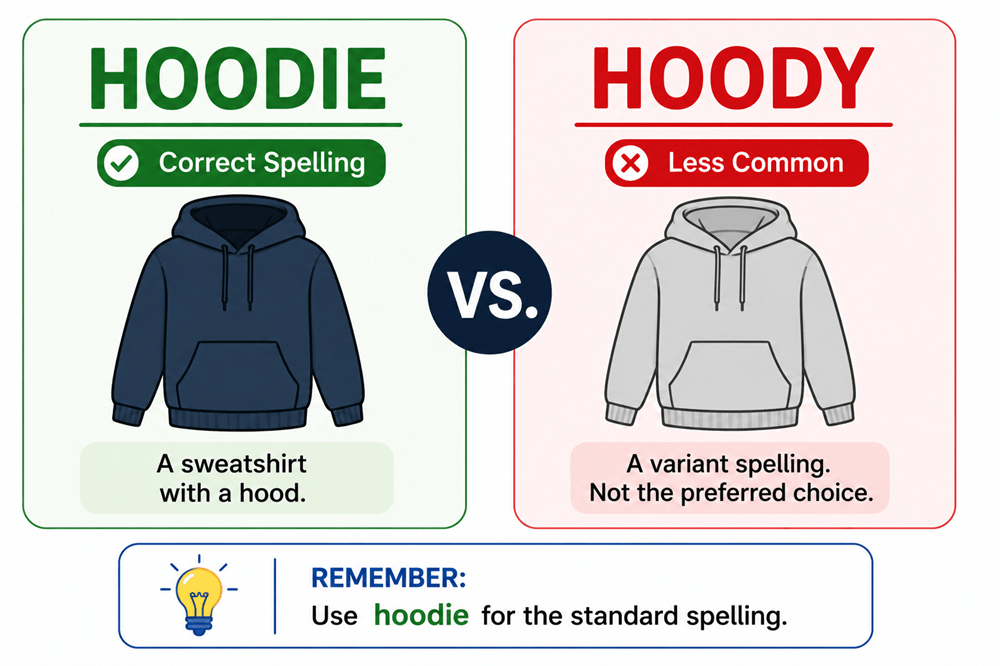
If you are choosing between hoody or hoodie, the more common and standard spelling is hoodie. It means a sweatshirt, jacket, or casual top with a hood. Hoody may appear sometimes as a variant, but hoodie is the spelling most readers, stores, brands, and style guides are likely to use.
Hoody or Hoodie: Which Spelling Is Correct?
The best spelling for modern everyday English is hoodie.
Hoody is sometimes used, but it is much less common. If you are writing a product description, blog post, school sentence, fashion article, caption, shopping list, or casual message, hoodie is usually the safer and more natural choice.
You should write:
Correct: You wore a warm hoodie to the game.
Less common: You wore a warm hoody to the game.
The meaning is usually understood either way, but hoodie looks more standard. It is the spelling most people expect when talking about a hooded sweatshirt.
What Does Hoodie Mean?
A hoodie is a casual piece of clothing with a hood attached. Most hoodies are soft, comfortable, and worn for warmth, lounging, exercise, school, travel, or everyday outfits.
A hoodie may be a pullover, meaning you pull it over your head. It may also have a zipper in the front. Some hoodies have a large front pocket, often called a kangaroo pocket. Others have drawstrings around the hood, ribbed cuffs, or a loose relaxed fit.
For example:
You grabbed your hoodie before leaving the house.
This means you took a hooded sweatshirt or casual hooded top with you.
You might also write:
The black hoodie matched your jeans and sneakers.
Here, hoodie refers to a specific clothing item.
Why Hoody Looks Like It Could Be Right
The spelling hoody looks logical because the word comes from hood. Since many English adjectives and casual nouns end in -y, your mind may expect:
hood + y = hoody
That spelling does make some sense visually. You can see the word hood inside it, and the ending -y often means “having” or “like.” For example, rainy means having rain, and windy means having wind. So hoody can look like it should mean “having a hood.”
But when English speakers commonly refer to the clothing item, the spelling hoodie became the more familiar form. The -ie ending gives the word a casual, noun-like feeling, similar to words like doggie, selfie, or freebie. It sounds friendly, informal, and familiar, which fits the everyday clothing item well.
Is Hoody Wrong?
Hoody is not always impossible, but it is not the preferred spelling for most modern writing. You may see it as an alternate spelling, a brand choice, a nickname, or a casual variant. Still, if you want the spelling that looks most natural to the widest audience, choose hoodie.
Think of hoody as a less common version. It may be understood, but it can look unfinished or unusual to some readers. In product listings and fashion writing, hoodie is especially more common.
For example, these phrases look more natural with hoodie:
zip-up hoodie
pullover hoodie
oversized hoodie
fleece hoodie
cropped hoodie
graphic hoodie
Using hoody in those phrases may still be understood, but it will not look as standard.
A Simple Way to Remember Hoodie
The easiest memory trick is:
A hoodie is a clothing item, and clothing words often look like names.
The -ie ending helps hoodie feel like the name of a thing, not just a description. You are not only saying the sweatshirt is hooded. You are naming the item itself.
You can also remember:
Hoodie has IE, like a cozy piece you wear.
This gives you a visual clue. The spelling hoodie has the extra ie at the end, and that is the spelling most people expect for the garment.
Another simple reminder is:
You wear a hoodie.
Both wear and hoodie are connected to clothing. If you are talking about the thing you put on, use hoodie.
Hoodie as a Clothing Word
Hoodie is useful because it names a very specific kind of casual clothing. A sweatshirt may or may not have a hood. A jacket may or may not be soft. A hoodie clearly tells the reader that the item has a hood and is usually casual.
For example:
You packed a sweatshirt.
This may mean a simple sweatshirt without a hood.
You packed a hoodie.
This clearly means the sweatshirt or top has a hood.
The word is especially common in casual fashion, sportswear, streetwear, school outfits, travel clothing, and comfortable everyday dressing. You can wear a hoodie at home, at the gym, on a walk, to class, on a flight, or under a coat in cold weather.
Common Phrases With Hoodie
Seeing hoodie in familiar phrases can help the spelling feel natural.
Zip-up hoodie means a hoodie with a zipper down the front.
You wore a zip-up hoodie over your T-shirt.
Pullover hoodie means a hoodie without a full front zipper.
The pullover hoodie felt warm and soft.
Oversized hoodie means a hoodie with a loose, roomy fit.
You bought an oversized hoodie for cold evenings.
Graphic hoodie means a hoodie with a printed design, logo, image, or phrase.
The graphic hoodie had a mountain design on the back.
Fleece hoodie means a hoodie made with soft, warm fleece fabric.
The fleece hoodie was perfect for the chilly morning.
In all these phrases, hoodie is the standard spelling.
Hoody vs Hoodie in Example Sentences
Side-by-side examples make the difference easier to see:
Correct: You left your hoodie in the car.
Less common: You left your hoody in the car.
Correct: She wore a gray hoodie with black leggings.
Less common: She wore a gray hoody with black leggings.
Correct: The store sells hoodies, T-shirts, and joggers.
Less common: The store sells hoodys, T-shirts, and joggers.
Correct: He pulled the hoodie over his head when it started raining.
Less common: He pulled the hoody over his head when it started raining.
Correct: You need a warmer hoodie for winter.
Less common: You need a warmer hoody for winter.
The meaning is clear in both forms, but hoodie is the spelling that looks more natural and polished.
What Is the Plural of Hoodie?
The plural of hoodie is hoodies.
Because hoodie ends in -ie, you remove nothing unusual. You simply change the ending to -ies in the plural:
hoodie → hoodies
For example:
You packed two hoodies for the weekend.
The brand released new hoodies in several colors.
All the hoodies were folded on the shelf.
Be careful not to write hoodys. Since the singular spelling is hoodie, the plural becomes hoodies.
Hoodie, Hooded Sweatshirt, or Hooded Jacket?
Hoodie is the casual everyday word. Hooded sweatshirt is more descriptive and slightly more formal. Hooded jacket may refer to a jacket with a hood, but it does not always mean a soft sweatshirt-style garment.
For example:
You wore a hoodie to stay comfortable.
This sounds casual and natural.
You wore a hooded sweatshirt to stay warm.
This sounds more specific and descriptive.
You wore a hooded jacket in the rain.
This may suggest something more weather-resistant than a hoodie.
If you are writing about casual clothing, hoodie is usually the simplest and clearest word.
How to Check Which Spelling You Need
Before choosing between hoody and hoodie, ask whether you are talking about a casual hooded sweatshirt or top. If yes, use hoodie.
You can use this quick check:
Is it clothing?
Does it have a hood?
Is it casual and sweatshirt-like?
If the answer is yes, write hoodie.
If you see hoody, understand that it may be a variant, but it is not the spelling most readers expect. For clean modern writing, hoodie is the better choice.
The Final Answer on Hoody or Hoodie
The standard and more common spelling is hoodie. It means a casual sweatshirt, jacket, or top with a hood. Hoody may appear as a variant, but it is less common and can look unusual in polished writing.
To remember the difference, think of hoodie as the name of the clothing item. The -ie ending is part of the spelling most people recognize. You wear a hoodie, and if you own more than one, you own hoodies.
So when you are writing about a cozy sweatshirt with a hood, choose hoodie. It is the clear, familiar, and reliable spelling for everyday English.