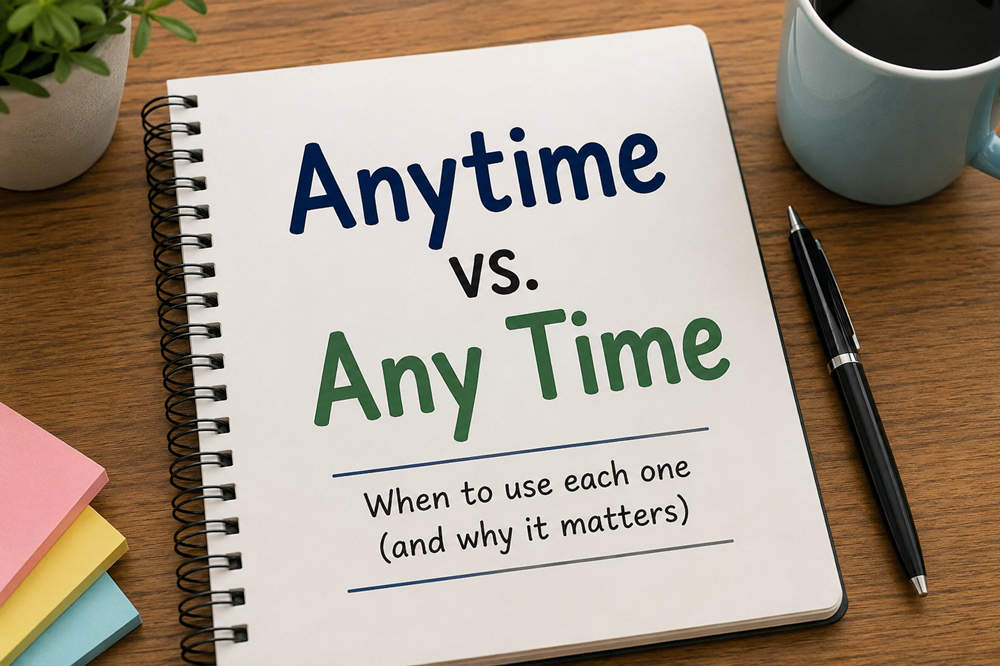
Is Anytime One Word? Anytime vs. Any Time Explained
Anytime is one word when it means “whenever” or “at any moment.” Use any time as two words when you are talking about an amount of time or when the phrase follows a preposition such as at.
For example, “Call me anytime” and “Do you have any time to talk?” are both correct. The first sentence means “Call me whenever you like,” while the second asks whether someone has time available.
Is Anytime One Word?
Yes, anytime is a correctly spelled word. It is an adverb that usually means “whenever,” “at any moment,” or “on any occasion.”
- You can call me anytime.
- Stop by anytime this afternoon.
- The delivery could arrive anytime now.
- You can begin anytime you’re ready.
In each example, the exact time is flexible or unknown. The word can often be replaced with whenever without changing the main meaning:
You can call me anytime.
You can call me whenever you like.
The difference between anytime and any time mainly depends on how the expression functions in the sentence.
When to Write Any Time as Two Words
Write any time as two words when time is a noun and any describes it. This form is common when discussing how much time is available, needed, or remaining.
- Do you have any time this morning?
- I don’t have any time to cook tonight.
- Is there any time left before the meeting?
- She hardly has any time for herself.
The expression should also remain two words when it follows a preposition such as at:
- You may leave at any time.
- The schedule could change at any time.
- We can meet at any time after lunch.
- Contact the office at any time during business hours.
In these sentences, any time is part of a longer prepositional phrase. Writing at anytime is incorrect.
Anytime vs. Any Time
| Form | When to Use It | Example |
|---|---|---|
| Anytime | When it means “whenever” or “at any moment” | Call me anytime. |
| Any time | When referring to an amount or period of time | Do you have any time today? |
| At any time | When the expression follows the preposition at | You may leave at any time. |
There is some flexibility when the expression is used adverbially. Both of these sentences are correct:
- You can visit anytime.
- You can visit any time.
The one-word form is often the simplest choice when the meaning is clearly “whenever,” but the two-word form is not automatically wrong.
A Simple Way to Choose the Correct Form
Try replacing the expression with whenever. If the sentence still sounds natural, anytime will usually work.
- Come over anytime.
- Come over whenever you like.
Use two words when the sentence refers to an amount of time:
- Do you have any time to help?
- I haven’t had any time to read the book.
You should also use two words whenever at appears directly before the expression:
- Correct: You can contact us at any time.
- Incorrect: You can contact us at anytime.
Is “At Anytime” Correct?
At anytime is not the standard spelling. The correct form is always at any time.
Because at is a preposition, it is followed by the noun phrase any time rather than the adverb anytime.
- Correct: The alarm may go off at any time.
- Incorrect: The alarm may go off at anytime.
You can often remove at and use the one-word form instead:
- The alarm may go off at any time.
- The alarm may go off anytime.
Both sentences are correct and have almost the same meaning.
Can Anytime Be a Reply to “Thank You”?
Anytime! can be used as an informal response to “Thank you.” It means that the speaker was happy to help and would willingly do so again.
“Thanks for helping me.”
“Anytime!”
This conversational use is normally written as one word.
Final Answer
Anytime is one word when it means “whenever” or “at any moment.” Use any time when referring to an amount of time or when the phrase follows a preposition.
- Call me anytime.
- Do you have any time today?
- You may leave at any time.
The easiest rule to remember is that at any time is always written as three separate words. Never write at anytime.