Is Cannot One Word? Cannot, Can Not, and Can’t Explained
Cannot is normally written as one word. It is the negative form of can and is used to express inability, impossibility, or lack of permission. Although can not is also possible, the one-word spelling is far more common. Can’t is the contracted form of cannot.
Is Cannot One Word or Two?
In most sentences, cannot should be written as one word.
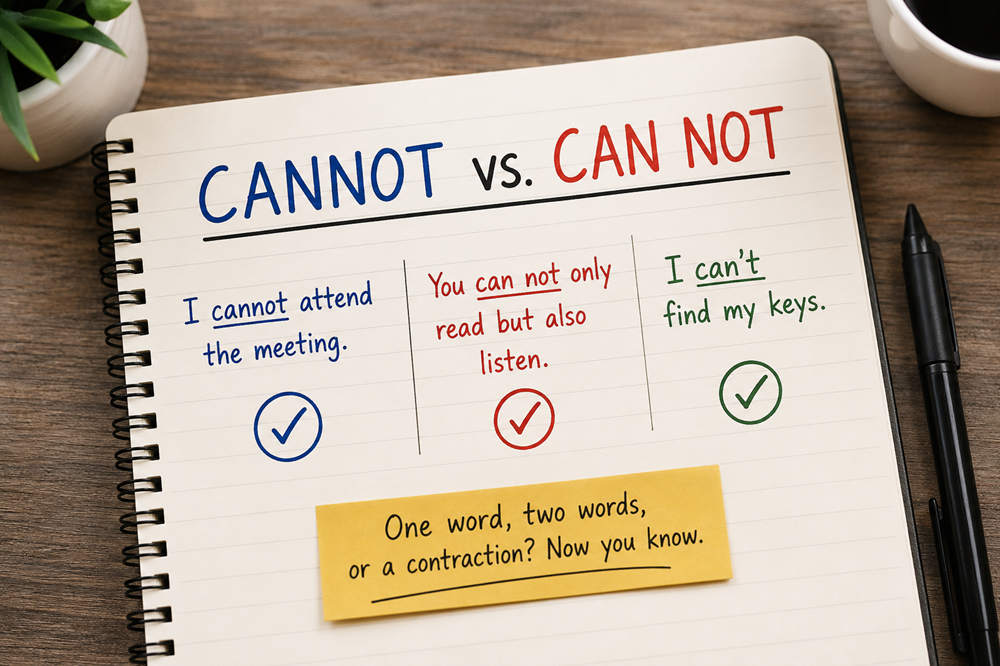
- I cannot attend the meeting tomorrow.
- She cannot find her phone.
- You cannot park here.
- This computer cannot open the file.
In these examples, cannot shows that someone is unable to do something, that something is impossible, or that an action is not permitted.
Both cannot and can not can be grammatically acceptable, but the one-word form is much more common. It is also the safest choice for formal and everyday writing.
When Is Can Not Written as Two Words?
Can not may be written as two words when not begins a separate phrase instead of simply making can negative.
The clearest example is the expression not only:
- You can not only read the book but also listen to it.
- The app can not only store photos but also edit them.
- She can not only sing but also play the piano.
In each sentence, not belongs with only. Joining the words as cannot only would change or confuse the intended meaning.
The separate form can also emphasize that someone has the option not to perform an action. However, sentences of this kind are usually clearer when rewritten with choose not to or decide not to.
- Less natural: You can not answer the question.
- Clearer: You can choose not to answer the question.
For an ordinary negative statement, use cannot:
- Standard: I cannot answer the question.
- Possible but less common: I can not answer the question.
Cannot vs. Can’t
Cannot and can’t have the same basic meaning. The main difference is tone.
Cannot is the full form. It is often used in formal writing, rules, instructions, and sentences that need emphasis.
- Employees cannot enter this area without permission.
- The company cannot guarantee delivery by Friday.
- I cannot accept those conditions.
Can’t is the contraction of cannot. It is common in speech, messages, dialogue, and writing with a conversational tone.
- I can’t find my keys.
- We can’t stay long.
- He can’t come to dinner tonight.
Use cannot when you want a more formal or emphatic tone. Use can’t when a natural, conversational style is appropriate.
Cannot, Can Not, Can’t, and Cant
| Form | How it is used | Example |
|---|---|---|
| cannot | The standard negative form of can | I cannot attend the event. |
| can not | A less common form, especially useful when not begins a separate phrase | You can not only watch but also participate. |
| can’t | The contraction of cannot | I can’t attend the event. |
| cant | A separate word with unrelated meanings | His speech was filled with political cant. |
When you mean the contraction of cannot, remember to include the apostrophe in can’t.
- Correct: I can’t hear you.
- Incorrect: I cant hear you.
Cant without an apostrophe is a different word. It can refer to insincere language, specialized jargon, or a sloping position.
How to Choose the Correct Form
A simple rule covers most situations:
- Use cannot for a normal negative statement.
- Use can’t when a contraction suits the tone.
- Use can not when not clearly belongs to a separate phrase, especially not only.
For example:
- I cannot drive. This means I am unable to drive.
- I can’t drive. This has the same meaning but sounds more conversational.
- I can not only drive but also repair cars. Here, not is part of not only.
Final Summary
Cannot is usually one word and is the standard choice for negative statements involving can. Can’t is its contraction, while can not is less common and is most useful when not begins a separate phrase such as not only. Cant without an apostrophe is an unrelated word.