Is Funnest a Word? Funnest vs. Most Fun Explained
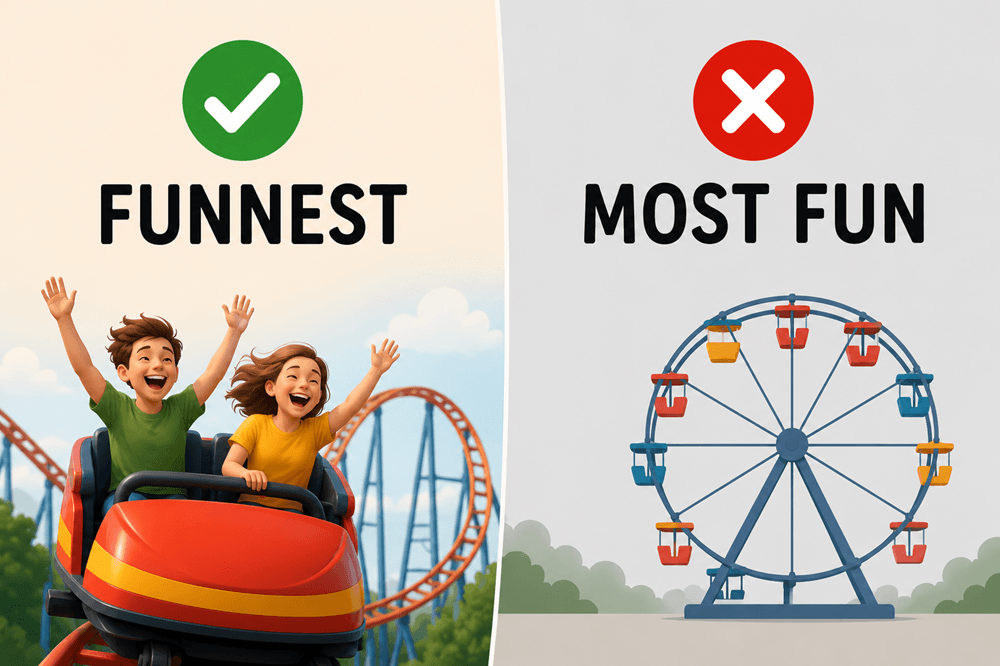
Yes, funnest is a word.
It is the superlative form of fun and means more enjoyable than all the other people, activities, places, or experiences being compared.
Examples:
- That was the funnest party of the year.
- This is the funnest game we have played.
- Summer camp was the funnest part of my vacation.
However, most fun is also correct and is often preferred in formal writing.
Quick Answer
Both forms can be used:
- funnest
- most fun
Examples:
- That was the funnest ride at the park.
- That ride was the most fun.
Funnest sounds casual and playful.
Most fun often sounds more natural in formal, professional, or carefully edited writing.
A simple rule is:
Funnest is acceptable in casual English, while most fun is the safer formal choice.
What Does Funnest Mean?
Funnest means the most enjoyable, entertaining, or amusing.
It compares one person, thing, activity, or experience with at least two others.
Examples:
- The water slide was the funnest attraction.
- Friday was the funnest day of the trip.
- She is the funnest teacher at the school.
- That was one of the funnest weekends I can remember.
In each sentence, one thing is described as providing more enjoyment than the others.
Is Funnest Proper English?
Yes. Funnest is widely used and accepted, especially in informal English.
Some people were taught that fun could only be a noun:
- We had fun.
- The trip was fun.
Under that older view, comparative forms such as funner and funnest were sometimes criticized.
However, fun is now commonly used as an adjective:
- a fun activity
- a fun evening
- a fun person
Once fun functions as an adjective, the comparative and superlative forms become natural:
- fun
- funner
- funnest
The forms may still sound informal to some readers, but they are not meaningless or accidental inventions.
Funnest vs. Most Fun
Both expressions communicate a superlative comparison.
| Form | Status | Typical Use |
|---|---|---|
| Funnest | Accepted but informal-sounding | Conversation and casual writing |
| Most fun | Standard and broadly accepted | Formal and informal writing |
Compare:
- It was the funnest activity at camp.
- It was the activity that was the most fun at camp.
The meanings are the same.
The first sounds more energetic and conversational. The second may sound more polished.
Which Form Is Better?
The best form depends on the sentence and tone.
Use funnest when the writing is:
- casual
- playful
- conversational
- aimed at children
- part of dialogue
- written for social media
Examples:
- This is going to be the funnest summer ever!
- That was the funnest birthday party.
- Which ride was the funnest?
Use most fun when the writing is:
- formal
- academic
- professional
- carefully edited
- intended for a broad audience
Examples:
- The group activity was the most fun.
- Participants said the final exercise was the most enjoyable.
- The museum visit was the part of the trip that was the most fun.
Funnest in a Sentence
Examples:
- The beach day was the funnest part of our vacation.
- This is the funnest class I have ever taken.
- The puppy is the funnest pet in the house.
- That was the funnest wedding I have attended.
- Which carnival game is the funnest?
- The final challenge was easily the funnest one.
- She planned the funnest activities for the children.
- Yesterday may have been the funnest day of the summer.
These sentences are natural in everyday speech and informal writing.
Most Fun in a Sentence
Examples:
- The final activity was the most fun.
- We had the most fun at the beach.
- Which part of the event was the most fun?
- The children said the treasure hunt was the most fun.
- Of all the classes, art was the most fun.
- That was the trip where we had the most fun.
Notice that most fun can appear in two different structures.
It may describe something:
- The treasure hunt was the most fun.
It may also describe the amount of enjoyment experienced:
- We had the most fun during the treasure hunt.
Is Funner a Word?
Yes. Funner is the comparative form of fun.
It means more enjoyable than something else.
Examples:
- This game is funner than the first one.
- The second party was funner.
- Playing outside is funner with friends.
However, more fun is often preferred:
- This game is more fun than the first one.
- The second party was more fun.
The full comparison can therefore be written in two ways:
- fun, funner, funnest
- fun, more fun, most fun
Why Do Some People Think Funnest Is Wrong?
The disagreement comes from the history of the word fun.
Traditionally, fun was treated mainly as a noun:
- We had fun.
- The activity provided fun.
Later, speakers increasingly used it as an adjective:
- a fun activity
- a fun teacher
- a fun trip
Some grammar teachers and editors resisted comparative forms because they considered the adjective use too informal.
Today, phrases such as a fun day are completely ordinary. As a result, funner and funnest have also become much more common.
The forms may still be avoided in formal style, but saying that funnest is not a word is too absolute.
Is Funnest Informal?
Yes. Funnest usually has an informal tone.
It fits naturally in sentences such as:
- That was the funnest sleepover ever.
- He is the funnest person to travel with.
- This has been the funnest week.
In a formal report, a different phrase may sound more appropriate:
Informal:
- The workshop was the funnest part of the conference.
Formal:
- The workshop was the most enjoyable part of the conference.
Other formal alternatives include:
- most entertaining
- most enjoyable
- most engaging
- most amusing
- most exciting
Is It “The Funnest” or Just “Funnest”?
Superlative adjectives usually appear with the.
Examples:
- the funnest game
- the funnest day
- the funnest person
Correct:
- That was the funnest ride.
The word the may be omitted in headlines, labels, or highly informal phrases:
- Funnest Activities for Kids
- Funnest Summer Ever
In complete ordinary sentences, the funnest is usually the natural structure.
Is It “One of the Funnest”?
Yes. The phrase one of the funnest is grammatically possible.
Examples:
- That was one of the funnest trips I have taken.
- She is one of the funnest people in the office.
- This is one of the funnest games for children.
Because the phrase begins with one of the, the noun that follows should normally be plural:
Correct:
- one of the funnest games
Incorrect:
- one of the funnest game
Is It “Most Funnest”?
No. Most funnest is incorrect because it uses two superlative markers.
The word funnest already contains the ending -est. Adding most repeats the comparison.
Incorrect:
- This is the most funnest activity.
Correct:
- This is the funnest activity.
- This is the most fun activity.
Use only one superlative form.
The same rule applies to:
- most happiest
- most fastest
- most easiest
Use:
- happiest
- fastest
- easiest
Is It “More Funnest”?
No. More funnest is also incorrect.
More creates a comparative, while funnest is already superlative.
Incorrect:
- This game is more funnest.
Correct:
- This game is more fun.
- This is the funnest game.
Choose the form that matches the comparison.
Funner, Funnest, and Funniest
Do not confuse funnest with funniest.
Funnest
Means most enjoyable.
- That was the funnest vacation.
Funniest
Means causing the most laughter.
- That was the funniest joke.
Something can be fun without being funny.
For example:
- Swimming is fun, but it is not necessarily funny.
- A comedy may be funny and fun.
Compare:
- The roller coaster was the funnest ride.
- The comedian told the funniest story.
Better Alternatives to Funnest
Depending on the context, you can use:
- most fun
- most enjoyable
- most entertaining
- most exciting
- most engaging
- most memorable
- most amusing
Examples:
- It was the most enjoyable part of the trip.
- The final game was the most entertaining.
- That was the most exciting ride.
- The discussion was the most engaging session.
These alternatives may sound more precise in formal writing.
Common Mistakes
Saying funnest is never a word
Too absolute:
- Funnest is always incorrect.
More accurate:
- Funnest is accepted but often informal.
Using most funnest
Incorrect:
- That was the most funnest game.
Correct:
- That was the funnest game.
- That game was the most fun.
Confusing funnest with funniest
- funnest = most enjoyable
- funniest = most humorous
Misspelling the word
Correct:
- funnest
Incorrect:
- funest
- funnestt
- funnist
The base word fun keeps both n letters when -est is added:
fun + n + est = funnest
How to Remember the Spelling
The word fun has a short vowel followed by one consonant.
When adding -est, double the final n:
- fun
- funner
- funnest
This follows a pattern similar to:
- big → bigger → biggest
- hot → hotter → hottest
- thin → thinner → thinnest
A simple memory sentence is:
The funnest things have double the fun—and double the n.
Final Answer
Yes, funnest is a word.
It is an accepted superlative form of fun and means the most enjoyable.
Examples:
- That was the funnest party of the year.
- This is the funnest game we have played.
Most fun is also correct and may be preferred in formal writing:
- That activity was the most fun.
Do not write most funnest, because that uses two superlative forms.
Remember:
Funnest is correct in casual English, while most fun is the safer formal choice.