Till or Til: Correct Spelling, Meaning, and Easy Ways to Remember Clearly
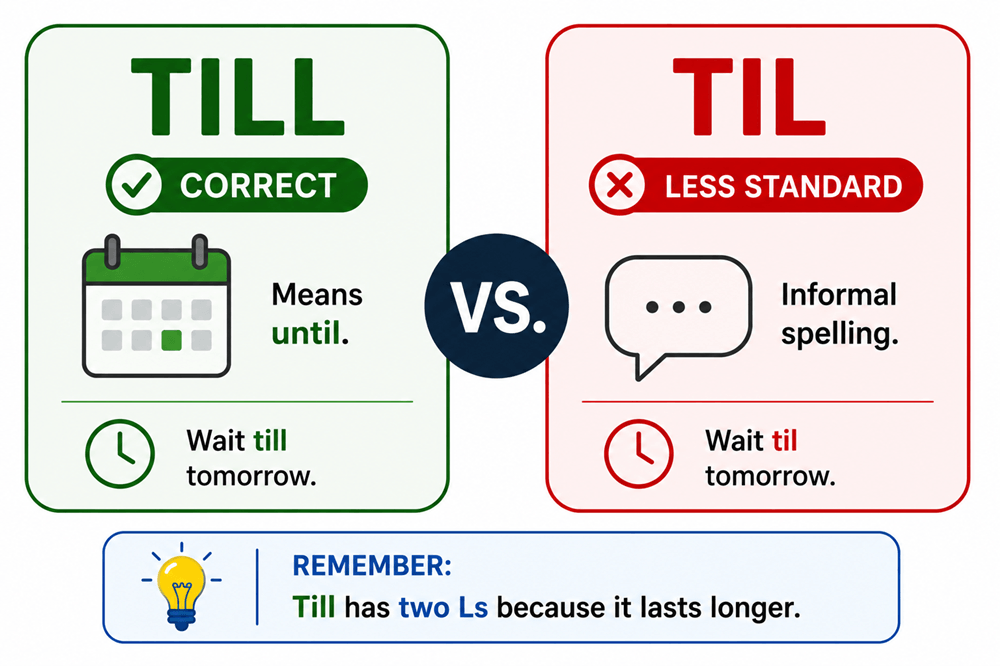
If you are choosing between till or til, the better standard spelling is till. You can use till to mean until, as in “wait till morning.” The spelling til is common in casual writing, but it is less standard. If you want the safest spelling for polished English, use till or use until.
Till or Til: Which Spelling Is Correct?
Till is the standard word. It means the same thing as until when used to talk about time.
Til is a shortened-looking form that many people use informally, but it is not the best choice in careful writing. If you are writing an article, essay, email, instruction, caption, or professional sentence, till usually looks cleaner and more correct.
You should write:
Correct: Wait till the soup cools before eating it.
Less standard: Wait til the soup cools before eating it.
You can also write:
Correct: Wait until the soup cools before eating it.
The most practical answer is simple: use till or until, but avoid til in polished writing.
What Does Till Mean?
Till can mean until. It is used when something continues up to a certain time or event.
For example:
You stayed awake till midnight.
This means you stayed awake until midnight.
You might also write:
The store is open till nine.
This means the store remains open until nine.
Till can also connect two parts of a sentence:
Do not leave till the rain stops.
Here, till means you should wait until the rain stops before leaving.
In this time-related meaning, till is not a mistake, and it is not just a lazy version of until. It is a real word with a long history in English. Many people mistakenly think till is a shortened form of until, but it stands as its own standard word.
What Does Til Mean?
Til is usually used as an informal spelling of till or a shortened form of until. You may see it in texts, social media posts, song titles, casual notes, and relaxed writing.
For example:
See you til tomorrow.
Most readers will understand this sentence. However, in standard writing, till or until is better:
See you till tomorrow.
Or:
See you until tomorrow.
The spelling til looks casual because it drops one l. It may feel quick and simple, but it can also look unfinished or informal. That is why it is not the safest choice when you want your writing to look polished.
What About ’Til With an Apostrophe?
You may also see ’til with an apostrophe. This form is meant to show that letters have been left out of until. It is common in informal writing, lyrics, dialogue, poetry, and casual titles.
For example:
Dance ’til morning.
Wait ’til you hear the news.
This spelling is more understandable than plain til because the apostrophe shows that the word is shortened. Still, for clean everyday writing, till or until is usually better.
Think of the choices this way:
Until is the clearest and most formal.
Till is standard and natural.
’Til is informal and expressive.
Til is casual and less standard.
Is Till Short for Until?
This is one of the biggest misunderstandings. Many people assume till is a shortened spelling of until. That seems logical because till is shorter. However, till is not simply a clipped version of until. It is a standard word in its own right.
That means you do not need an apostrophe before till. You should not write:
Incorrect: Wait ’till noon.
The apostrophe is unnecessary because till is already a complete word.
You should write:
Correct: Wait till noon.
Or:
Correct: Wait until noon.
If you want the shortened informal form of until, use ’til, not ’till. But again, for most standard writing, till is the simpler and better choice.
Why Til Looks Like It Could Be Right
The spelling til looks believable because English often shortens words in casual writing. You see shortened spellings in texts, signs, captions, and song lyrics. Since until can sound like til in speech, people often spell it the way it sounds.
Another reason til seems tempting is that it looks neat and minimal. If someone thinks till is only a shortened version of until, they may assume one l is enough.
But the standard word is till, with two ls. The double l is not extra. It belongs to the word.
So the spelling pattern is:
till = standard word
til = informal or less standard spelling
If your writing needs to look correct to the widest audience, choose till.
A Simple Way to Remember Till
The easiest memory trick is:
Till has two Ls because it lasts longer.
This works because till is about time continuing up to a point. The double l can remind you that something lasts until a certain moment.
You can also remember:
Till is full. Til is missing an L.
This is a practical visual clue. If you are tempted to write til, ask whether the word looks complete. In standard English, the complete form is till.
Another useful phrase is:
Use till until you choose until.
That little sentence reminds you that till and until are the two safest options.
Till vs Until
Till and until usually mean the same thing. The difference is tone.
Until often sounds a little more formal, careful, or complete.
Till often sounds more casual, natural, and conversational.
For example:
You can stay until the meeting ends.
This sounds slightly more formal.
You can stay till the meeting ends.
This sounds more relaxed but still correct.
Both sentences are acceptable. If you are writing a formal document, until may be the better choice. If you are writing naturally or conversationally, till works well.
Common Examples With Till
Here are common sentences where till is correct:
You waited till the bus arrived.
The children played outside till dinner.
Do not open the door till you hear the bell.
She worked till late in the evening.
The shop stays open till eight on Fridays.
You kept reading till the final page.
In each sentence, till means until. It shows that something continues up to a time, event, or condition.
Till vs Til in Example Sentences
Side-by-side examples make the difference easier to see:
Correct: Wait till tomorrow before making a decision.
Less standard: Wait til tomorrow before making a decision.
Correct: The office is closed till Monday.
Less standard: The office is closed til Monday.
Correct: You stayed there till the end of the show.
Less standard: You stayed there til the end of the show.
Correct: Keep stirring till the sauce thickens.
Less standard: Keep stirring til the sauce thickens.
Correct: She waited till everyone left.
Less standard: She waited til everyone left.
The meaning is usually clear either way, but till is the safer standard spelling.
Other Meanings of Till
Till can also mean something other than until. This is one reason it is useful to know the spelling clearly.
As a noun, a till can mean a cash drawer or money box in a store.
The cashier counted the money in the till.
As a verb, till can mean to prepare soil for planting.
The farmer tilled the field before spring planting.
These meanings are different from the time-related meaning, but the spelling is the same: till. The word til does not work for these standard meanings.
How to Check Which Word You Need
Before choosing between till and til, ask what kind of writing you are doing.
If you are writing something polished, choose till or until.
If you are writing something very casual, poetic, or song-like, ’til may fit.
If you are writing til without an apostrophe, pause and consider replacing it. In most cases, till will look better.
You can use this quick check:
Do you mean until?
Use till or until.
Do you want an informal contraction?
Use ’til.
Do you want standard spelling?
Avoid til.
The Final Answer on Till or Til
The standard spelling is till. Use it when you mean until, as in wait till morning, open till nine, or stay till the end. Till is a real word, not a mistaken shortening of until.
Til is common in casual writing, but it is less standard. If you want a shortened informal form of until, ’til is clearer because the apostrophe shows that letters are missing. For the safest choice, use till or until.
To remember the difference, use this simple clue: till has two Ls because it lasts longer. When something continues up to a certain time, choose till. If your writing is formal, choose until. Avoid plain til unless you are writing very casually.