Is Snuck a Word? Snuck vs. Sneaked Explained
Yes, snuck is a word.
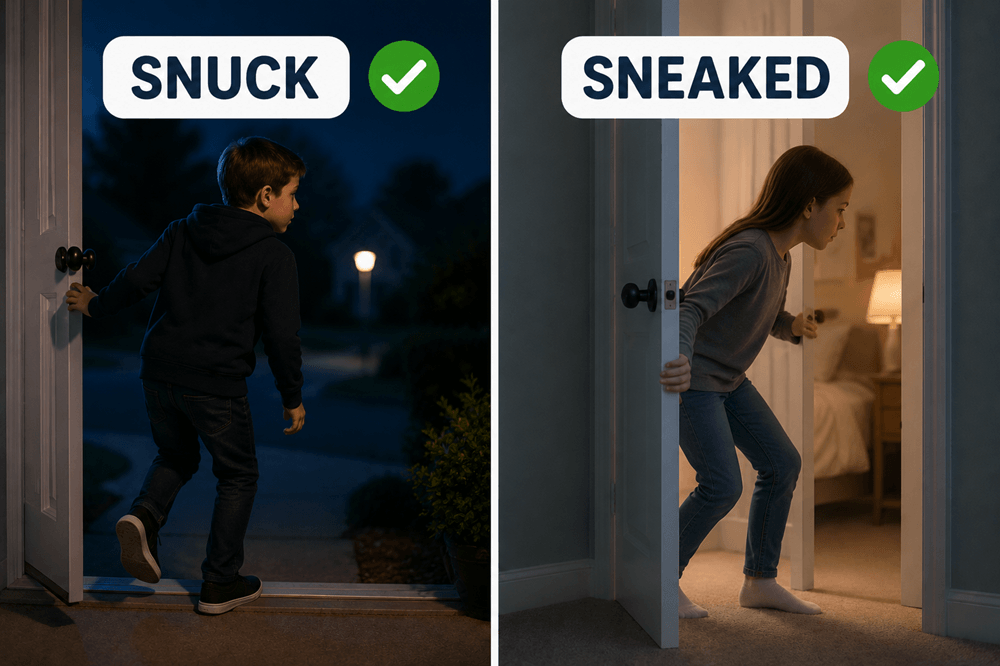
Snuck is a widely accepted past-tense and past-participle form of sneak, especially in American and Canadian English.
Examples:
- He snuck out of the house.
- She had snuck into the room quietly.
- The cat snuck under the table.
The form sneaked is also correct.
Examples:
- He sneaked out of the house.
- She had sneaked into the room quietly.
Both forms are standard, but their popularity can vary by region and writing style.
Quick Answer
Use either snuck or sneaked as the past tense of sneak.
- sneak → snuck
- sneak → sneaked
Snuck is more common in informal North American English.
Sneaked is the older and more traditional form and may be preferred in formal or British writing.
A simple rule is:
Snuck is correct, and sneaked is correct too.
What Does Snuck Mean?
Snuck means moved quietly, secretly, or without being noticed.
It is the past tense or past participle of sneak.
Examples:
- The child snuck downstairs after bedtime.
- Someone snuck into the building.
- She had snuck a snack before dinner.
- The dog snuck onto the couch.
The word often suggests that someone was trying not to be seen or heard.
Is Snuck Proper English?
Yes. Snuck is accepted in modern English.
It was once considered informal or nonstandard by some editors, but it has become firmly established, particularly in American English.
Today, you will commonly see snuck in:
- conversations
- novels
- news writing
- television dialogue
- informal emails
- everyday speech
It is not a misspelling.
Is Sneaked Also Correct?
Yes. Sneaked is also correct.
It follows the regular pattern for forming the past tense:
sneak + ed = sneaked
Examples:
- He sneaked past the guard.
- The children sneaked into the kitchen.
- She had sneaked away before anyone noticed.
Some writers prefer sneaked because it follows the normal spelling pattern of regular verbs.
Snuck vs. Sneaked
The difference is mainly one of usage and style.
| Form | Status | Common Use |
|---|---|---|
| Snuck | Correct | Common in North American English |
| Sneaked | Correct | Traditional and widely accepted |
| Snuck | More informal-sounding to some readers | Conversation and general writing |
| Sneaked | Sometimes preferred in formal writing | Edited or British English |
Neither form changes the meaning.
Compare:
- The boy snuck out through the window.
- The boy sneaked out through the window.
Both sentences are correct.
Is Snuck American English?
Snuck is especially common in American and Canadian English.
Many North American speakers naturally say:
- I snuck out.
- She snuck in.
- They had snuck away.
In British English, sneaked has traditionally been more common.
Examples:
- He sneaked out.
- She sneaked into the room.
However, snuck is also understood and increasingly used outside North America.
Is Snuck Formal or Informal?
Snuck is standard, but it may sound slightly more conversational than sneaked.
In informal writing, snuck is completely natural.
Example:
- I snuck downstairs for a snack.
In very formal writing, some editors may prefer sneaked.
Example:
- The intruder sneaked into the restricted area.
This is a style preference, not a strict grammar rule.
Snuck in a Sentence
Examples:
- The cat snuck through the open door.
- He snuck a look at the answer sheet.
- She snuck out before the meeting ended.
- We snuck into the theater after the movie started.
- The child had snuck a cookie from the kitchen.
- They snuck past the sleeping dog.
These sentences all describe quiet, secretive, or unnoticed movement.
Sneaked in a Sentence
Examples:
- The fox sneaked into the yard.
- She sneaked away from the crowd.
- He had sneaked into the office before sunrise.
- The students sneaked a glance at their phones.
- Someone sneaked behind the curtain.
- They sneaked past the guard.
The meaning is the same as with snuck.
Is It “Snuck In” or “Sneaked In”?
Both are correct.
Examples:
- He snuck in through the back door.
- He sneaked in through the back door.
Snuck in is more common in casual North American speech.
Sneaked in may sound more traditional or formal.
Is It “Snuck Out” or “Sneaked Out”?
Both are correct.
Examples:
- She snuck out after midnight.
- She sneaked out after midnight.
The phrase means that someone left quietly or secretly.
Is It “Had Snuck” or “Had Sneaked”?
Both forms can be used after had.
Correct:
- He had snuck away.
- He had sneaked away.
The word after had is the past participle.
Both snuck and sneaked can serve as past participles.
Is It “Have Snuck” or “Have Sneaked”?
Both are correct.
Examples:
- They have snuck into the building before.
- They have sneaked into the building before.
Again, snuck is more common in North American usage, while sneaked may sound more traditional.
Is Snuck an Irregular Verb?
Yes. Snuck is an irregular past-tense form because it does not use the regular -ed ending.
Compare:
- walk → walked
- jump → jumped
- sneak → snuck
By contrast, sneaked is the regular form.
This means sneak has both a regular and an irregular past-tense option.
Why Are Both Snuck and Sneaked Correct?
English sometimes keeps more than one past-tense form for the same verb.
Other examples include:
- dreamed and dreamt
- learned and learnt
- burned and burnt
- smelled and smelt
- spelled and spelt
In many cases, one form is more common in American English and another in British English.
Snuck and sneaked follow a similar pattern.
Common Phrases With Snuck
Snuck in
- He snuck in after everyone was asleep.
Snuck out
- She snuck out through the side door.
Snuck up
- The cat snuck up on the bird.
Snuck past
- They snuck past the security desk.
Snuck a look
- I snuck a look at the surprise gift.
Snuck into
- The dog snuck into the bedroom.
All of these are natural uses of snuck.
Is It “Snuck Up On” or “Sneaked Up On”?
Both are correct.
Examples:
- He snuck up on me.
- He sneaked up on me.
The phrase means approaching someone quietly without being noticed.
In casual conversation, snuck up on is extremely common.
Is Snuck Slang?
No. Snuck is not merely slang.
It may sound informal to some speakers, but it is recognized as a legitimate word.
Slang is usually limited to a particular group or casual setting. Snuck is much more widely accepted than that.
It appears in standard dictionaries and ordinary edited writing.
Is Snuck a Real Past Tense?
Yes. Snuck is a real past-tense form of sneak.
Present tense:
- I sneak out.
Past tense:
- I snuck out.
- I sneaked out.
Past participle:
- I have snuck out.
- I have sneaked out.
Both sets are grammatically correct.
Common Mistakes
Thinking snuck is not a word
Incorrect assumption:
- Snuck is always wrong.
Correct:
- Snuck is widely accepted.
Mixing present and past forms
Incorrect:
- Yesterday, he sneak out.
Correct:
- Yesterday, he snuck out.
- Yesterday, he sneaked out.
Using snuck after did
Incorrect:
- Did he snuck out?
Correct:
- Did he sneak out?
After did, use the base form sneak.
Using sneakeded
Incorrect:
- He sneakeded away.
Correct:
- He sneaked away.
How to Remember Snuck or Sneaked
Use this simple memory rule:
Sneaked follows the rule. Snuck breaks the rule—but both are correct.
- regular form: sneak → sneaked
- irregular form: sneak → snuck
You can also remember that snuck sounds similar to other irregular forms:
- stick → stuck
- strike → struck
- sneak → snuck
The pattern is not exact, but it can make the form easier to remember.
Which Form Should You Use?
Use snuck when:
- writing informally
- using American or Canadian English
- matching natural conversation
- writing dialogue
Use sneaked when:
- following a style guide that prefers it
- writing more formally
- using traditional British English
- wanting a regular past-tense form
The most important rule is consistency.
Do not switch unnecessarily between the two forms in the same passage.
Final Answer
Yes, snuck is a word.
It is a correct past-tense and past-participle form of sneak, especially in North American English.
Examples:
- He snuck out.
- She had snuck into the room.
Sneaked is also correct:
- He sneaked out.
- She had sneaked into the room.
Remember:
Snuck and sneaked are both correct. Snuck is more common in casual North American English, while sneaked is more traditional.