Travelling or Traveling: Correct Spelling, Meaning, American and British English Usage Explained
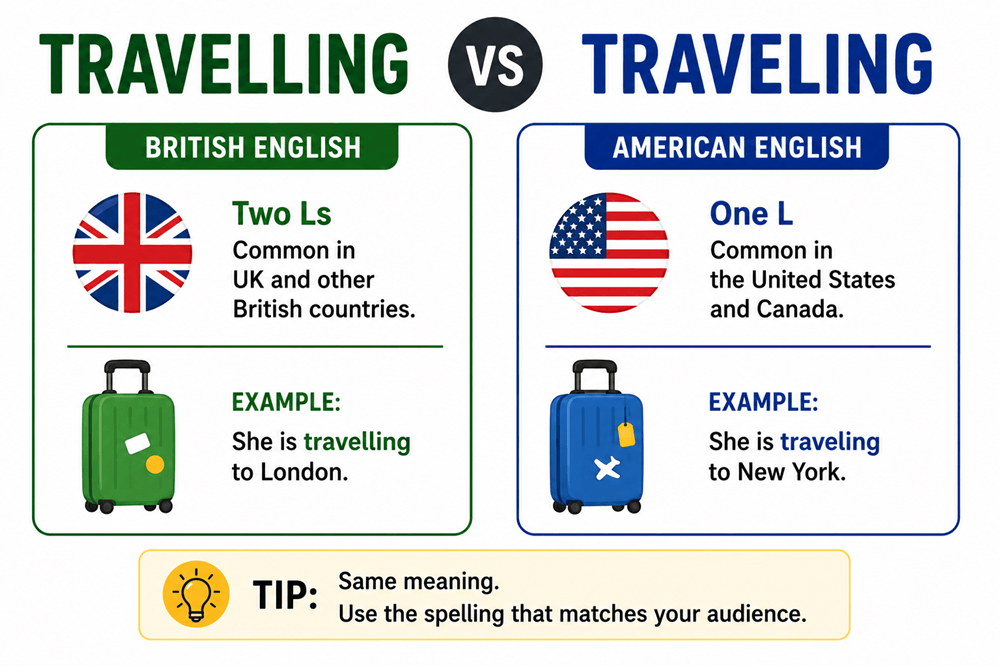
Travelling and traveling are both correct spellings. The difference is regional. Traveling with one l is the standard spelling in American English, while travelling with two ls is the standard spelling in British English. Both words mean going from one place to another, especially over some distance.
Quick Answer
Use traveling if you are writing in American English.
- She is traveling to New York next week.
- They spent the summer traveling across the country.
- Traveling alone can be exciting and challenging.
Use travelling if you are writing in British English.
- She is travelling to London next week.
- They spent the summer travelling across Europe.
- Travelling alone can be exciting and challenging.
The meaning is the same. The spelling depends on the English style you are using.
Travelling or Traveling: What Is the Difference?
The difference between travelling and traveling is spelling, not meaning. Both words come from the verb travel. When you add -ing, American English usually keeps one l, while British English usually doubles the l.
| Spelling | Where It Is Common | Example |
|---|---|---|
| Traveling | American English | We are traveling by train. |
| Travelling | British English | We are travelling by train. |
If your readers are mostly in the United States, traveling is usually the better choice. If your readers are in the United Kingdom, Australia, or another place that follows British spelling patterns, travelling will usually look more natural.
What Does Traveling Mean?
Traveling is the American English spelling. It means going from one place to another. It can refer to vacations, work trips, long journeys, daily movement, or the general experience of being away from home.
Examples:
- She enjoys traveling to new cities.
- He is traveling for work this month.
- The family is traveling by car.
- Traveling can teach you a lot about people.
- They are traveling through the mountains.
In American English, traveling is the normal form in school writing, business writing, travel blogs, emails, resumes, articles, and everyday communication.
What Does Travelling Mean?
Travelling is the British English spelling. It has the same meaning as traveling. It can describe the action of going somewhere, the habit of taking trips, or the experience of moving from place to place.
Examples:
- She enjoys travelling to new cities.
- He is travelling for work this month.
- The family is travelling by car.
- Travelling can teach you a lot about people.
- They are travelling through the countryside.
If your writing uses British spellings such as colour, favour, cancelled, and modelling, then travelling is the spelling that fits best.
Is Traveling Wrong?
No, traveling is not wrong. It is the standard American English spelling. American readers expect one l in this word.
Use traveling in American-style sentences like these:
- I will be traveling next weekend.
- She started a traveling photography project.
- The musician is traveling across the country.
- He gets nervous before traveling by plane.
These sentences are correct in American English. If you are writing for a U.S. audience, traveling is usually the safest spelling.
Is Travelling Wrong?
No, travelling is not wrong either. It is the standard British English spelling. British readers usually expect two ls in this word.
Use travelling in British-style sentences like these:
- I will be travelling next weekend.
- She started a travelling photography project.
- The musician is travelling across the country.
- He gets nervous before travelling by plane.
These sentences are correct in British English. If your article follows British spelling, travelling is the better choice.
Why Does British English Use Two Ls?
The spelling difference comes from a common pattern in American and British English. In many words ending in l, British English doubles the final l before adding endings like -ing or -ed. American English often keeps one l when the stress is not on the final syllable.
That is why you see pairs like these:
- American English: traveling / British English: travelling
- American English: traveled / British English: travelled
- American English: labeling / British English: labelling
- American English: canceling / British English: cancelling
- American English: modeling / British English: modelling
You do not need to memorize every word at once. For this topic, just remember that American English usually uses traveling, while British English usually uses travelling.
Traveling and Travelling as Verb Forms
Both spellings can be used as verb forms. They describe the action of someone going from one place to another.
American English:
- She is traveling to Chicago tomorrow.
- They are traveling with two suitcases.
- He was traveling when the storm started.
British English:
- She is travelling to Manchester tomorrow.
- They are travelling with two suitcases.
- He was travelling when the storm started.
The grammar is the same. The meaning is the same. Only the spelling changes.
Traveling and Travelling as Adjectives
Traveling and travelling can also describe a person, group, job, show, or activity that moves from place to place.
American English examples:
- She works as a traveling nurse.
- The city hosted a traveling art exhibit.
- A traveling salesperson visited the office.
British English examples:
- She works as a travelling nurse.
- The city hosted a travelling art exhibition.
- A travelling salesperson visited the office.
In this use, the word describes something that moves from one location to another. Again, choose the spelling that matches your English style.
Traveling or Travelling in Travel Writing
If you write travel articles, destination guides, hotel reviews, packing tips, or personal travel stories, consistency is important. Choose one spelling style and use it throughout the article.
American English style:
- Traveling light makes airport days easier.
- She learned a lot while traveling alone.
- The guide explains how to save money while traveling.
British English style:
- Travelling light makes airport days easier.
- She learnt a lot while travelling alone.
- The guide explains how to save money while travelling.
Neither version is more meaningful than the other. The best spelling depends on your audience.
Common Phrases With Traveling or Travelling
These common phrases can use either spelling, depending on your region.
| American English | British English |
|---|---|
| traveling abroad | travelling abroad |
| traveling alone | travelling alone |
| traveling by train | travelling by train |
| traveling for work | travelling for work |
| traveling light | travelling light |
| traveling expenses | travelling expenses |
If your article uses American spellings like color, center, and traveled, use traveling. If it uses British spellings like colour, centre, and travelled, use travelling.
Examples of Traveling in Sentences
Here are natural examples of traveling in American English:
- She loves traveling during the fall.
- He is traveling from Boston to Miami.
- Traveling with children requires extra planning.
- The band is traveling across the country.
- I get tired after traveling all day.
- The company pays for traveling expenses.
- She wrote a blog about traveling alone.
- They are traveling by bus instead of flying.
Examples of Travelling in Sentences
Here are natural examples of travelling in British English:
- She loves travelling during the autumn.
- He is travelling from London to Edinburgh.
- Travelling with children requires extra planning.
- The band is travelling across the country.
- I get tired after travelling all day.
- The company pays for travelling expenses.
- She wrote a blog about travelling alone.
- They are travelling by coach instead of flying.
These examples show that both spellings work in the same kinds of sentences. The regional spelling style is the only difference.
Common Mistakes to Avoid
The biggest mistake is mixing both spellings in the same article without a reason.
Inconsistent:
- She loves traveling, but travelling alone makes her nervous.
Better in American English:
- She loves traveling, but traveling alone makes her nervous.
Better in British English:
- She loves travelling, but travelling alone makes her nervous.
Another mistake is assuming one spelling is always wrong. That is not true. Traveling is correct in American English. Travelling is correct in British English. The right choice depends on your audience and spelling style.
How to Remember Traveling or Travelling
Here is an easy way to remember the difference:
Traveling has one l, which is standard in American English.
Travelling has two ls, which is standard in British English.
- Traveling = American English
- Travelling = British English
You can also remember that British English often doubles the final l in words like travelling, modelling, labelling, and cancelled.
Final Answer
Traveling and travelling are both correct. Use traveling in American English and travelling in British English. Both words mean going from one place to another, and both can be used as verb forms or adjectives. Choose the spelling that matches your audience, region, and overall spelling style.