Nosey or Nosy: Correct Spelling, Meaning, Usage, and Simple Examples for Writers
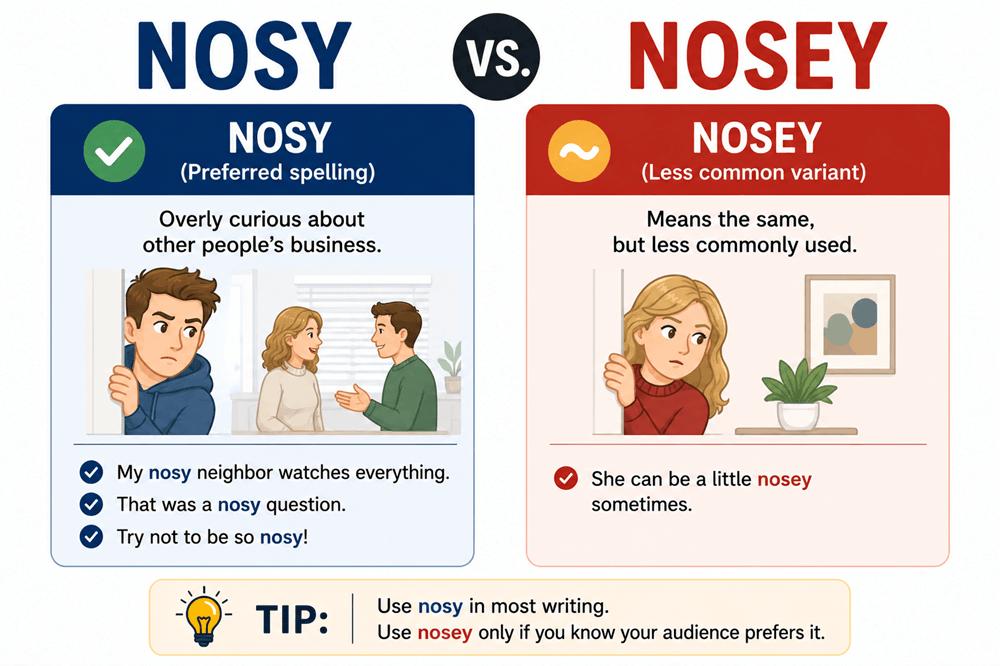
Nosy is the preferred spelling when you mean overly curious about other people’s private business. Nosey is a less common variant spelling with the same meaning, but many readers expect nosy. If you are writing for school, work, a website, or general readers, nosy is usually the safer and cleaner choice.
Quick Answer
Use nosy in most writing.
- My nosy neighbor watches everyone from her window.
- He asked a nosy question about my salary.
- Try not to be nosy.
Nosey is a variant spelling, but it is less common.
- She can be a little nosey sometimes.
The simple rule is: nosy is the preferred spelling. Nosey means the same thing but is less standard.
Nosey or Nosy: What Is the Difference?
The difference between nosey and nosy is spelling, not meaning. Both words describe someone who is too interested in other people’s personal matters, secrets, conversations, problems, or private choices.
Nosy is the more common spelling. It is short, direct, and widely used in modern English. If you want the spelling that looks most natural to most readers, choose nosy.
Nosey is a variant spelling. It may look logical because the word is connected to the idea of sticking your nose into someone else’s business. However, the shorter spelling nosy is generally preferred.
| Word | Use | Example |
|---|---|---|
| Nosy | Preferred spelling | That was a nosy question. |
| Nosey | Less common variant | That was a nosey question. |
If your sentence is about someone prying into private matters, nosy is usually the best spelling.
What Does Nosy Mean?
Nosy is an adjective. It describes someone who asks too many personal questions, watches too closely, listens to private conversations, or tries to learn things that are not their business.
Examples:
- The nosy neighbor wanted to know why the police were outside.
- She asked a nosy question about my relationship.
- He is not mean, just nosy.
- The children were nosy about the wrapped presents.
- I did not want to sound nosy, so I changed the subject.
Nosy is usually negative or mildly critical. It suggests that someone is crossing a social boundary. A curious person wants to learn. A nosy person wants to know things that may be private.
What Does Nosey Mean?
Nosey means the same thing as nosy. It describes someone who is overly curious or intrusive.
Examples:
- Her nosey aunt asked too many questions.
- He got annoyed with the nosey comments.
- The reporter seemed too nosey for a friendly interview.
This spelling is understandable because it visually contains the word nose. Still, for most modern writing, nosy is the spelling that looks cleaner and more standard.
Is Nosey Wrong?
Nosey is not always wrong, but it is less preferred. Some readers will accept it as a variant spelling, while others may think it looks informal, old-fashioned, or like a misspelling of nosy.
If you are writing casually, nosey may pass without much trouble. But if you are writing an article, school paper, business message, caption, story, or edited content, nosy is usually the better choice.
Less preferred:
- My nosey coworker read the note on my desk.
Preferred:
- My nosy coworker read the note on my desk.
The meaning is the same, but nosy will look more natural to many readers.
Nosy as an Adjective
Nosy most often appears before a noun or after a linking verb such as be, seem, look, or sound.
Before a noun:
- a nosy neighbor
- a nosy question
- a nosy coworker
- a nosy reporter
- a nosy child
After a linking verb:
- She is nosy.
- That sounds nosy.
- He seemed nosy during the conversation.
- I do not want to be nosy.
In all of these examples, nosy describes a person, question, attitude, or behavior that feels too curious or intrusive.
Nosy vs Curious
Nosy and curious are related, but they do not have the same tone.
Curious is often positive or neutral. It means someone wants to learn, understand, explore, or ask questions.
- The child was curious about how plants grow.
- She is curious about history.
Nosy is more negative. It means someone is too interested in private information.
- The child was nosy about the surprise party.
- She was nosy about her neighbor’s divorce.
A curious person asks because they want to understand. A nosy person asks because they want information that may not belong to them.
Nosy vs Noisy
Nosy is sometimes confused with noisy, but they mean completely different things.
Nosy means overly curious.
- My nosy neighbor asked where I was going.
Noisy means loud or full of noise.
- My noisy neighbor played music all night.
The words look similar, but the extra i in noisy changes the meaning. If the problem is sound, use noisy. If the problem is too many personal questions, use nosy.
Examples of Nosy in Sentences
Here are natural examples of nosy used correctly:
- I did not mean to be nosy.
- That is a nosy question.
- She has a nosy neighbor who watches everyone.
- He became nosy after hearing part of the conversation.
- The children were nosy about the birthday gifts.
- My coworker is friendly, but sometimes too nosy.
- The reporter’s nosy tone made the guest uncomfortable.
- Please stop being nosy and let them handle it privately.
These examples show how nosy is used for people, questions, behavior, and tone.
Examples of Nosey in Sentences
Here are examples of nosey used as a variant spelling:
- She has a nosey neighbor.
- He asked a nosey question.
- I did not want to seem nosey.
These sentences are understandable, but nosy is still the stronger spelling for most writing.
Preferred versions:
- She has a nosy neighbor.
- He asked a nosy question.
- I did not want to seem nosy.
Common Phrases With Nosy
Nosy appears in many everyday phrases. These are usually informal and conversational.
- nosy neighbor
- nosy question
- nosy coworker
- nosy reporter
- nosy relative
- stop being nosy
- not to be nosy
- too nosy
Examples:
- Not to be nosy, but are you moving?
- My nosy neighbor noticed the new car.
- That question feels too nosy.
These phrases are common in casual speech, personal writing, fiction, and everyday conversation.
Nosier and Nosiest
The comparative form of nosy is nosier. The superlative form is nosiest.
- nosy
- nosier
- nosiest
Examples:
- My little brother is nosier than he admits.
- She is the nosiest person in the office.
- The reporter became nosier as the interview continued.
Do not write nosyest. The y changes to i before -er and -est.
Nosiness
The noun form is nosiness. It means the quality or habit of being nosy.
Examples:
- Her nosiness made people uncomfortable.
- He apologized for his nosiness.
- The story turns ordinary curiosity into comic nosiness.
Nosiness is useful when you want to talk about the behavior itself rather than the person doing it.
Common Mistakes to Avoid
The biggest mistake is assuming nosey is the best spelling because it contains the word nose.
Less preferred:
- She is too nosey.
- That was a nosey question.
Preferred:
- She is too nosy.
- That was a nosy question.
Another mistake is confusing nosy with noisy.
Incorrect if you mean curious:
- My noisy aunt asked about my personal life.
Correct:
- My nosy aunt asked about my personal life.
Use noisy for sound. Use nosy for prying curiosity.
How to Remember Nosey or Nosy
Here is an easy way to remember the spelling:
Nosy is short, and it is the standard choice.
You can also remember:
- nosy = preferred spelling
- nosey = less common variant
- noisy = loud
A simple memory sentence is:
A nosy person sticks their nose into your business.
Even though the idea involves a nose, the preferred spelling is still nosy.
Final Answer
Nosy is the preferred spelling for someone who is overly curious about other people’s private matters. Nosey is a less common variant with the same meaning, but it may look less standard to many readers. Use nosy in most writing, especially in articles, schoolwork, business messages, and polished content. Remember: nosy means prying or too curious, while noisy means loud.