Is Conversate a Word? Conversate vs. Converse Explained
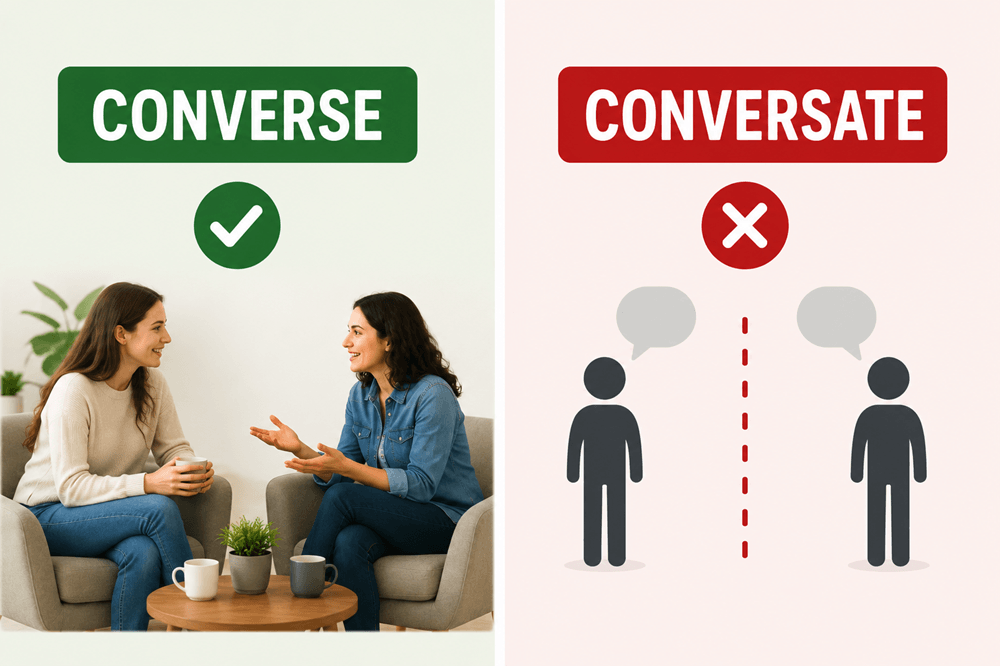
Yes, conversate is a word, but it is often considered informal or nonstandard.
It means to talk with someone or exchange ideas through conversation.
Examples:
- We sat outside and conversated for an hour.
- The host encouraged the guests to conversate.
- They were conversating about their plans.
However, converse is the more widely accepted and traditionally preferred verb.
Preferred in formal writing:
- We sat outside and conversed for an hour.
- The two managers conversed about the project.
Merriam-Webster recognizes conversate as a verb meaning to exchange thoughts and opinions in speech. Collins also records the word but labels it nonstandard.
Quick Answer
Both words refer to talking:
- conversate: established but informal or disputed
- converse: standard and preferred in careful writing
For school assignments, professional documents, reports, and formal communication, use converse.
A simple memory rule is:
You have a conversation, but you converse.
What Does Conversate Mean?
Conversate means to engage in conversation.
People use it when describing two or more people talking, sharing ideas, or discussing a subject.
Examples:
- The students were allowed to conversate before class.
- We conversated about music and travel.
- She enjoys conversating with new people.
- They conversated quietly during dinner.
The meaning is generally clear. The disagreement concerns the word’s style and acceptance, not what it communicates.
Is Conversate a Real Word?
Yes. Conversate is a real word because it has an established meaning and a documented history of use.
Merriam-Webster notes that the word has been used for more than 200 years, with written evidence dating to at least 1811. It was not invented recently by social media users, musicians, or television personalities.
However, describing a word as real does not mean that every teacher, editor, or style guide recommends it.
Words can be:
- standard
- informal
- regional
- dialectal
- nonstandard
- outdated
Conversate is recognized, but many readers still consider it less appropriate than converse.
Is Conversate Grammatically Correct?
Conversate functions grammatically as a verb.
Its forms include:
- conversate
- conversates
- conversated
- conversating
Examples:
- I conversate with my neighbors regularly.
- He conversates easily with strangers.
- We conversated after the meeting.
- They are conversating in the hallway.
These forms follow ordinary English verb patterns.
The main concern is usage rather than grammar. In formal standard English, many editors would replace conversate with converse, talk, or have a conversation.
Conversate vs. Converse
Conversate and converse usually have the same basic meaning, but they differ in style.
| Word | Meaning | Typical Use |
|---|---|---|
| Conversate | To engage in conversation | Informal or nonstandard speech |
| Converse | To exchange thoughts through speech | Standard formal and general English |
Compare:
- We conversated for several hours.
- We conversed for several hours.
Both sentences are understandable.
The second is more likely to be accepted in academic, professional, and carefully edited writing.
Is Converse a Word?
Yes. Converse is the traditional standard verb meaning to speak or exchange thoughts.
Examples:
- The two friends conversed over coffee.
- She enjoys conversing with people from different backgrounds.
- We conversed briefly after the presentation.
- They were too busy to converse.
Its main verb forms are:
- converse
- converses
- conversed
- conversing
Notice that the stress and pronunciation may differ from the adjective converse, meaning opposite or reversed.
As a verb, converse is generally pronounced:
kun-VURS
Why Is Conversate Controversial?
Many people object to conversate because they believe it was unnecessarily created from conversation when the shorter verb converse already existed.
The word is a back-formation.
A back-formation develops when speakers remove what appears to be an ending from an existing word to create a new one.
In this case:
- conversation
- conversate
Merriam-Webster identifies conversate as a back-formation and explains that this method of creating words is normal in English. Other established back-formations include verbs formed from longer nouns.
The fact that a word was created through back-formation does not automatically make it incorrect.
Is Conversate Slang?
Conversate is not merely slang, although it is often informal.
Slang is usually strongly associated with a particular group, period, or social setting. Conversate has a much longer documented history and appears across different contexts.
Still, it may sound:
- casual
- conversational
- regional
- unconventional
- nonstandard
Some speakers use it naturally, while others strongly dislike it.
Because reactions vary, converse is the safer choice when your audience’s expectations are unknown.
Is Conversate American English?
The word is especially associated with American English, including several regional and cultural varieties.
However, it should not be treated as a new mistake or as a word used by only one particular community. Its written history extends back more than two centuries.
In international or formal English, converse is more broadly accepted.
Conversate in a Sentence
Examples of how the word is used include:
- We conversated while waiting for the train.
- The event gave employees time to conversate.
- They were conversating about the election.
- He prefers to conversate face-to-face.
- The guests ate, laughed, and conversated.
- She can conversate comfortably with almost anyone.
These sentences are understandable, but some editors would revise them.
More standard versions:
- We conversed while waiting for the train.
- The event gave employees time to talk.
- They were discussing the election.
- He prefers to have conversations face-to-face.
Is Conversated a Word?
Conversated is the regular past-tense form of conversate.
Example:
- We conversated for an hour.
Because conversate is controversial, conversated may attract even more attention.
In careful writing, use:
- conversed
- talked
- discussed
- had a conversation
Preferred:
- We conversed for an hour.
- We talked for an hour.
Is Conversating a Word?
Conversating is the present-participle form of conversate.
Example:
- They are conversating outside.
The sentence is understandable, but many readers prefer:
- They are conversing outside.
- They are talking outside.
- They are having a conversation outside.
Conversing is shorter and more widely accepted.
Conversate or Converse in Formal Writing?
Use converse in formal writing.
Recommended:
- The participants conversed after the presentation.
- Students were encouraged to converse in small groups.
- The two leaders conversed privately.
Avoid when a formal tone is required:
- The participants conversated after the presentation.
This recommendation applies to:
- essays
- research papers
- business reports
- professional emails
- résumés
- news articles
- formal presentations
Using converse prevents the wording from distracting readers who consider conversate nonstandard.
Better Alternatives to Conversate
Depending on the sentence, you can use:
- converse
- talk
- speak
- communicate
- chat
- discuss
- exchange ideas
- have a conversation
Examples:
- We talked after dinner.
- They conversed about literature.
- The group discussed the proposal.
- She chatted with her coworkers.
- The participants exchanged ideas.
Choose the word that best describes the type of communication.
Converse vs. Discuss
Converse means to talk or exchange thoughts.
Discuss usually means to talk about a particular subject.
Compare:
- We conversed for an hour.
The topics may have varied. - We discussed the budget for an hour.
The conversation focused on the budget.
Do not normally add about after discuss.
Less concise:
- We discussed about the budget.
Correct:
- We discussed the budget.
- We conversed about the budget.
Converse vs. Conversation
Converse is a verb.
- We converse regularly.
Conversation is a noun.
- We had a long conversation.
Do not use conversation as the verb:
Incorrect:
- We conversation every week.
Correct:
- We converse every week.
- We have a conversation every week.
The relationship between these words helps explain why some speakers created conversate, but the traditional verb remains converse.
Common Mistakes
Saying conversate is not a word
Too absolute:
- Conversate is not a word.
More accurate:
- Conversate is an established word, but it is often considered informal or nonstandard.
Using conversate in formal writing
Less suitable:
- The executives conversated about the proposal.
Better:
- The executives conversed about the proposal.
- The executives discussed the proposal.
Confusing converse with conversation
Incorrect:
- We had a converse.
Correct:
- We had a conversation.
- We conversed.
Writing conversate with an extra “s”
Incorrect:
- converssate
Correct:
- conversate
How to Remember the Preferred Word
Start with the noun:
conversation
Then remember that the traditional verb is shorter:
converse
Use this memory sentence:
You have a conversation when you converse.
Another useful pattern is:
- conversation: noun
- conversational: adjective
- converse: verb
Although conversate exists, you usually do not need it because converse already performs the same job.
Final Answer
Yes, conversate is a word.
It means to engage in conversation and has been documented in English for more than 200 years. Merriam-Webster recognizes it, while Collins labels it nonstandard.
However, converse is the more widely accepted and preferred word.
Informal:
- We conversated after dinner.
Standard:
- We conversed after dinner.
- We talked after dinner.
Remember:
Conversate exists, but converse is the safer choice in formal writing.