Gasses or Gases: Correct Plural Spelling, Meaning, Usage, and Examples Explained
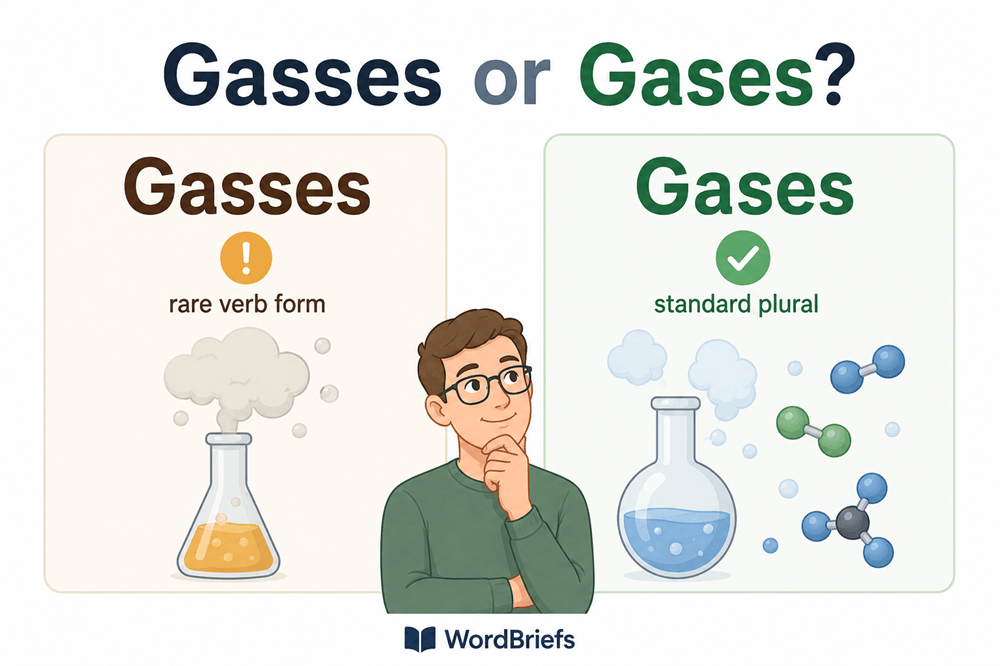
Gases is the standard plural form of gas. Use gases when you are talking about more than one type or amount of gas, such as oxygen, nitrogen, carbon dioxide, or natural gas. Gasses is sometimes seen, but it is much less common and is usually considered nonstandard as a plural noun. The easiest rule is this: one gas, many gases.
Quick Answer
Use gases as the normal plural of gas.
- Correct: The atmosphere contains many gases.
- Correct: Oxygen and nitrogen are gases.
- Correct: The scientist measured the gases released during the reaction.
Gasses is not the usual plural spelling in modern standard English.
- Less standard: The atmosphere contains many gasses.
- Preferred: The atmosphere contains many gases.
The simple rule is this: if you mean more than one gas, write gases.
Gasses or Gases: What Is the Difference?
The difference between gasses and gases is mostly spelling and standard usage. Gases is the accepted plural noun used in science, school writing, professional writing, environmental writing, medical writing, and everyday English. Gasses may appear as a variant, but it is much less common and can look like a mistake to many readers.
A gas is a substance that spreads to fill the space available to it. Air is made of gases. Steam is water in gas form. Carbon dioxide, oxygen, helium, hydrogen, and methane are all gases.
| Word | Main Use | Example |
|---|---|---|
| Gas | Singular noun | The gas filled the container. |
| Gases | Standard plural noun | The gases filled the container. |
| Gasses | Rare or less standard plural; sometimes a verb form | The machine gasses the chamber. |
If you are writing a normal sentence about more than one gas, gases is the safe and correct choice.
What Does Gas Mean?
Gas is a noun that can refer to a state of matter, a substance used as fuel, or a vapor-like form of something. In science, gas is one of the basic states of matter, along with solid, liquid, and plasma. A gas does not keep a fixed shape or fixed volume. Instead, it spreads out to fill its container.
Examples:
- Oxygen is a gas that people need to breathe.
- The balloon was filled with helium gas.
- Natural gas is used for heating and cooking.
- The gas expanded when the temperature rose.
In everyday English, gas can also refer to gasoline, especially in American English.
- The car needs gas.
- She stopped at the gas station.
- Gas prices rose again this week.
When gas means gasoline, it is often used as a mass noun. That means it usually does not need a plural form. You would normally say “more gas,” not “more gases,” when talking about fuel for a car.
What Does Gases Mean?
Gases means more than one gas. It is the standard plural form of the noun gas. You use it when discussing different gases, multiple gas substances, or several gas emissions.
Examples:
- The air is made up of several gases.
- Some gases are invisible and odorless.
- The factory releases gases into the air.
- Greenhouse gases trap heat in the atmosphere.
In each sentence, gases refers to more than one gas or more than one kind of gas. This spelling is clear, standard, and widely expected.
Gases is especially common in scientific and environmental contexts.
- noble gases
- greenhouse gases
- toxic gases
- industrial gases
- compressed gases
- exhaust gases
These phrases are almost always spelled with gases, not gasses.
Is Gasses Wrong?
Gasses is not always impossible, but it is not the standard plural spelling most readers expect. In ordinary writing, gases is much better. If you write gasses as the plural of gas, many readers may think it is a spelling mistake.
Compare these examples:
- Less standard: The lab tested several gasses.
- Preferred: The lab tested several gases.
- Less standard: The planet’s atmosphere contains different gasses.
- Preferred: The planet’s atmosphere contains different gases.
In polished writing, scientific writing, school assignments, articles, and professional documents, use gases. It is the form that looks correct and natural.
When Can Gasses Be Correct?
Gasses can appear as a verb form. The verb gas means to expose someone or something to gas, to fill something with gas, or, in some contexts, to poison or attack with gas. In that verb sense, gasses may be used as a third-person singular form.
Examples:
- The machine gasses the chamber before the test begins.
- The technician gasses the sample in a controlled environment.
- The process gasses the material before sealing it.
These sentences are not using gasses as a plural noun. They are using it as a verb. The subject is doing an action.
However, this use is much rarer than the noun gases. Most people asking about gasses or gases want the plural noun, and for that purpose, gases is the right spelling.
Why Is the Plural Gases?
Gases is spelled with one s before -es because gas forms its standard plural by adding -es. The result is gases, not gass plus es.
Many short nouns ending in s, x, z, ch, or sh add -es in the plural because the extra syllable makes the word easier to pronounce.
- bus → buses
- box → boxes
- church → churches
- wish → wishes
- gas → gases
The word gas follows this pattern, but it does not double the final s in the standard plural. That is why gases is the spelling you should use.
Greenhouse Gasses or Greenhouse Gases?
The correct phrase is greenhouse gases.
Correct:
- Carbon dioxide and methane are greenhouse gases.
- Greenhouse gases trap heat in the atmosphere.
- The report measured greenhouse gases from transportation.
Less standard:
- Carbon dioxide and methane are greenhouse gasses.
- Greenhouse gasses trap heat in the atmosphere.
Because greenhouse gases is a scientific and environmental term, the standard spelling is especially important. Use gases.
Toxic Gasses or Toxic Gases?
The correct phrase is toxic gases.
Correct:
- The fire released toxic gases.
- Workers wore masks to avoid breathing toxic gases.
- The detector warned them about dangerous gases.
Less standard:
- The fire released toxic gasses.
- Workers wore masks to avoid breathing toxic gasses.
If you are writing about safety, chemistry, health, or the environment, gases is the clearer and more professional spelling.
Noble Gasses or Noble Gases?
The correct phrase is noble gases.
Correct:
- Helium, neon, argon, krypton, xenon, and radon are noble gases.
- Noble gases are known for being very stable.
- The periodic table includes a group called the noble gases.
Less standard:
- Helium, neon, argon, krypton, xenon, and radon are noble gasses.
In chemistry, the standard spelling is noble gases. This is the form students, teachers, scientists, and readers expect.
Gas’s, Gases, or Gases’?
Gas’s, gases, and gases’ are different forms.
| Form | Meaning | Example |
|---|---|---|
| Gas | One gas or fuel generally | The gas is odorless. |
| Gas’s | Something belonging to one gas | The gas’s pressure increased. |
| Gases | More than one gas | The gases expanded. |
| Gases’ | Something belonging to multiple gases | The gases’ properties were compared. |
Use gases without an apostrophe when you simply mean more than one gas.
- Correct: The gases were tested.
- Incorrect: The gas’s were tested.
Apostrophes show possession. They do not make normal plurals.
Common Mistakes With Gasses and Gases
The most common mistake is writing gasses when the sentence needs the plural noun gases.
Less standard:
- The atmosphere contains many gasses.
- The reaction produced several gasses.
- The factory released harmful gasses.
- The students studied noble gasses.
Preferred:
- The atmosphere contains many gases.
- The reaction produced several gases.
- The factory released harmful gases.
- The students studied noble gases.
Another mistake is using gases when you mean gasoline in everyday American English. If you are talking about fuel for a car, you normally use gas as an uncountable noun.
Awkward:
- I need to buy gases for the car.
Natural:
- I need to buy gas for the car.
Use gases for substances in gas form. Use gas for gasoline in ordinary conversation.
Examples of Gases in Sentences
Here are examples of gases used correctly:
- The scientist collected gases from the reaction.
- Some gases are lighter than air.
- The atmosphere contains several important gases.
- Greenhouse gases affect the planet’s temperature.
- The tank stores compressed gases safely.
- Exhaust gases can harm air quality.
- The students learned how gases expand when heated.
- Different gases behave differently under pressure.
In each sentence, gases means more than one gas or more than one kind of gas.
Examples of Gasses in Sentences
Here are examples of gasses used as a verb form:
- The machine gasses the chamber before the experiment.
- The technician gasses the container during preparation.
- The system gasses the sample under controlled pressure.
These examples are much less common than sentences with gases. They are also technical. In everyday writing, you are far more likely to need gases as the plural noun.
How to Remember Gasses or Gases
A simple way to remember the correct plural is this:
- Gas = one
- Gases = more than one
You can also remember this sentence:
Many gases have one s before -es.
That reminder helps you avoid adding an extra s. The plural is not gasses; it is gases.
If you are writing about science, air, pollution, chemistry, fuel emissions, or the atmosphere, choose gases. If you are using the word as a rare verb meaning “exposes to gas,” gasses may appear, but most writers will not need it often.
Final Answer
Gases is the standard plural form of gas. Use it when talking about more than one gas or multiple types of gas, such as oxygen, nitrogen, methane, carbon dioxide, greenhouse gases, toxic gases, or noble gases. Gasses is much less common as a plural and may look incorrect in standard writing.
The easiest rule is simple: one gas, many gases. In almost every ordinary sentence where you mean the plural noun, choose gases.