Lier or Liar: Correct Spelling, Meaning, Difference, and Examples for Clear Writing
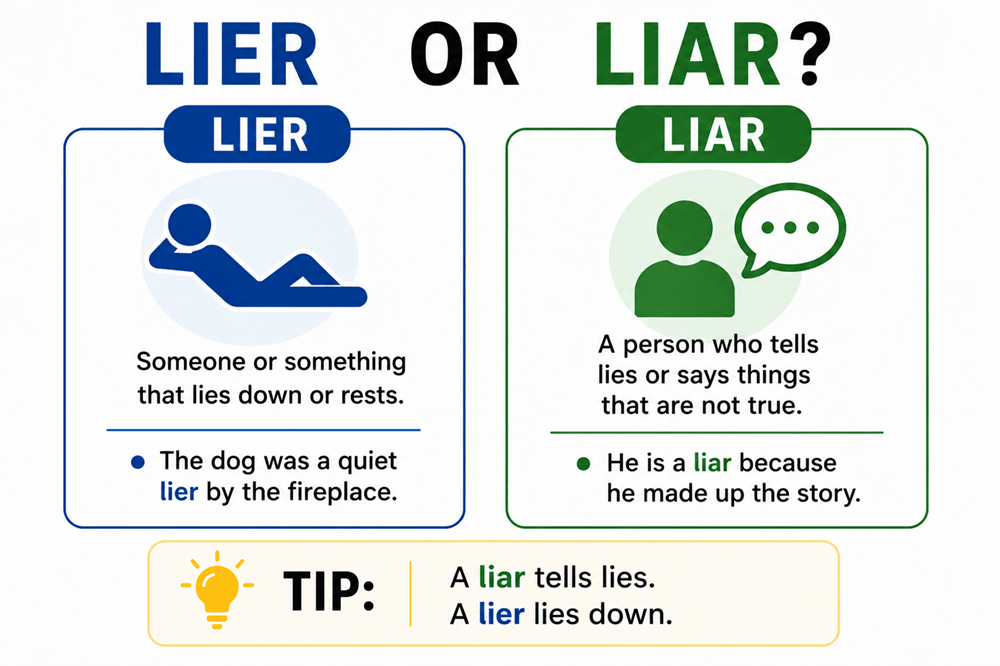
Liar and lier look similar, but they do not mean the same thing. Use liar when you mean a person who tells lies or says things that are not true. Lier is rare and usually means someone or something that lies down or rests in a position. In almost every everyday sentence, the word you want is liar.
Quick Answer
Use liar when you mean someone who lies by saying something false.
- Correct: He is a liar because he made up the story.
- Correct: Do not call someone a liar without proof.
- Correct: The witness was exposed as a liar.
Lier is a rare word. It can refer to a person or thing that lies down, rests, or is positioned somewhere, but it is not the normal word for someone who tells lies.
- Rare: The dog was a quiet lier by the fireplace.
- Common: The dog was lying quietly by the fireplace.
The simple rule is this: liar tells lies. Lier lies down.
Lier or Liar: What Is the Difference?
The difference between lier and liar comes from two different meanings of the word lie. English has more than one verb spelled lie, and that is why this pair can be confusing.
One meaning of lie is to say something false. A person who does that is a liar.
- She lied about where she was.
- She is a liar.
Another meaning of lie is to recline, rest, or be in a flat position. A person or thing that lies in that sense could technically be called a lier, but this word is very uncommon in modern everyday writing.
- The cat lies on the sofa.
- The cat is lying on the sofa.
Most readers expect liar when the sentence is about dishonesty. If you write lier when you mean someone who tells lies, it will usually look like a spelling mistake.
| Word | Meaning | Example |
|---|---|---|
| Liar | A person who tells lies | The liar admitted the truth later. |
| Lier | A person or thing that lies down or rests | The lier remained still on the ground. |
If the sentence is about false words, deception, dishonesty, or not telling the truth, use liar.
What Does Liar Mean?
Liar means a person who tells lies. A lie is a false statement, especially one told on purpose. A liar may hide the truth, invent a story, deny something that happened, or say something they know is not true.
Examples:
- The liar changed his story three times.
- She felt hurt when he called her a liar.
- A good investigator can often spot a liar.
- The child was not a liar; he was just confused.
Liar is a strong word. It does not simply mean someone is mistaken. A person can say something false by accident without being a liar. To call someone a liar usually suggests that the person meant to deceive.
For example:
- Mistake: He gave the wrong date because he forgot.
- Lie: He gave the wrong date because he wanted to hide the truth.
In the second case, liar may fit. In the first case, it may be too harsh.
What Does Lier Mean?
Lier is a rare noun that can mean one who lies, but not usually in the sense of telling lies. It is connected to the verb lie meaning to recline, rest, or be located somewhere.
For example, a lier could technically be someone lying down, someone resting, or something positioned in a place. However, most modern speakers do not use this word often. Instead, they usually rewrite the sentence with lying, resting, or reclining.
Rare or awkward:
- The tired lier stayed on the couch all afternoon.
More natural:
- The tired person lay on the couch all afternoon.
- The tired person was lying on the couch all afternoon.
Because lier is so rare, it can confuse readers. If you mean someone who tells lies, never use lier. Use liar.
Why Liar Is Spelled With -ar
Liar is spelled with -ar, not -er. This spelling may look unusual because many English words for people end in -er.
- teach → teacher
- write → writer
- drive → driver
Because of that pattern, you might expect lie to become lier. But when lie means to tell an untruth, the noun is liar.
- lie → liar
This is the accepted spelling. Words do not always follow the pattern that looks most obvious at first. In modern English, liar is the correct word for a dishonest person.
Why Lier Is Usually the Wrong Choice
Lier is usually the wrong choice because most people asking about this pair are trying to describe someone who tells lies. For that meaning, liar is always the correct spelling.
Incorrect:
- He is a lier.
- Do not trust that lier.
- The lier finally told the truth.
Correct:
- He is a liar.
- Do not trust that liar.
- The liar finally told the truth.
In these examples, the person is dishonest. The word must be liar.
If you write lier in this kind of sentence, readers may still understand what you meant, but the spelling will look incorrect. In school writing, business writing, captions, articles, stories, and everyday messages, use liar for someone who lies.
When to Use Liar
Use liar when talking about a person who tells lies, especially intentionally.
Examples:
- The liar tried to blame someone else.
- She knew he was a liar after checking the messages.
- Calling someone a liar is a serious accusation.
- The story is about a clever liar who gets caught.
You can use liar in personal, legal, fictional, emotional, or everyday contexts. However, because it is a direct and negative word, it can sound harsh.
For a softer tone, you might use:
- dishonest person
- someone who lied
- person who was not truthful
- person who misled others
Still, when the direct word is needed, liar is the correct spelling.
When to Use Lier
Use lier only in rare situations where you specifically mean someone or something that lies down or rests. Even then, another wording is usually clearer.
Possible but rare:
- The lier on the grass did not move.
- The old dog was a patient lier by the door.
More natural:
- The person lying on the grass did not move.
- The old dog lay patiently by the door.
Because lier is uncommon, it may distract readers. In most cases, you should avoid it unless you have a specific reason to use it. For ordinary writing, use lying person, reclining person, person lying down, or a similar phrase.
Liar vs Lie
Liar is a noun. Lie can be a verb or a noun. This difference matters because the words are used differently in sentences.
Lie as a verb means to say something false:
- Do not lie to your parents.
- He lied about the missing money.
- She was lying when she said she was home.
Lie as a noun means a false statement:
- That was a lie.
- He told a lie.
- The lie caused a lot of trouble.
Liar means the person who tells the lie:
- He told a lie.
- He is a liar.
The action is lie. The false statement is a lie. The person who tells it is a liar.
Liar vs Lyer
Another spelling mistake is lyer. This is not the correct spelling for a person who tells lies. The correct word is still liar.
Incorrect:
- He is a lyer.
- She called him a lyer.
Correct:
- He is a liar.
- She called him a liar.
Lyer may appear as a typo, name, or rare old form, but it is not the standard word you need. For modern writing, use liar.
Common Mistakes With Lier and Liar
The most common mistake is spelling liar as lier. This happens because -er is a common ending for people who do things. But this word is an exception.
Incorrect:
- The lier made up the entire story.
- Nobody believed the lier.
- A lier can damage trust quickly.
Correct:
- The liar made up the entire story.
- Nobody believed the liar.
- A liar can damage trust quickly.
Another mistake is using liar too quickly when someone is simply wrong. A liar is usually someone who knowingly says something false. A person who makes an honest mistake is not necessarily a liar.
For example:
- Too harsh: She gave the wrong time, so she is a liar.
- Better: She gave the wrong time, but she may have made a mistake.
Use liar when dishonesty is clear, not just when a statement turns out to be incorrect.
Examples of Liar in Sentences
Here are examples of liar used correctly:
- The liar finally admitted what really happened.
- He was called a liar after the evidence appeared.
- A skilled liar can make a false story sound believable.
- She did not want to be seen as a liar.
- The movie’s main character is a charming liar.
- Trust is hard to rebuild after someone proves to be a liar.
- The child was not a liar; he misunderstood the question.
- The liar’s story fell apart under pressure.
In each sentence, liar means someone who says something false or deceptive.
Examples of Lier in Sentences
Here are rare examples of lier used in its reclining or resting sense:
- The lier on the bench appeared to be asleep.
- The dog was a quiet lier in the afternoon sun.
- The lier in the grass did not notice the approaching rain.
These sentences are grammatically possible, but they sound unusual. In most cases, the sentence would sound more natural if rewritten.
- The person lying on the bench appeared to be asleep.
- The dog lay quietly in the afternoon sun.
- The person in the grass did not notice the approaching rain.
This is why lier is rarely the best choice. It exists, but it is not very useful in normal writing.
How to Remember Lier or Liar
A simple way to remember the difference is this:
- Liar has an a.
- A liar tells a false statement.
You can connect the a in liar with acting, because a liar may act like something false is true.
You can also remember this sentence:
A liar tells lies.
That short sentence gives you the spelling and the meaning at the same time. If you mean a dishonest person, write liar.
For lier, remember that it is connected to lying down, not lying as in telling falsehoods. But because it is rare, you will almost never need it.
Final Answer
Liar is the correct spelling when you mean a person who tells lies or says things that are not true. Lier is a rare word that can mean someone or something that lies down or rests, but it is not the normal word for a dishonest person.
The easiest rule is simple: a liar tells lies. A lier lies down. In almost every everyday sentence, especially when talking about dishonesty, choose liar.