Quite or Quiet: Correct Meaning, Spelling Difference, Usage, and Easy Examples Explained
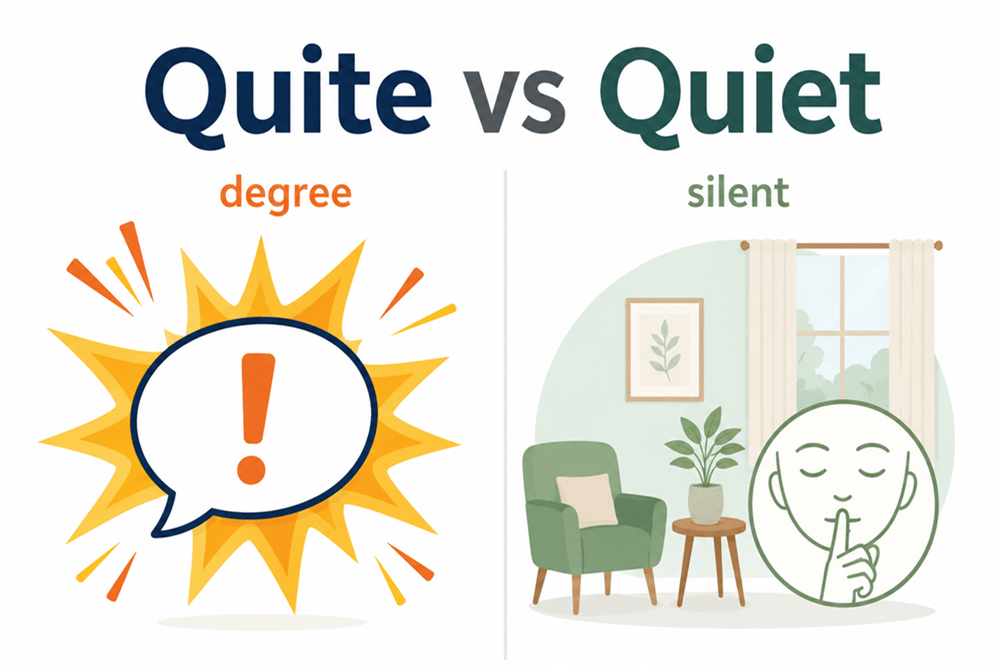
Quite and quiet are both correct words, but they mean different things. Use quite when you mean fairly, very, completely, or to a noticeable degree. Use quiet when you mean silent, calm, low in noise, or not loud. The easiest rule is: quite adds emphasis, while quiet means not noisy.
Quick Answer
Use quite when you want to describe degree, amount, or intensity.
- The movie was quite good.
- She is quite sure about her answer.
- That was quite a surprise.
Use quiet when you mean silent, calm, peaceful, or not loud.
- The room was quiet.
- Please be quiet during the test.
- They moved to a quiet neighborhood.
The simple rule is: quite means fairly, very, or completely. Quiet means not loud.
Quite or Quiet: What Is the Difference?
The difference between quite and quiet is meaning, spelling, and pronunciation. They look similar because they use the same letters, but the order of the letters changes the word completely.
Quite is usually an adverb. It adds emphasis or shows degree. It can mean fairly, rather, very, really, or completely, depending on the sentence and the variety of English being used.
Quiet is usually an adjective, though it can also be a noun or a verb. It describes low noise, silence, calmness, stillness, or lack of disturbance.
| Word | Main Meaning | Example |
|---|---|---|
| Quite | Fairly, very, completely, or to a degree | The test was quite difficult. |
| Quiet | Silent, calm, or not noisy | The library was quiet. |
If your sentence is about how much, how strongly, or how true something is, use quite. If your sentence is about sound, calmness, or silence, use quiet.
What Does Quite Mean?
Quite is an adverb. It modifies adjectives, adverbs, verbs, and sometimes whole expressions. It often adds emphasis or shows that something is true to a noticeable degree.
Examples:
- The answer is quite simple.
- She was quite happy with the result.
- The house is quite old.
- He speaks quite clearly.
- That is quite enough for today.
In these sentences, quite does not refer to sound. It changes the strength of another word. It tells the reader that something is fairly, very, noticeably, or completely true.
What Does Quiet Mean?
Quiet usually means not loud, peaceful, calm, still, or free from noise. It can describe a person, place, voice, moment, room, street, mood, or activity.
Examples:
- The baby is finally quiet.
- They enjoyed a quiet evening at home.
- Her voice was soft and quiet.
- The office becomes quiet after five o’clock.
- He prefers quiet places.
In these sentences, quiet is about sound, calmness, or peacefulness. It does not mean fairly or very.
How to Pronounce Quite and Quiet
Quite and quiet are pronounced differently.
Quite is one syllable:
- kwite
It rhymes with right, light, and night.
Quiet is usually two syllables:
- QUI-et
It does not rhyme with quite. The extra vowel sound in the middle helps separate the two words when spoken carefully.
Examples of Quite in Sentences
Here are natural examples of quite used correctly:
- The instructions were quite clear.
- She is quite talented.
- That restaurant is quite popular.
- He was quite surprised by the news.
- The walk was quite long.
- This problem is quite different from the last one.
- I am quite certain that we locked the door.
- It was quite a busy morning.
In every example, quite adds degree or emphasis. It helps describe how clear, talented, popular, surprised, long, different, certain, or busy something is.
Examples of Quiet in Sentences
Here are natural examples of quiet used correctly:
- The classroom was quiet during the exam.
- She wanted a quiet place to read.
- Please keep your voice quiet.
- The street was unusually quiet.
- He gave a quiet laugh.
- The house felt peaceful and quiet.
- They spent a quiet weekend by the lake.
- The dog became quiet after the storm passed.
In every example, quiet refers to low noise, calmness, or stillness.
Quite as “Fairly” or “Very”
Quite can be tricky because its strength can change by region and context. In many everyday sentences, it can mean fairly, rather, or very.
Examples:
- The room is quite small.
- The book was quite interesting.
- She seemed quite tired.
Depending on tone, these sentences may mean the room is fairly small, the book is very interesting, or she seemed noticeably tired. Context matters.
In American English, quite often sounds stronger and closer to very. In British English, it can sometimes sound softer, closer to fairly or rather. This does not change the spelling, but it can affect how the sentence feels.
Quite as “Completely”
Sometimes quite means completely or entirely, especially before words that already suggest a complete state.
Examples:
- You are quite right.
- That is quite true.
- I am quite finished with this task.
- The result was quite unexpected.
In these sentences, quite can make the statement feel more complete or certain. It adds emphasis, not quietness.
Quiet as an Adjective
Quiet is most often used as an adjective. It describes a noun or pronoun.
Examples:
- a quiet room
- a quiet child
- a quiet street
- a quiet morning
- a quiet voice
When someone says a place is quiet, they usually mean there is little noise or activity. When someone says a person is quiet, they may mean the person does not talk much, speaks softly, or behaves calmly.
Quiet as a Noun and Verb
Quiet can also be a noun. As a noun, it means silence or calm.
Examples:
- She enjoyed the quiet of the early morning.
- After the children left, the house returned to quiet.
- He needed a little peace and quiet.
Quiet can also be a verb. As a verb, it means to make something quieter or calmer.
Examples:
- The teacher tried to quiet the class.
- She sang softly to quiet the baby.
- The announcement helped quiet everyone’s fears.
Even as a noun or verb, quiet is still connected to calmness, silence, or reduced noise.
Common Phrases With Quite
Quite appears in many common English phrases. These phrases are about degree, emphasis, surprise, or certainty.
- quite good
- quite sure
- quite right
- quite a lot
- quite a few
- quite different
- quite enough
- quite frankly
Examples:
- She is quite sure about her decision.
- There were quite a few people at the event.
- Quite frankly, I disagree.
Common Phrases With Quiet
Quiet appears in phrases about silence, calmness, privacy, or low noise.
- quiet room
- quiet voice
- quiet place
- quiet time
- peace and quiet
- keep quiet
- stay quiet
- quiet down
Examples:
- I need some peace and quiet.
- Please keep quiet during the movie.
- The room finally began to quiet down.
Common Mistakes to Avoid
The most common mistake is writing quiet when the sentence needs quite.
Incorrect:
- The test was quiet hard.
- She is quiet sure.
- That was quiet funny.
Correct:
- The test was quite hard.
- She is quite sure.
- That was quite funny.
Another mistake is writing quite when the sentence needs quiet.
Incorrect:
- The room was quite.
- Please be quite.
Correct:
- The room was quiet.
- Please be quiet.
If the sentence is about silence or low noise, use quiet. If the sentence is about degree or emphasis, use quite.
How to Remember Quite or Quiet
Here is an easy way to remember the difference:
Quiet has et at the end, and you can think of a quiet room as one where everything is still and settled.
Quite is shorter and quicker. It adds emphasis to another word.
- Quite = fairly, very, completely, or to a degree
- Quiet = silent, calm, or not loud
You can also remember this sentence:
The quiet room was quite peaceful.
In that sentence, quiet describes the room, and quite strengthens the word peaceful.
Final Answer
Quite and quiet are both correct, but they mean different things. Use quite when you mean fairly, very, completely, or to a noticeable degree. Use quiet when you mean silent, calm, peaceful, or not loud. Remember: quite adds emphasis, while quiet means low noise.