Whether or Wether: Correct Spelling, Meaning Difference, Grammar Usage, and Examples Explained Clearly
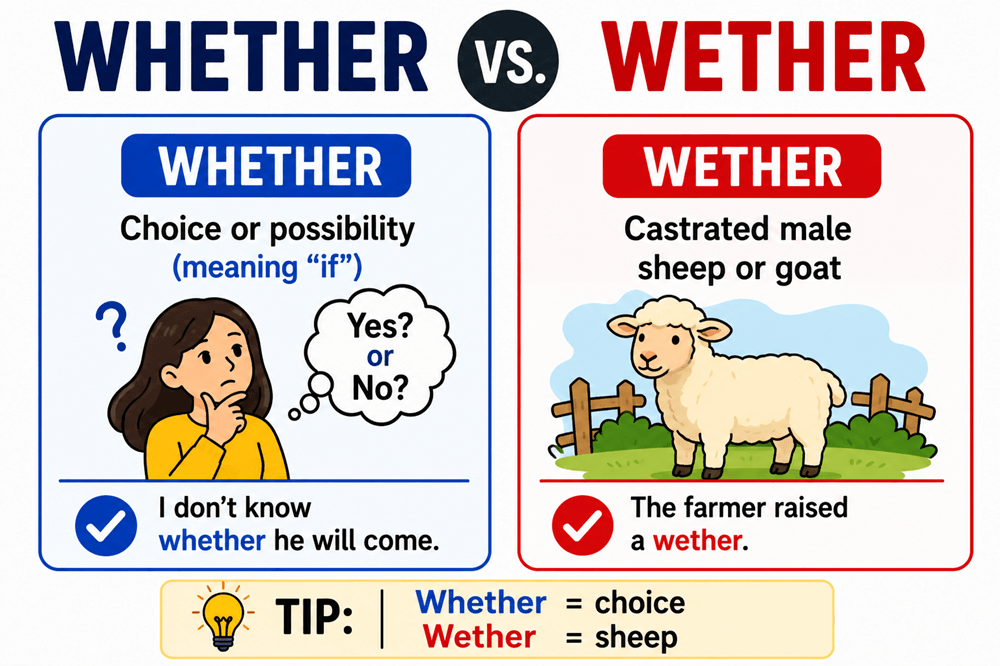
Whether and wether are both real words, but they mean very different things. In almost all everyday writing, the correct word is whether. Use whether when you are talking about a choice, possibility, doubt, or condition. Wether is a rare noun that means a castrated male sheep or goat.
Quick Answer
Use whether when you mean if, which of two choices, or regardless of which option is true.
- I do not know whether she is coming.
- We must decide whether to stay or leave.
- Tell me whether you want tea or coffee.
Use wether only when referring to a specific kind of male sheep or goat.
- The farmer separated the wether from the flock.
- A wether is a castrated male sheep or goat.
The simple rule is: whether is for choices and possibilities. Wether is an animal term.
Whether or Wether: What Is the Difference?
The difference between whether and wether is meaning and usage. They look almost the same, and they are usually pronounced the same, but they are not interchangeable.
Whether is a conjunction. It connects a sentence to a question, choice, doubt, condition, or possibility. You use it in sentences like whether you agree, whether it rains, whether to go, and whether or not.
Wether is a noun. It is a farming or livestock word. It refers to a castrated male sheep or goat. Unless you are writing about animals, farms, livestock, or agriculture, you probably do not need wether.
| Word | Meaning | Common Use |
|---|---|---|
| Whether | If, which choice, or regardless of which option | Questions, choices, doubt, conditions |
| Wether | A castrated male sheep or goat | Livestock and farming contexts |
If your sentence has nothing to do with sheep or goats, whether is almost certainly the correct spelling.
What Does Whether Mean?
Whether is used when a sentence involves uncertainty, choice, or possibility. It often introduces two possible options, even when only one option is directly stated.
Examples:
- I am not sure whether he understood the question.
- She asked whether the store was open.
- They are deciding whether to move.
- We need to know whether the payment went through.
- He wondered whether he had made the right choice.
In these examples, whether introduces uncertainty. It points to a yes-or-no question, a possible outcome, or a decision that has not been settled yet.
What Does Wether Mean?
Wether is a noun. It means a castrated male sheep or goat. This word is rare in everyday English, but it is correct in farming, livestock, veterinary, and agricultural contexts.
Examples:
- The farmer bought a young wether.
- The wether grazed near the fence.
- The flock included ewes, lambs, and one wether.
- The goat was classified as a wether.
Most general readers do not use wether often. Because it is uncommon, many people who write wether are actually trying to write whether.
Why Wether Is Usually the Wrong Word
Wether is usually the wrong word because most sentences that contain this sound are about choices, questions, or possibilities, not livestock.
Incorrect:
- I do not know wether she is coming.
- We have to decide wether to wait.
- Tell me wether you agree.
Correct:
- I do not know whether she is coming.
- We have to decide whether to wait.
- Tell me whether you agree.
In each corrected sentence, the word introduces a question, choice, or condition. That means whether is the right spelling.
Whether as a Choice Between Options
Whether often appears when a sentence presents two or more options. The options may be directly stated, or one may be implied.
Examples:
- We must choose whether to drive or fly.
- She cannot decide whether to call or text.
- He asked whether we wanted pizza or pasta.
- The team debated whether the plan was realistic or too risky.
In these sentences, whether helps introduce a choice. The sentence is not about a sheep or goat, so wether would be wrong.
Whether in Yes-or-No Situations
Whether can also introduce a yes-or-no possibility. In these sentences, the second option is often unstated, but it is understood.
Examples:
- I wonder whether it will rain.
- Do you know whether the office is open?
- She asked whether I had finished the report.
- We need to confirm whether the email was received.
Each sentence suggests two possibilities. It may rain or it may not. The office may be open or it may not. The report may be finished or it may not. That uncertainty is exactly where whether belongs.
Whether or Not
The phrase whether or not is common. It means that something is true, important, or will happen regardless of the answer.
Examples:
- We are leaving now, whether or not you are ready.
- She will speak honestly, whether or not people agree.
- The rule applies whether or not you read the notice.
- He plans to attend, whether or not he receives an invitation.
Sometimes or not is necessary for clarity. Other times, it can be left out.
- I do not know whether she will come.
- I do not know whether or not she will come.
Both versions can be correct. The shorter version is often smoother unless you need to stress both possibilities.
Whether vs If
Whether and if can sometimes mean similar things, especially in indirect yes-or-no questions.
Examples:
- I do not know whether he is home.
- I do not know if he is home.
Both sentences are understandable. However, whether is often better when the sentence clearly presents alternatives.
- We must decide whether to stay or leave.
In formal writing, whether is usually the stronger choice before to and when listing alternatives.
- Correct: She is deciding whether to accept the offer.
- Awkward: She is deciding if to accept the offer.
When the sentence means in the event that, use if, not whether.
- If it rains, we will stay inside.
That sentence gives a condition. It does not simply ask which possibility is true.
Whether Before “To”
Use whether before an infinitive phrase beginning with to.
Examples:
- She is deciding whether to apply.
- He asked whether to bring a jacket.
- They discussed whether to sell the house.
- We need to choose whether to continue.
Do not use wether in these sentences. This structure is about decisions, choices, and possibilities, so it needs whether.
Examples of Whether in Sentences
Here are natural examples of whether used correctly:
- I cannot tell whether she is joking.
- They asked whether we needed help.
- He wondered whether the story was true.
- We need to decide whether this plan is worth the cost.
- She does not know whether to laugh or cry.
- The teacher asked whether everyone understood the lesson.
- It is unclear whether the meeting will be postponed.
- Tell me whether you prefer morning or afternoon.
These examples all involve uncertainty, possibility, or choice. That is why whether is correct.
Examples of Wether in Sentences
Here are examples of wether used correctly as an animal term:
- The wether stayed close to the rest of the flock.
- The farm kept one wether with the ewes.
- The goat was a healthy wether.
- The livestock report listed each wether separately.
These examples are specific to animals. If your sentence is not about livestock, wether is probably not the word you need.
Common Mistakes to Avoid
The biggest mistake is using wether instead of whether.
Incorrect:
- I am not sure wether this is correct.
- She asked wether we were ready.
- We need to decide wether to leave early.
Correct:
- I am not sure whether this is correct.
- She asked whether we were ready.
- We need to decide whether to leave early.
Another mistake is using whether when a simple condition needs if.
Less natural:
- Whether it rains, we will stay inside.
Better:
- If it rains, we will stay inside.
Use whether for uncertainty or alternatives. Use if for conditions.
How to Remember Whether or Wether
Here is an easy memory trick:
Whether has h, and choice has h.
That can remind you that whether is used for choices and possibilities.
- Whether = choice, doubt, possibility
- Wether = sheep or goat
You can also remember this sentence:
Whether asks which possibility is true.
If your sentence is asking about a possibility, decision, or alternative, use whether.
Final Answer
Whether and wether are both real words, but they are not interchangeable. Use whether for choices, doubts, questions, alternatives, and possibilities. Use wether only when referring to a castrated male sheep or goat. In everyday writing, whether is almost always the word you need.