Adviser or Advisor: Correct Spelling, Meaning, Usage, and Examples for Writers Today
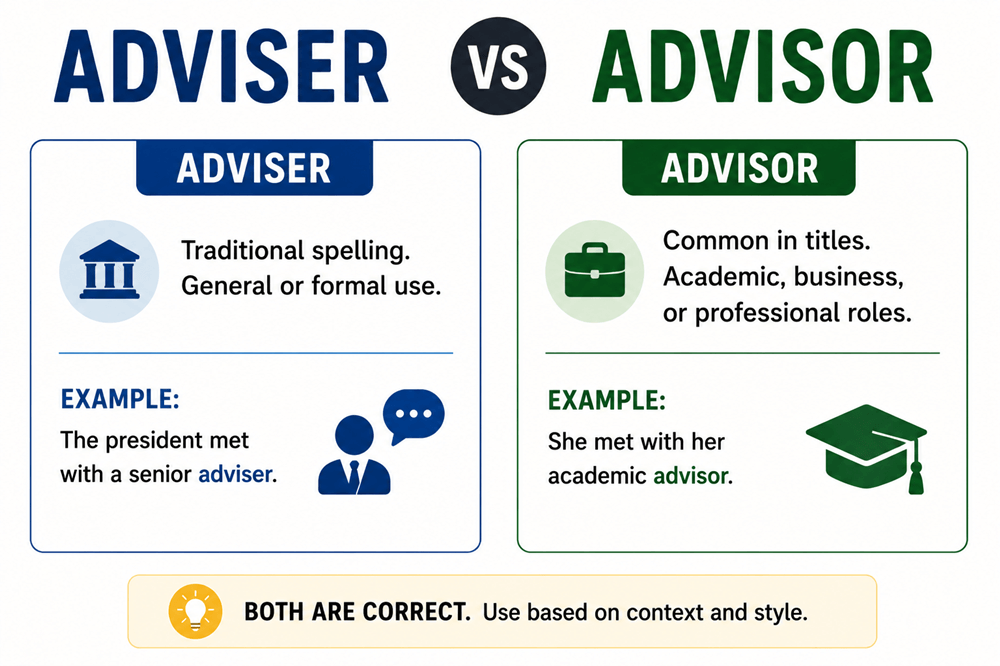
Adviser and advisor are both correct spellings. They both mean a person who gives advice, guidance, or recommendations. The difference is mostly style and preference. Adviser is often treated as the more traditional spelling, while advisor is common in job titles, academic roles, financial services, and business settings.
Quick Answer
Use adviser when you want the more traditional or general spelling.
- She works as a policy adviser.
- The president met with a senior adviser.
- He became a trusted adviser to the team.
Use advisor when it appears in an official title, job name, department name, or professional role.
- She met with her academic advisor.
- He works as a financial advisor.
- The company hired a legal advisor.
The simple rule is: both are correct, but adviser is more traditional, while advisor is common in professional titles.
Adviser or Advisor: What Is the Difference?
The difference between adviser and advisor is not meaning. Both words refer to someone who gives advice. The difference is spelling preference, tone, and context.
Adviser is often seen as the older, simpler, and more traditional spelling. It follows the common English pattern of adding -er to a verb: advise becomes adviser, just as teach becomes teacher and write becomes writer.
Advisor is also correct and widely used. It is especially common in formal job titles, professional services, universities, business settings, finance, and official organizational language. Many people are used to seeing phrases such as academic advisor, financial advisor, legal advisor, and career advisor.
| Word | Correct? | Common Use |
|---|---|---|
| Adviser | Yes | Traditional spelling, general writing, journalism, policy roles |
| Advisor | Yes | Job titles, universities, finance, business, official roles |
If you are writing generally and do not need to match an official title, adviser is a safe choice. If you are referring to a specific job title or organization that uses advisor, keep that spelling.
What Does Adviser Mean?
An adviser is a person who gives advice, guidance, information, or recommendations. The advice may be personal, political, professional, financial, legal, academic, or strategic.
Examples:
- The mayor listened to her chief adviser.
- He served as an adviser during the campaign.
- The committee brought in an outside adviser.
- She became a trusted adviser to the founder.
- The government appointed a science adviser.
In these sentences, adviser means someone who helps others make decisions. The word does not mean the person has final authority. An adviser gives guidance, but someone else may still make the final choice.
What Does Advisor Mean?
Advisor has the same basic meaning as adviser. It also means a person who gives advice or guidance. The spelling advisor is especially common when the word is part of a role or title.
Examples:
- She spoke with her academic advisor before choosing classes.
- The couple hired a financial advisor.
- He works as a career advisor at the college.
- The company uses an outside tax advisor.
- The board appointed a strategic advisor.
In these examples, advisor feels natural because it sounds like a formal role. Many schools, banks, firms, and organizations use advisor in official job titles.
Is Adviser Correct?
Yes, adviser is correct. It is often the preferred spelling in general writing, especially when the word is not part of a formal title.
Examples:
- She became an important adviser to the new director.
- The senator consulted several foreign policy advisers.
- He trusted his adviser’s judgment.
Adviser can look cleaner in ordinary prose because it follows the verb advise more directly. If your sentence is not referring to a specific official title, this spelling is often a strong choice.
Is Advisor Correct?
Yes, advisor is also correct. It is not a misspelling. It is widely used in professional and institutional contexts.
Examples:
- The student emailed her academic advisor.
- He met with a financial advisor about retirement.
- The startup hired a marketing advisor.
Use advisor when it is part of a person’s official job title or when a company, school, or organization uses that spelling. For example, if someone’s title is Student Advisor, you should not change it to Student Adviser.
Adviser and Advisor in Job Titles
Job titles often determine which spelling you should use. Many organizations choose one spelling and use it consistently.
Common titles with advisor include:
- academic advisor
- financial advisor
- career advisor
- student advisor
- legal advisor
- business advisor
Common titles with adviser include:
- policy adviser
- political adviser
- senior adviser
- special adviser
- communications adviser
These are not strict rules. You may see financial adviser and financial advisor. You may also see policy advisor and policy adviser. The best choice depends on the style you are following and whether the phrase is an official title.
Financial Adviser or Financial Advisor?
Both financial adviser and financial advisor can be correct. In everyday business and finance writing, financial advisor is very common. Many firms, websites, and professionals use that spelling in their titles.
Examples:
- She hired a financial advisor to help with retirement planning.
- He works as a financial advisor at an investment firm.
Financial adviser may also appear, especially in more traditional or formal writing.
- The article explained how to choose a financial adviser.
- A good financial adviser should explain risks clearly.
If you are writing about a specific person’s professional title, use the spelling that person or organization uses. If you are writing generally, either spelling can work, but financial advisor may look more familiar to many readers.
Academic Adviser or Academic Advisor?
Both forms are possible, but academic advisor is very common in colleges and universities. Many schools use advisor for the staff or faculty member who helps students choose classes, understand requirements, and plan their degree path.
Examples:
- Talk to your academic advisor before changing your major.
- Her academic advisor helped her plan the semester.
You may still see academic adviser, especially if a school or publication prefers that spelling.
- The academic adviser reviewed the student’s course plan.
When writing for a specific school, copy the school’s official spelling.
Examples of Adviser in Sentences
Here are natural examples of adviser used correctly:
- The president spoke with a senior adviser.
- She is a trusted adviser to the organization.
- The campaign hired several policy advisers.
- He became an informal adviser to younger employees.
- The board asked an outside adviser for guidance.
- Her adviser recommended a more careful approach.
These examples work well in general, political, professional, and editorial writing.
Examples of Advisor in Sentences
Here are natural examples of advisor used correctly:
- My academic advisor approved my course schedule.
- The company hired a business advisor.
- She met with a financial advisor before investing.
- The career advisor helped him update his resume.
- He serves as a technical advisor for the project.
- The student advisor answered questions about registration.
These examples sound natural because advisor often appears in formal job roles and institutional settings.
Common Mistakes to Avoid
The main mistake is assuming one spelling is always wrong. Adviser and advisor are both standard words. The issue is not correctness but consistency and context.
Another mistake is changing an official title. If someone’s title is Financial Advisor, do not rewrite it as Financial Adviser. If an organization uses Policy Adviser, do not change it to Policy Advisor.
Inconsistent writing can also look messy:
- The student met with her academic advisor, and the adviser helped her choose classes.
Better:
- The student met with her academic advisor, and the advisor helped her choose classes.
Or:
- The student met with her academic adviser, and the adviser helped her choose classes.
Choose one spelling style and use it consistently unless you are quoting official titles that use different spellings.
How to Remember Adviser or Advisor
Here is a simple way to remember the difference:
Adviser is the traditional general spelling.
Advisor is common in official roles and titles.
You can also remember it this way:
- Adviser = general writing
- Advisor = job titles and professional roles
If you are unsure, look at the surrounding context. If it is an official title, copy the official spelling. If it is a general noun, adviser is often a safe and traditional choice.
Final Answer
Adviser and advisor are both correct. They both mean a person who gives advice or guidance. Adviser is often the more traditional spelling and works well in general writing. Advisor is common in job titles, academic roles, financial services, business settings, and official organizational language. The best choice depends on your style, audience, and whether you are using an official title.