Whos or Whose: Correct Spelling, Meaning, Apostrophe Rule, and Easy Examples for Writers
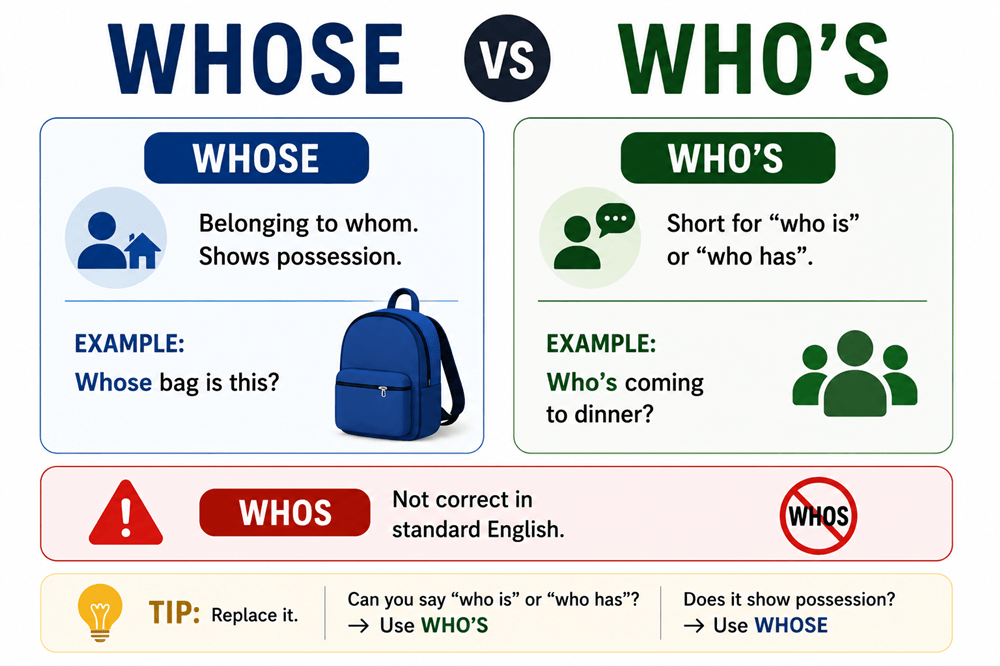
Whos is not the correct spelling in standard English. The word you probably need is either whose or who’s. Use whose when you mean “belonging to whom.” Use who’s when you mean who is or who has. The form whos without an apostrophe is usually a spelling mistake.
Quick Answer
Use whose when you are asking or talking about ownership, connection, or belonging.
- Whose bag is this?
- I know the woman whose car was stolen.
- Whose idea was that?
Use who’s when you mean who is or who has.
- Who’s coming to dinner?
- Who’s been using my phone?
- Do you know who’s in charge?
Do not use whos in standard writing. It is usually a misspelling of who’s.
Whos or Whose: Which One Is Correct?
Whose is a correct word. Whos is not normally correct in standard English.
The confusion happens because whose and who’s sound exactly the same. When people hear the word aloud, they may not know whether it should be written with an apostrophe, without an apostrophe, or with the spelling whose. That is why whos often appears as a mistake.
| Word | Correct? | Meaning |
|---|---|---|
| Whose | Yes | Belonging to whom |
| Who’s | Yes | Who is or who has |
| Whos | No | A common misspelling, usually of who’s |
If you are choosing between whos and whose, the answer is usually whose. But if your sentence means who is or who has, the correct spelling is who’s, not whos.
What Does Whose Mean?
Whose is a possessive word. It asks or shows who something belongs to, who something is connected with, or who is associated with something.
Use whose when the sentence is about ownership or relationship.
Examples:
- Whose keys are on the table?
- Whose phone keeps ringing?
- Whose turn is it to speak?
- Whose coat did you borrow?
- The student whose essay won the prize was very surprised.
In each sentence, whose points to a connection. The keys belong to someone. The phone belongs to someone. The essay belongs to a student. That is why whose is correct.
What Does Who’s Mean?
Who’s is a contraction. A contraction is a shortened form of two words. Who’s can mean either who is or who has.
Examples where who’s means who is:
- Who’s at the door?
- Who’s ready to leave?
- Who’s your favorite author?
- Do you know who’s speaking tonight?
Each sentence can be expanded:
- Who is at the door?
- Who is ready to leave?
- Who is your favorite author?
Examples where who’s means who has:
- Who’s taken my notebook?
- Who’s been calling you all morning?
- Who’s finished the assignment?
These can also be expanded:
- Who has taken my notebook?
- Who has been calling you all morning?
- Who has finished the assignment?
If the sentence works with who is or who has, use who’s with an apostrophe.
Why Whos Is Incorrect
Whos is incorrect because it is missing the apostrophe from who’s or is being used in place of whose. In standard English, whos is not the normal spelling for either meaning.
Incorrect:
- Whos coming with us?
- Whos bag is this?
Correct:
- Who’s coming with us?
- Whose bag is this?
The first sentence means who is coming with us, so it needs who’s. The second sentence asks who owns the bag, so it needs whose.
Whose and Who’s Side by Side
Seeing the two correct forms together can make the difference easier to understand.
| Whose | Who’s |
|---|---|
| Whose jacket is this? | Who’s wearing the jacket? |
| I know the man whose dog ran away. | I know the man who’s looking for his dog. |
| Whose name is on the list? | Who’s on the list? |
| Whose car did you use? | Who’s driving the car? |
Whose shows ownership or connection. Who’s means who is or who has.
The Replacement Test
The easiest way to choose between whose and who’s is to use the replacement test.
Ask yourself: can I replace the word with who is or who has?
If yes, use who’s.
- Who’s calling?
- Who is calling?
That works, so who’s is correct.
Now test this sentence:
- Whose book is on the desk?
Try replacing it:
- Who is book is on the desk?
- Who has book is on the desk?
Neither version works. The sentence is about ownership, so whose is correct.
Examples of Whose in Sentences
Here are natural examples of whose used correctly:
- Whose backpack is by the door?
- Whose handwriting is this?
- Whose idea started the project?
- Whose house are we visiting?
- The woman whose phone rang apologized.
- The author whose book we read visited the school.
- The employee whose report was late stayed after work.
- I met a singer whose voice sounded familiar.
In each sentence, whose connects a person to something that belongs to them or is related to them.
Examples of Who’s in Sentences
Here are natural examples of who’s used correctly:
- Who’s coming to the meeting?
- Who’s been eating my snacks?
- Do you know who’s available today?
- I wonder who’s responsible for the mistake.
- Who’s going to call the client?
- Tell me who’s in charge of the schedule.
- Who’s finished the report already?
- She asked who’s joining the group.
In every example, who’s can be expanded to who is or who has.
Common Mistakes to Avoid
One common mistake is writing whos without an apostrophe.
Incorrect:
- Whos ready?
- Whos been here before?
Correct:
- Who’s ready?
- Who’s been here before?
Another common mistake is using who’s when the sentence needs whose.
Incorrect:
- Who’s jacket is this?
Correct:
- Whose jacket is this?
The jacket belongs to someone, so the possessive word whose is correct.
A third mistake is assuming that every possessive word needs an apostrophe. Whose is already possessive, so it does not need one.
How to Remember Whose or Who’s
Use this simple memory trick:
Who’s has an apostrophe because letters are missing.
The missing letters come from who is or who has.
- Who’s there? = Who is there?
- Who’s been here? = Who has been here?
Whose shows ownership.
- Whose phone is this?
- Whose turn is next?
The easiest rule is: if you can say “who is” or “who has,” use who’s. If you mean belonging to whom, use whose.
Final Answer
Whos is not correct in standard English. Use whose when you mean “belonging to whom.” Use who’s when you mean who is or who has. If the sentence is about ownership, choose whose. If the sentence works with who is or who has, choose who’s.