Bear or Bare: What’s the Difference?
Bear and bare sound the same, but they mean very different things.
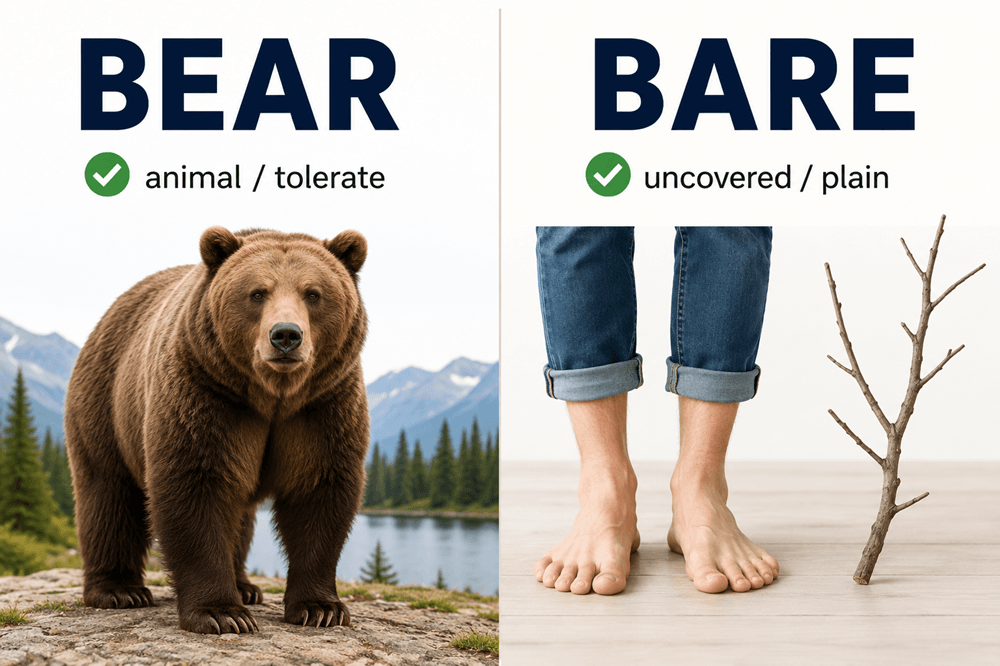
Use bear when you mean the animal, to carry something, to tolerate something, or to keep something in mind.
Use bare when you mean uncovered, naked, plain, empty, or minimal.
Examples:
- A bear walked through the forest.
- Please bear with me for a moment.
- I can’t bear the noise anymore.
- He walked across the floor with bare feet.
- The room was almost bare.
The most common mistake is writing bare with me when you mean bear with me. The correct phrase is bear with me, because it means “please be patient with me.”
Quick Answer
Use bear for:
- the animal
- carrying or supporting
- tolerating
- “bear with me”
- “bear in mind”
Use bare for:
- uncovered
- exposed
- plain
- empty
- minimal
Correct:
- Please bear with me while I explain.
- She walked outside in bare feet.
Incorrect:
- Please bare with me while I explain.
That would sound like you are asking someone to get uncovered, which is not the meaning you want.
What Does Bear Mean?
Bear has several meanings.
First, bear can mean a large animal.
Examples:
- We saw a bear near the campsite.
- A polar bear lives in cold Arctic regions.
- The bear searched for food near the river.
Second, bear can mean to carry, hold, or support something.
Examples:
- The bridge can bear heavy weight.
- She had to bear the responsibility alone.
- The wall bears the weight of the roof.
Third, bear can mean to tolerate or endure something difficult.
Examples:
- I can’t bear the pain.
- He could not bear the silence.
- She had to bear many challenges.
Fourth, bear appears in common expressions.
Examples:
- Please bear with me.
- Bear in mind that prices may change.
- The facts bear this out.
In these uses, bear is about carrying, enduring, supporting, or keeping something in your mind.
What Does Bare Mean?
Bare means uncovered, exposed, plain, empty, or without extra things.
Examples:
- He walked on the grass with bare feet.
- The tree had bare branches in winter.
- The room was bare except for one chair.
- She told the bare truth.
- They packed only the bare essentials.
Bare can also be a verb meaning to uncover or reveal something.
Examples:
- The dog bared its teeth.
- He bared his arm for the injection.
- The storm bared the roots of the tree.
In most everyday writing, bare is used as an adjective. It describes something that is uncovered, empty, simple, or stripped down.
Bear vs Bare: The Main Difference
The easiest difference is this:
Bear usually means to carry, tolerate, or refer to the animal.
Bare usually means uncovered or plain.
Examples:
- I cannot bear this stress.
- The shelves were bare.
- Please bear with me.
- She wore bare feet on the beach.
If the meaning is about patience, pressure, responsibility, pain, or memory, use bear.
If the meaning is about being uncovered, empty, exposed, or minimal, use bare.
Bear With Me or Bare With Me?
The correct phrase is bear with me.
It means “please be patient with me.”
Correct:
- Please bear with me while I find the file.
- Bear with me for a second.
- If you can bear with me, I’ll explain the process.
Incorrect:
- Please bare with me.
This is one of the most common mistakes with these words. The phrase does not mean “be bare with me.” It means “endure this delay with me” or “be patient while I continue.”
So remember:
Bear with me = be patient with me
Bear in Mind or Bare in Mind?
The correct phrase is bear in mind.
It means “remember” or “keep this in mind.”
Correct:
- Bear in mind that the office closes early today.
- Please bear in mind that this is only an estimate.
- You should bear in mind the cost before deciding.
Incorrect:
- Bare in mind that the office closes early today.
The phrase uses bear because the idea is to carry a thought in your mind.
Bare Minimum or Bear Minimum?
The correct phrase is bare minimum.
It means the smallest amount needed.
Correct:
- We packed the bare minimum for the trip.
- He did the bare minimum to pass the class.
- The room had only the bare minimum of furniture.
Incorrect:
- We packed the bear minimum.
Here, bare means stripped down, plain, or without extra things.
How to Remember the Difference
A simple memory trick:
Bear has ear in it.
You can think:
A bear has ears.
That helps you remember the animal spelling: b-e-a-r.
Another trick:
Bear = carry a burden.
Both bear and burden start with b, and they are connected in meaning. To bear something means to carry or endure it.
For bare, think:
Bare = exposed air.
The word bare ends with are, and something bare is open to the air.
Examples:
- bare skin
- bare feet
- bare branches
- bare walls
So:
bear = animal, carry, tolerate
bare = uncovered, plain, empty
Spelling Structure
Bear is spelled:
b-e-a-r
It sounds like “bear,” the animal. Remember the animal has ears, and bear contains ear.
Bare is spelled:
b-a-r-e
It has are at the end. Think of something bare as exposed to the air.
The spelling difference is small, but the meaning difference is big.
Common Mistakes
Mistake 1: Writing “bare with me”
Incorrect:
- Please bare with me.
Correct:
- Please bear with me.
Use bear because the meaning is “be patient” or “endure the wait.”
Mistake 2: Writing “bear feet”
Incorrect:
- She walked outside in bear feet.
Correct:
- She walked outside in bare feet.
Use bare because her feet are uncovered.
Mistake 3: Writing “bare in mind”
Incorrect:
- Bare in mind that this may change.
Correct:
- Bear in mind that this may change.
Use bear because the meaning is “carry this thought in your mind.”
Mistake 4: Writing “bear minimum”
Incorrect:
- He did the bear minimum.
Correct:
- He did the bare minimum.
Use bare because the meaning is “only the smallest amount.”
Example Sentences With Bear
- A bear crossed the road near the forest.
- I can’t bear this heat much longer.
- Please bear with me while I check.
- Bear in mind that the rules may change.
- The beams can bear the weight of the roof.
- She had to bear the cost herself.
Example Sentences With Bare
- The child ran across the sand in bare feet.
- The walls were bare after they removed the paintings.
- The tree had bare branches all winter.
- He told the bare facts.
- We brought only the bare essentials.
- The dog bared its teeth.
Final Answer: Bear or Bare?
Bear and bare are both correct words, but they are used differently.
Use bear for the animal, carrying, supporting, tolerating, or remembering.
Use bare for something uncovered, exposed, plain, empty, or minimal.
The easiest way to remember it is:
A bear has ears.
Bare means exposed to the air.
So write:
- bear with me
- bear in mind
- bare feet
- bare minimum
These phrases will help you choose the correct word quickly.