Whoever or Whomever: Correct Meaning, Grammar Rule, Usage, and Examples Clearly Explained
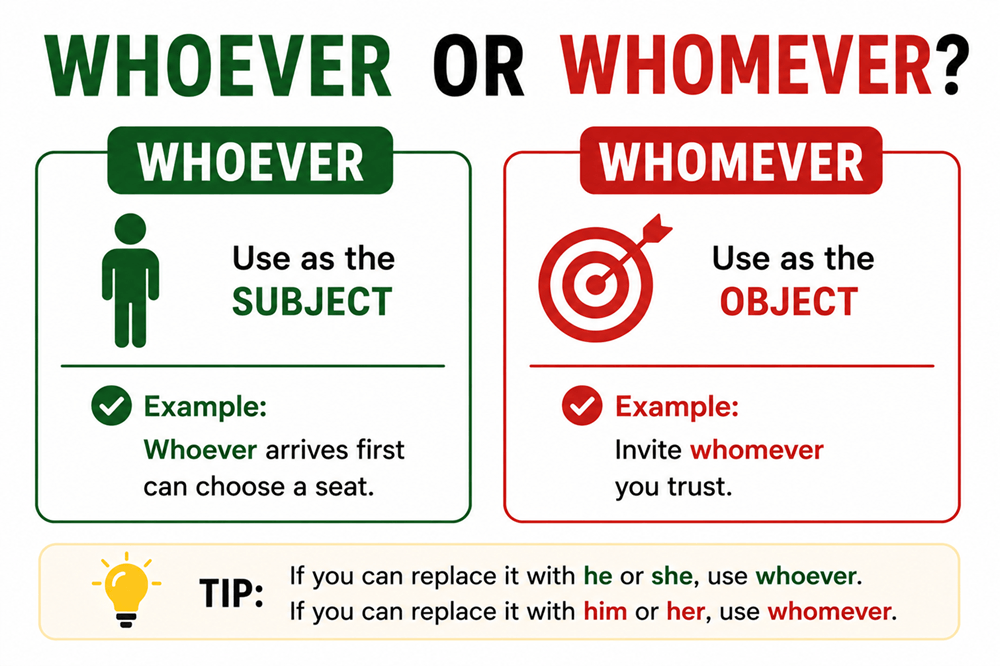
Whoever and whomever are both correct words, but they are used in different grammatical roles. Use whoever when the word is acting like a subject. Use whomever when the word is acting like an object. In everyday writing, whoever is much more common, while whomever sounds more formal and is used less often. The easiest rule is this: use whoever when you could say he or she, and use whomever when you could say him or her.
Quick Answer
Use whoever when the word is the subject of its own clause.
- Correct: Whoever called you should leave a message.
- Correct: Give the prize to whoever wins.
- Correct: Whoever wants to join can sign up today.
Use whomever when the word is the object of a verb or preposition in its own clause.
- Correct: Invite whomever you trust.
- Correct: Give the file to whomever you choose.
- Correct: She will support whomever the committee selects.
The simple rule is this: whoever does the action. Whomever receives the action.
Whoever or Whomever: What Is the Difference?
The difference between whoever and whomever is the same basic difference between who and whom. Whoever is used for a subject. Whomever is used for an object.
A subject is the person doing the action in a clause. An object is the person receiving the action or following a preposition. That sounds technical, but you can often test the sentence by replacing the word with he, she, him, or her.
| Word | Role | Example |
|---|---|---|
| Whoever | Subject | Whoever arrives first can choose a seat. |
| Whomever | Object | You may invite whomever you like. |
In the first example, whoever is doing the action of arriving. In the second example, whomever is the person being liked or invited. That is why the forms are different.
What Does Whoever Mean?
Whoever means any person who, no matter who, or the person who. It is used when you are talking about an unknown, unspecified, or open-ended person. The person may be one individual, one of many people, or anyone who fits the situation.
Examples:
- Whoever finds the keys should bring them to the office.
- Whoever made this cake did a wonderful job.
- Whoever wants more coffee can help themselves.
- Whoever answers first will get a point.
In each sentence, whoever refers to a person doing something. Someone finds the keys. Someone made the cake. Someone wants coffee. Someone answers first.
Whoever often introduces a clause that works like a noun. That clause can act as the subject, object, or complement of the larger sentence, but whoever itself still depends on its role inside its own smaller clause.
- Whoever wins will receive a trophy.
- Give the trophy to whoever wins.
Both sentences use whoever because in the smaller clause, the person is doing the action: whoever wins.
What Does Whomever Mean?
Whomever also means any person whom, no matter whom, or the person whom. It is used when the unknown person is receiving an action or is the object of a preposition inside the clause.
Examples:
- You may invite whomever you want.
- She will hire whomever the panel recommends.
- Give the envelope to whomever the manager names.
- The school will recognize whomever the judges select.
In these sentences, whomever is not doing the main action inside its clause. The person is being wanted, recommended, named, or selected. That makes whomever the object.
Whomever is correct in formal grammar, but it can sound stiff in casual writing. Many speakers use whoever in places where traditional grammar would call for whomever. For polished writing, however, it is useful to know the distinction.
The He/Him Test
The easiest way to choose between whoever and whomever is to use the he/him test.
- If he or she fits, use whoever.
- If him or her fits, use whomever.
Example:
- Correct: Whoever called you should call again.
Test it:
- He called you.
Since he fits, use whoever.
Another example:
- Correct: Invite whomever you trust.
Test it:
- You trust him.
Since him fits, use whomever.
This test works best when you focus on the smaller clause that contains whoever or whomever. Do not judge only by the word that comes right before it.
When to Use Whoever
Use whoever when the word is the subject of the verb in its own clause. In simpler terms, use whoever when the person is doing something.
Examples:
- Whoever left the door open should close it.
- Whoever finishes first can take a break.
- Whoever knows the answer should raise their hand.
- Whoever wrote this note has beautiful handwriting.
In each example, whoever is doing the action: leaving, finishing, knowing, or writing.
Use whoever even after a preposition if the word is still the subject of the clause that follows.
- Give the ticket to whoever arrives first.
- Send the message to whoever handles scheduling.
- Offer the seat to whoever needs it most.
This point confuses many writers. The word to may make you expect whomever, but the correct choice is whoever because the person is doing the action inside the clause: whoever arrives, whoever handles, whoever needs.
When to Use Whomever
Use whomever when the word is the object of a verb or preposition in its own clause. In simpler terms, use whomever when something is being done to that person.
Examples:
- You can invite whomever you like.
- She will thank whomever helped her most.
- The company may hire whomever the board approves.
- We will support whomever the voters choose.
In these examples, the person is being liked, thanked, approved, or chosen. That makes whomever the object inside its own clause.
Whomever is also used after prepositions when the word itself is the object of the preposition.
- Give it to whomever.
- Speak with whomever you trust most.
- The decision rests with whomever the director appoints.
Still, many sentences that look like they need whomever actually need whoever, so the clause test matters.
Give It to Whoever or Whomever?
The correct choice depends on what comes after the word.
Use whoever when the person is doing the action in the clause:
- Correct: Give it to whoever asks first.
Test it:
- He asks first.
Since he fits, use whoever.
Use whomever when the person is receiving the action:
- Correct: Give it to whomever you choose.
Test it:
- You choose him.
Since him fits, use whomever.
This is why you should not choose whomever automatically after to. You must look at the role of the word inside its clause.
Whoever You Choose or Whomever You Choose?
The correct phrase is usually whomever you choose when choose is acting on the person.
Correct:
- You may invite whomever you choose.
- The award will go to whomever the judges choose.
- We will work with whomever you choose.
Test it:
- You choose him.
- The judges choose her.
Since him and her fit, whomever is correct.
However, if the person is doing the choosing, use whoever.
- Correct: Whoever chooses first gets the best seat.
Test it:
- He chooses first.
Since he fits, use whoever.
Whoever Wins or Whomever Wins?
The correct phrase is whoever wins.
Correct:
- Whoever wins will receive a trophy.
- Give the trophy to whoever wins.
- Whoever wins the contest will be announced tomorrow.
Wins needs a subject, and the person doing the winning is whoever. You would say:
- He wins.
- She wins.
You would not say:
- Him wins.
- Her wins.
That is why whoever wins is correct, even in a sentence like Give the prize to whoever wins.
Common Mistakes With Whoever and Whomever
The most common mistake is using whomever simply because the sentence sounds formal. A formal tone does not automatically require whomever.
Incorrect:
- Whomever finishes first may leave.
- Give the job to whomever applies first.
- Whomever called should call back.
Correct:
- Whoever finishes first may leave.
- Give the job to whoever applies first.
- Whoever called should call back.
In each correct sentence, the person is doing the action: finishing, applying, or calling.
Another mistake is using whoever when the word is clearly receiving the action.
Less formal or incorrect in careful grammar:
- Invite whoever you want.
- Choose whoever you trust.
More formally correct:
- Invite whomever you want.
- Choose whomever you trust.
In casual writing, many people use whoever in these sentences. In polished or formal writing, whomever is the more precise choice.
Examples of Whoever in Sentences
Here are examples of whoever used correctly:
- Whoever left the lights on should turn them off.
- Whoever wants dessert can have some.
- Give the form to whoever needs it.
- Whoever arrives early can save seats.
- Whoever made this playlist has good taste.
- The job should go to whoever is most qualified.
- Whoever calls first will get the appointment.
- Send the update to whoever manages the account.
In each sentence, whoever is the subject of its own clause. The person is doing the action.
Examples of Whomever in Sentences
Here are examples of whomever used correctly:
- You may bring whomever you like.
- The director will choose whomever she trusts most.
- Give the package to whomever the label names.
- The committee will interview whomever the manager recommends.
- She will support whomever the group selects.
- Invite whomever you feel comfortable inviting.
- The prize may go to whomever the audience chooses.
- We can assign the task to whomever you prefer.
In each sentence, whomever is the object inside its own clause. The person is being liked, trusted, named, recommended, selected, chosen, or preferred.
How to Remember Whoever or Whomever
A simple way to remember the difference is this:
- Whoever = he or she
- Whomever = him or her
Try replacing the clause with a simple sentence:
- Whoever called should leave a message. He called. Use whoever.
- Invite whomever you trust. You trust him. Use whomever.
You can also remember that whomever contains m, just like him. That small spelling clue can help you connect whomever with object form.
When in doubt, especially in casual writing, whoever will often sound more natural. But when you want careful grammar, use the he/him test and choose the form that matches the word’s role.
Final Answer
Whoever and whomever are both correct, but they are used differently. Use whoever when the word is the subject of its own clause, meaning the person is doing the action. Use whomever when the word is the object, meaning the person is receiving the action.
The easiest rule is simple: if he or she fits, use whoever. If him or her fits, use whomever. For everyday writing, whoever is more common, but whomever is still useful when you need a formal or grammatically precise sentence.