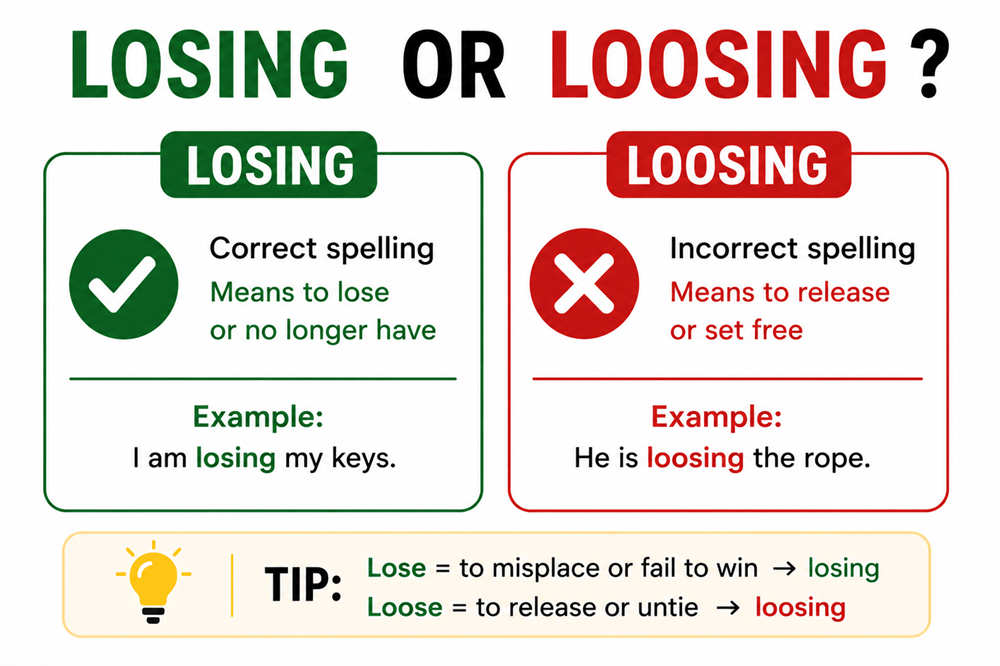
Losing or Loosing: Correct Spelling, Meaning, Difference, and Examples for Better Writing
Losing and loosing are both real words, but they mean very different things. Use losing when you mean failing to win, misplacing something, becoming less successful, or no longer having something. Use loosing only when you mean releasing, untying, or setting something free. In everyday writing, the word most people need is usually losing.
Quick Answer
Use losing when something is being lost.
- Correct: The team is losing the game.
- Correct: I keep losing my keys.
- Correct: She is losing patience.
- Correct: He is losing weight.
Use loosing only when something is being loosened, released, or set free.
- Correct: The archer was loosing arrows into the target.
- Correct: The sailor was loosing the ropes from the dock.
- Correct: The trainer was loosing the horses into the field.
The simple rule is this: losing means failing to keep, win, or hold something. Loosing means releasing or setting something loose.
Losing or Loosing: What Is the Difference?
The difference between losing and loosing is meaning and pronunciation. Losing comes from the verb lose. It means to misplace something, fail to win, no longer have something, or become less successful.
Loosing comes from the verb loose. It means to release, free, untie, or let something go. This word is much less common in modern everyday English.
| Word | Base Verb | Meaning | Example |
|---|---|---|---|
| Losing | Lose | Failing to keep, win, or have something | She is losing her phone again. |
| Loosing | Loose | Releasing, freeing, or untying something | He is loosing the rope. |
Most confusion happens because lose and loose look similar. But they are not pronounced the same. Lose rhymes with choose. Loose rhymes with goose. Their -ing forms follow the same difference: losing has a “z” sound, while loosing has an “s” sound.
What Does Losing Mean?
Losing is the present participle of lose. It describes the action of no longer having something, failing to win, becoming less strong, or not being able to keep something.
Examples:
- He is losing his wallet again.
- The team is losing by ten points.
- She is losing interest in the project.
- The company is losing money each month.
In these sentences, losing means something is being lost. It may be a physical object, a competition, a feeling, a chance, control, money, time, or confidence.
Losing is common in everyday English because people lose many different kinds of things. You can lose your keys, lose a game, lose hope, lose sleep, lose your temper, lose weight, lose money, or lose your place in a book.
What Does Loosing Mean?
Loosing is the present participle of loose as a verb. It means releasing, unfastening, freeing, or letting something go. This use is real, but it is far less common than losing.
Examples:
- The archer was loosing arrows toward the target.
- The worker was loosing the chains from the gate.
- The farmer was loosing the animals into the pasture.
- The sailor was loosing the boat from the dock.
In these sentences, loosing means setting something free or releasing it from restraint. The word often sounds formal, old-fashioned, or literary. In ordinary speech, many people would use releasing, freeing, untieing, or letting loose instead.
Because loosing is rare, it is usually not the word you want unless your sentence clearly involves releasing something.
Why Losing Is Usually the Correct Word
Losing is usually correct because most everyday sentences are about losing something, not releasing something. When people write loosing, they often mean losing.
Incorrect:
- I am loosing my mind.
- The team is loosing the match.
- She keeps loosing her phone.
- He is loosing weight.
Correct:
- I am losing my mind.
- The team is losing the match.
- She keeps losing her phone.
- He is losing weight.
In each sentence, nothing is being released or untied. Something is being lost, so the correct word is losing.
When to Use Losing
Use losing when someone or something is no longer keeping, holding, winning, or having something.
Use losing for misplaced objects:
- I keep losing my glasses.
- She is always losing her keys.
- He hates losing important documents.
Use losing for games and competitions:
- The team is losing badly.
- No one likes losing a close match.
- They were losing until the final minute.
Use losing for emotions, qualities, or control:
- She is losing patience.
- He is losing confidence.
- The driver was losing control of the car.
Use losing for body weight, money, time, or progress:
- He is losing weight slowly.
- The business is losing money.
- We are losing time.
- The project is losing momentum.
If the sentence means “something is going away,” losing is usually the correct spelling.
When to Use Loosing
Use loosing only when the sentence means releasing, freeing, unfastening, or setting something loose. This word is not common in everyday writing, but it is still correct in the right context.
Examples:
- The handler was loosing the dog from its leash.
- The archer was loosing arrows one after another.
- The crew was loosing the ropes before the ship departed.
- The farmer was loosing the cattle into the open field.
Even in these examples, some writers may prefer simpler alternatives:
- The handler was releasing the dog from its leash.
- The archer was shooting arrows one after another.
- The crew was untying the ropes before the ship departed.
- The farmer was letting the cattle into the open field.
Because loosing can confuse readers, use it only when it is clearly the best word for the meaning.
Losing Weight or Loosing Weight?
The correct phrase is losing weight.
Correct:
- He is losing weight after changing his diet.
- She started losing weight slowly and safely.
- The doctor asked whether he was losing weight unexpectedly.
Incorrect:
- He is loosing weight after changing his diet.
- She started loosing weight slowly and safely.
- The doctor asked whether he was loosing weight unexpectedly.
Losing weight means body weight is decreasing. Since nothing is being released or untied, loosing is wrong here.
Losing My Mind or Loosing My Mind?
The correct phrase is losing my mind.
Correct:
- I feel like I am losing my mind.
- She thought she was losing her mind from stress.
- He was losing his mind trying to solve the problem.
Incorrect:
- I feel like I am loosing my mind.
- She thought she was loosing her mind from stress.
- He was loosing his mind trying to solve the problem.
Losing your mind is an idiom. It means feeling overwhelmed, confused, extremely stressed, or mentally out of control. The correct spelling is always losing.
Losing Interest or Loosing Interest?
The correct phrase is losing interest.
Correct:
- She is losing interest in the show.
- The audience started losing interest halfway through.
- He is losing interest in the hobby he once loved.
Incorrect:
- She is loosing interest in the show.
- The audience started loosing interest halfway through.
- He is loosing interest in the hobby he once loved.
Losing interest means interest is fading or going away. That meaning belongs to lose, so the correct form is losing.
Losing Game or Loosing Game?
The correct phrase is usually losing game, depending on the sentence.
Correct:
- The team was losing the game.
- They played a losing game from the beginning.
- It felt like a losing game after the first quarter.
Incorrect:
- The team was loosing the game.
- They played a loosing game from the beginning.
- It felt like a loosing game after the first quarter.
If the meaning is about not winning, the correct word is losing. Loosing would only fit if something were being released, which is not the meaning in a game or competition.
Lose, Loose, Losing, and Loosing
The confusion between losing and loosing usually starts with lose and loose. These words are related only by appearance. They have different meanings and sounds.
| Word | Part of Speech | Meaning | Example |
|---|---|---|---|
| Lose | Verb | To misplace, fail to win, or no longer have | Do not lose your ticket. |
| Losing | Verb form | In the process of losing | He is losing his ticket. |
| Loose | Adjective or verb | Not tight; or to release | The rope is loose. |
| Loosing | Verb form | In the process of releasing | He is loosing the rope. |
Lose has one o and a “z” sound. Loose has two os and an “s” sound. When you add -ing, the spelling difference remains.
Common Mistakes With Losing and Loosing
The most common mistake is writing loosing when the sentence needs losing. This happens because loose is a familiar word, and the extra o can look tempting.
Incorrect:
- I am loosing sleep over this problem.
- She is loosing her voice.
- The company is loosing customers.
- They are loosing the election.
Correct:
- I am losing sleep over this problem.
- She is losing her voice.
- The company is losing customers.
- They are losing the election.
Another mistake is using loosing because the sentence includes something that is becoming less tight. If something is becoming less tight, the more common word is usually loosening, not loosing.
- Correct: The screw is loosening.
- Correct: The knot is loosening.
- Awkward: The knot is loosing.
Loosening means becoming or making something less tight. Loosing means releasing or setting free.
Examples of Losing in Sentences
Here are examples of losing used correctly:
- She is losing her patience with the delay.
- The team is losing the championship game.
- I keep losing my place while reading.
- He is losing money on the investment.
- The old photo is losing its color.
- They are losing customers because of poor service.
- She is losing confidence after several setbacks.
- We are losing daylight, so we should leave soon.
In each sentence, losing means something is being lost, reduced, misplaced, or no longer kept.
Examples of Loosing in Sentences
Here are examples of loosing used correctly in its less common meaning:
- The archer was loosing arrows at the target.
- The sailor was loosing the rope from the post.
- The guards were loosing the prisoners from their chains.
- The farmer was loosing the animals into the pasture.
These sentences are correct because they involve releasing or setting something free. Still, many modern writers would choose simpler words like releasing, freeing, or untying.
How to Remember Losing or Loosing
A simple way to remember the difference is this:
- Losing comes from lose.
- Loosing comes from loose.
- If something is lost, use losing.
- If something is set loose, use loosing.
You can also remember the sound:
- Losing sounds like “loo-zing.”
- Loosing sounds like “loo-sing.”
Another helpful phrase is:
If you lose it, you are losing it.
That reminder covers most everyday uses. You are losing a game, losing time, losing money, losing your keys, losing hope, losing sleep, and losing weight. You are almost never loosing those things.
Final Answer
Losing is the correct word when you mean failing to win, misplacing something, no longer having something, or becoming less successful. Use it in phrases like losing weight, losing my mind, losing interest, losing money, and losing the game.
Loosing is a much rarer word that means releasing, freeing, or setting something loose. The easiest rule is simple: if something is being lost, use losing. If something is being released, use loosing. In most everyday writing, losing is the word you need.