What Is the Plural of Radius? Radii or Radiuses Explained
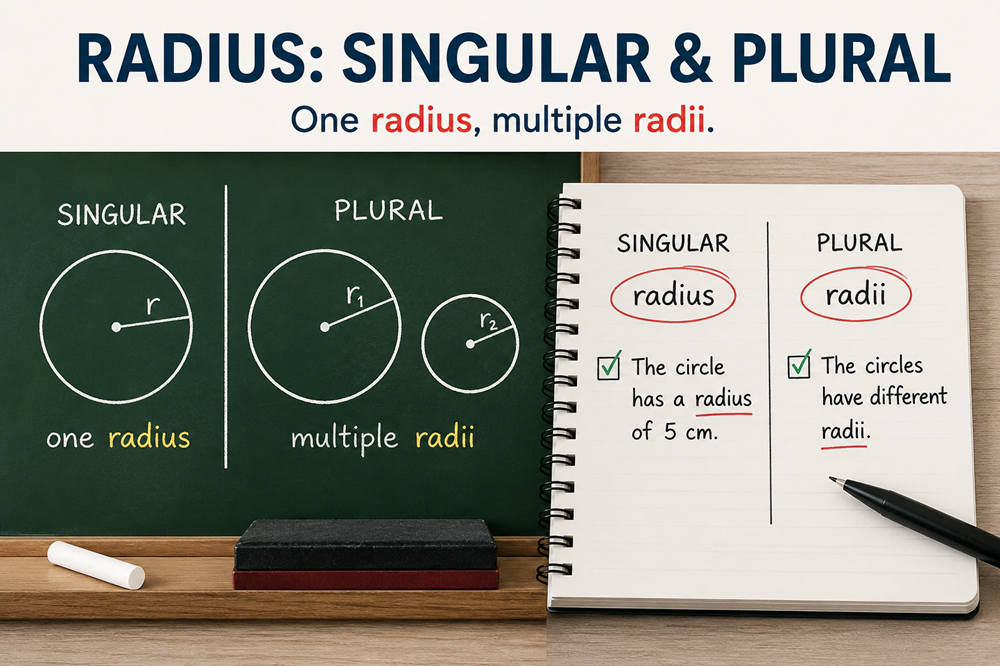
The usual plural of radius is radii. For example, one circle has a radius, while two circles have radii.
Radiuses is also a correct plural, but it is much less common. In mathematics, science, medicine, engineering, and most other writing, radii is the better choice.
What Is the Plural of Radius?
The singular and plural forms of radius are:
| Form | Word | Example |
|---|---|---|
| Singular | Radius | The circle has a radius of five inches. |
| Standard plural | Radii | The circles have different radii. |
| Alternative plural | Radiuses | The circles have different radiuses. |
Both plural forms are accepted, but radii is the form most readers expect to see.
Radii or Radiuses: Which Is Correct?
Both radii and radiuses are grammatically correct. However, they are not equally common.
Radii is the traditional plural and is widely used in technical and educational contexts:
- The radii of the two circles are equal.
- Scientists calculated the radii of the planets.
- The doctor examined the radii in both forearms.
Radiuses follows the regular English pattern of adding -es to a word ending in -s:
- The designer tested several corner radiuses.
- The map shows circles with different radiuses.
These examples are correct, but many readers will find radii more familiar. Merriam-Webster lists both plural forms, so using radiuses is not a grammatical mistake.
For school assignments, professional documents, and technical subjects, choose radii.
Why Does Radius Become Radii?
Radius came into English from Latin. The Latin word could refer to a rod, the spoke of a wheel, or a ray of light. It later became the mathematical term for a line from the center of a circle to its edge.
The classical Latin plural was radii, and English kept that form. The history of the word radius explains why its plural does not follow the pattern used by most English nouns.
English speakers also formed radiuses by adding the usual -es ending. This gave the word two accepted plurals.
Not every noun ending in -us changes to -i. For example:
- The plural of virus is viruses.
- The plural of bus is buses.
- The plural of campus is campuses.
It is therefore best to learn the plural of each -us word individually.
How to Pronounce Radii
Radii is pronounced roughly RAY-dee-eye. The final i sounds like the word eye.
- Radius: RAY-dee-us
- Radii: RAY-dee-eye
- Radiuses: RAY-dee-us-iz
You can remember the pronunciation of radii by dividing it into three sounds: ray + dee + eye.
Radius and Radii in Example Sentences
Radius has several meanings, but radii can be used as its plural in each case.
Geometry
- The circle has a radius of six centimeters.
- The radii of the two circles are equal.
- Measure the radii before calculating the areas.
- Larger circles usually have longer radii.
Distance and Coverage
A radius can also describe the distance extending outward from a central point.
- The restaurant delivers within a five-mile radius.
- The delivery areas have different radii.
- The map shows the radii of the two coverage zones.
- Several schools are located within a ten-mile radius.
Anatomy
The radius is one of the two long bones in the forearm. It is on the same side as the thumb.
- The X-ray showed a fracture in the radius.
- The doctor compared the radii in both arms.
- Neither of the patient’s radii showed signs of injury.
Radius, Radii, and Radiuses at a Glance
Use radius when referring to one measurement, area, or forearm bone. Use radii when referring to more than one.
Radiuses is also accepted, but it is less common. In most school, professional, scientific, mathematical, and medical writing, radii is the clearest choice.