Dieing or Dying: Correct Spelling, Meaning, Usage, and Simple Examples Explained Clearly
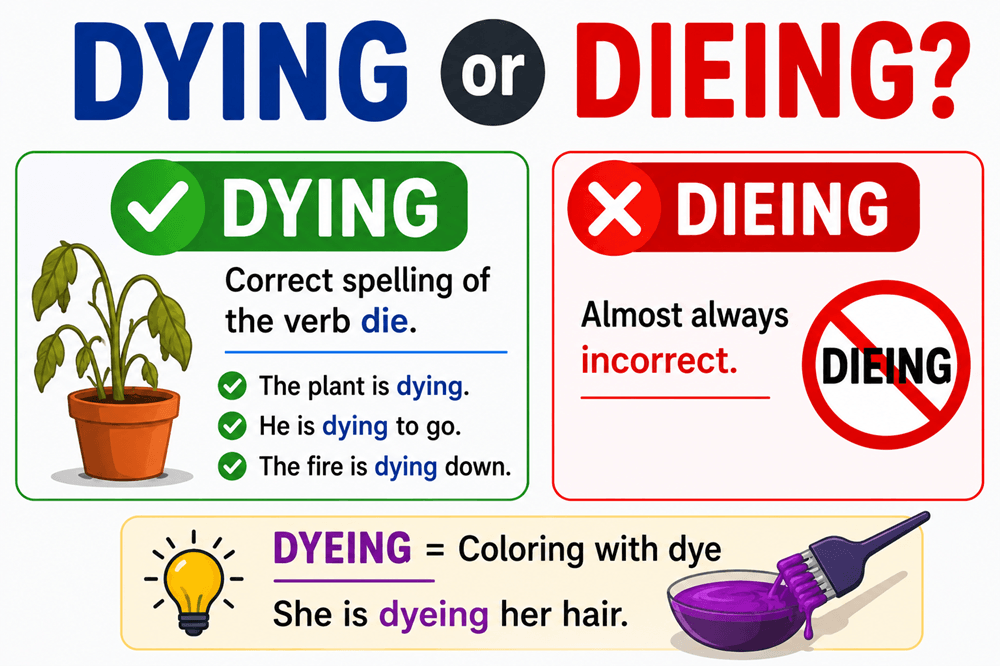
The correct spelling is usually dying. Use dying when you mean approaching death, stopping, fading away, or strongly wanting something. Dieing is almost never the word you need in everyday writing. If you mean coloring fabric, hair, or material, the correct word is dyeing, not dying or dieing.
Quick Answer
Use dying when talking about death, fading, ending, or wanting something badly.
- Correct: The plant is dying.
- Correct: She is dying to hear the news.
- Correct: The old tradition is slowly dying out.
Do not use dieing for the normal present participle of die.
- Incorrect: The plant is dieing.
- Incorrect: He is dieing to go home.
The simple rule is: die becomes dying, not dieing.
Dieing or Dying: Which One Is Correct?
Dying is the correct spelling for the common verb form of die. It is used when something is losing life, coming to an end, disappearing, or becoming weaker.
Dieing looks logical because many verbs simply add -ing. For example, play becomes playing, and work becomes working. But die is different. When you add -ing, the spelling changes from die to dying.
| Word | Correct? | Meaning |
|---|---|---|
| Dying | Yes | Losing life, ending, fading, or strongly wanting something |
| Dieing | Usually no | A rare technical form, but not correct for death or fading |
| Dyeing | Yes | Coloring fabric, hair, or material with dye |
For everyday writing, the answer is easy: use dying when you mean the -ing form of die.
What Does Dying Mean?
Dying is the present participle of die. It can describe something that is losing life, close to death, ending, disappearing, or becoming weak.
Examples:
- The flowers are dying because they need water.
- The old tree is slowly dying.
- Many small traditions are dying out.
- The fire was dying down by midnight.
- His phone battery is dying.
In these examples, dying does not always mean literal death. A phone battery can be dying, a fire can be dying down, and an old custom can be dying out. The word often means that something is weakening, ending, or disappearing.
Why Dieing Is Usually Incorrect
Dieing is usually incorrect because the verb die changes spelling before -ing. Instead of keeping the ie, English changes ie to y.
That is why:
- die becomes dying
- lie becomes lying
- tie becomes tying
This pattern helps make the word easier to read and pronounce. So even though dieing may seem like it should be correct, the standard spelling is dying.
Is Dieing Ever a Word?
Dieing can appear as a rare technical word connected to the noun die, meaning a tool used for cutting, stamping, shaping, or forming material. In that narrow industrial sense, dieing may refer to working with a die.
However, this use is uncommon. Most writers never need it. If you are writing about a person, animal, plant, battery, fire, trend, habit, hope, feeling, or tradition coming to an end, the spelling is dying.
For normal writing, avoid dieing. It will usually look like a mistake.
Dying vs Dyeing
Dying and dyeing sound the same, but they mean different things.
Dying comes from die. It means losing life, ending, fading, or strongly wanting something.
- The plant is dying.
- She is dying to know the answer.
Dyeing comes from dye. It means coloring something with dye.
- She is dyeing her hair red.
- The company is dyeing the fabric blue.
This distinction matters because a sentence can change completely if you use the wrong word.
| Word | Comes From | Example |
|---|---|---|
| Dying | Die | The roses are dying. |
| Dyeing | Dye | She is dyeing the roses blue. |
Examples of Dying in Sentences
Here are natural examples of dying used correctly:
- The candle flame was dying in the wind.
- My laptop battery is dying.
- The patient was seriously ill but not dying.
- She watered the dying plant.
- The old language is slowly dying out.
- He is dying to tell you what happened.
- The laughter was dying down when the teacher entered.
- The town’s main street felt quiet, but not dying.
These examples show that dying can be literal or figurative. It can describe actual death, loss of power, fading energy, disappearing customs, or strong desire.
Examples of Dyeing in Sentences
Use dyeing when the sentence is about adding color with dye.
- She is dyeing her hair black.
- They are dyeing the shirts for the event.
- The artist enjoys dyeing fabric by hand.
- He ruined the towel while dyeing his jeans.
- The company specializes in dyeing leather.
If color is involved, check whether you need dyeing. If death, fading, ending, or strong desire is involved, use dying.
Dying to Do Something
The phrase dying to means strongly wanting to do something. It does not usually mean literal death.
Examples:
- I am dying to see that movie.
- She is dying to know the secret.
- They were dying to go on vacation.
- He is dying to try the new restaurant.
This expression is informal and common in everyday English. Do not spell it dieing to. The correct phrase is always dying to.
Dying Out and Dying Down
Dying out means gradually disappearing or becoming extinct.
- Some old customs are dying out.
- The species is dying out because its habitat is shrinking.
Dying down means becoming weaker, quieter, or less intense.
- The noise began dying down after midnight.
- The wind was finally dying down.
Both phrases use dying, not dieing.
Common Mistakes to Avoid
The most common mistake is writing dieing when you mean dying.
Incorrect:
- The flowers are dieing.
- My phone is dieing.
- He is dieing to hear the news.
Correct:
- The flowers are dying.
- My phone is dying.
- He is dying to hear the news.
Another mistake is using dying when you mean dyeing.
Incorrect:
- She is dying her hair purple.
Correct:
- She is dyeing her hair purple.
The difference is simple: dying is about death or ending. Dyeing is about color.
How to Remember Dying
Here is an easy way to remember the correct spelling:
Die changes to dying.
When a verb ends in ie, the ie often changes to y before -ing.
- die → dying
- lie → lying
- tie → tying
You can also remember this sentence:
If something may die, it is dying.
Final Answer
Dying is the correct spelling when you mean losing life, fading, ending, weakening, or strongly wanting something. Dieing is almost never correct in everyday writing and should not be used for the present participle of die. If you mean adding color to hair, fabric, or material, use dyeing. Remember: die becomes dying.