Judgement or Judgment: Correct Spelling, Meaning, Regional Usage, and Examples Explained
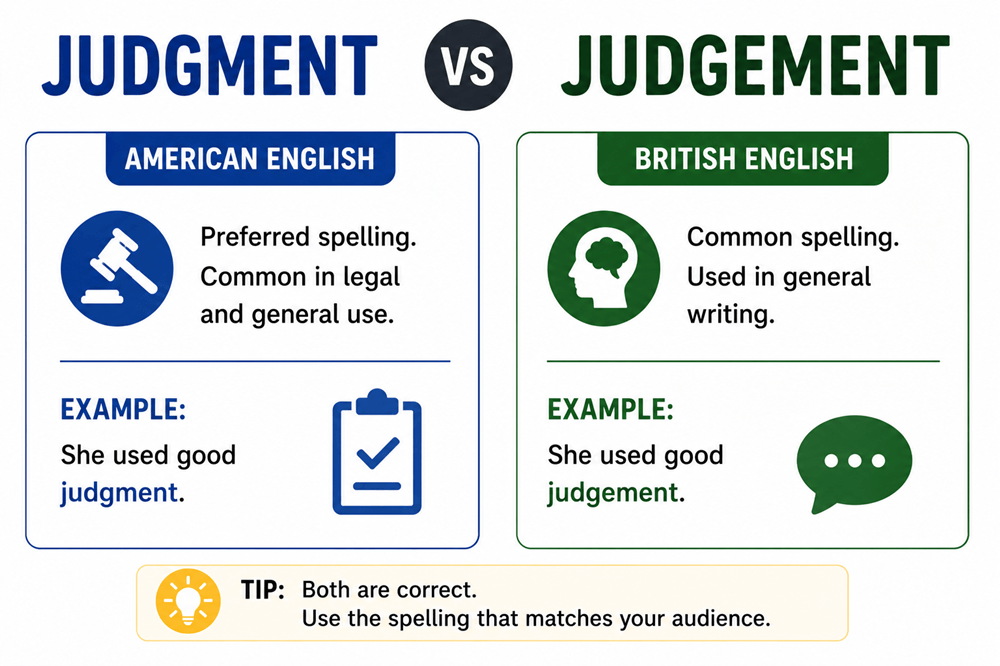
Judgment and judgement are both used in English, but judgment is the preferred spelling in American English. Judgement is common in British English for general writing, though judgment is often used in legal contexts. Both words mean the ability to make decisions, an opinion, or an official decision made by a court.
Quick Answer
Use judgment in American English.
- She showed good judgment under pressure.
- The court issued its final judgment.
- His judgment improved with experience.
Use judgement in British English for general, non-legal writing if that is the spelling style you follow.
- She showed good judgement under pressure.
- In my judgement, the plan needs more work.
- He made an error of judgement.
The simple rule is: judgment is standard in American English, while judgement is common in British general English.
Judgement or Judgment: What Is the Difference?
The difference between judgement and judgment is mostly spelling and regional preference. The meaning is usually the same.
Judgment is the shorter spelling, without the extra e after g. It is the normal spelling in American English and is also common in legal writing.
Judgement keeps the e from the word judge. It is widely used in British English, especially when the word means opinion, wisdom, decision-making ability, or personal assessment.
| Spelling | Where It Is Common | Best Use |
|---|---|---|
| Judgment | American English | General writing, legal writing, formal writing |
| Judgement | British English | General writing, personal opinion, decision-making |
If you are writing for American readers, choose judgment. If you are writing for British readers, judgement is often acceptable in everyday writing, but judgment may still be preferred in legal contexts.
What Does Judgment Mean?
Judgment can mean the ability to make sensible decisions. It can also mean an opinion, conclusion, or official court decision.
Examples:
- She used good judgment when handling the problem.
- His judgment was affected by stress.
- The manager trusted her team’s judgment.
- The judge delivered the judgment on Monday.
- In my judgment, the offer is fair.
In American English, judgment is the standard spelling for all of these meanings. It works for personal decisions, opinions, moral choices, legal decisions, business writing, and everyday communication.
What Does Judgement Mean?
Judgement has the same basic meaning as judgment. It can refer to decision-making ability, an opinion, a conclusion, or a formal decision.
Examples:
- She showed poor judgement in that situation.
- It was an error of judgement.
- In my judgement, the evidence is not strong enough.
- He questioned her judgement.
- Good judgement comes with experience.
This spelling is especially common in British English when the word is used in a general sense. It may look unusual to American readers, but it is not automatically wrong.
Is Judgment Correct?
Yes, judgment is correct. It is the preferred spelling in American English and a strong choice for formal writing.
Use judgment in sentences like these:
- The company relied on her judgment.
- The final judgment changed the outcome of the case.
- He made a quick judgment based on limited information.
- Parents often have to use careful judgment.
If you want one spelling that will look natural to American readers and acceptable in many formal settings, judgment is the safest choice.
Is Judgement Correct?
Yes, judgement can be correct, especially in British English. It is not simply a misspelling in all contexts.
Use judgement when your writing follows British spelling and the context is general rather than strictly legal.
- He made a serious error of judgement.
- Her judgement was usually reliable.
- In my judgement, the decision was unfair.
However, if you are writing for an American audience, judgement may look like a spelling mistake. In that case, use judgment.
Judgment in Legal Writing
In legal writing, judgment is often the preferred spelling, especially in American English. It refers to an official decision made by a court.
Examples:
- The court entered a judgment against the defendant.
- The judge issued a written judgment.
- The lawyer appealed the judgment.
- The final judgment was published last week.
If you are writing about courts, lawsuits, legal decisions, or official rulings, judgment is usually the safer spelling. This is especially true in American legal writing.
Judgement in General British English
In British English, judgement often appears when the word means personal opinion, wisdom, decision-making ability, or assessment.
Examples:
- She trusted his judgement.
- The mistake showed poor judgement.
- It is a matter of personal judgement.
- The teacher used her professional judgement.
This spelling fits naturally beside other British spelling patterns. Still, if you are writing for a specific publication, school, company, or legal setting, follow the style guide they use.
Judgment and Judgement in Everyday Meaning
Both spellings can refer to the ability to think clearly and make sensible choices. This meaning appears often in personal, professional, and moral contexts.
American English:
- Good judgment helped her avoid a bigger problem.
- He made the decision without using much judgment.
British English:
- Good judgement helped her avoid a bigger problem.
- He made the decision without using much judgement.
The meaning is the same. The spelling simply changes based on the English style.
Judgment and Judgement as an Opinion
The word can also mean an opinion or conclusion after thinking about something.
Examples:
- In my judgment, the plan is too risky.
- In my judgement, the plan is too risky.
- Do not rush to judgment before hearing the facts.
- Do not rush to judgement before hearing the facts.
Again, both spellings can express the same idea. The best choice depends on the spelling style you are using.
Examples of Judgment in Sentences
Here are natural examples of judgment used correctly:
- She showed excellent judgment during the emergency.
- The court’s judgment was final.
- He trusted his own judgment.
- The teacher used professional judgment when grading the project.
- Do not let anger cloud your judgment.
- The manager questioned his judgment.
- The final judgment ended the dispute.
These examples are especially natural in American English and formal contexts.
Examples of Judgement in Sentences
Here are natural examples of judgement used correctly in British-style writing:
- She showed excellent judgement during the emergency.
- He trusted his own judgement.
- The decision was a matter of professional judgement.
- Do not let anger cloud your judgement.
- It was a simple error of judgement.
- In her judgement, the plan needed more detail.
These examples are common in British general writing, especially when the word refers to wisdom, opinion, or decision-making.
Common Mistakes to Avoid
The biggest mistake is assuming one spelling is always wrong. Judgment and judgement both exist, but they are not equally common everywhere.
Use judgment for American English:
- Correct: Her judgment was sound.
Avoid judgement in American writing unless you have a specific reason to use British spelling:
- Less natural in American English: Her judgement was sound.
Another mistake is mixing both spellings in the same article without a reason.
Inconsistent:
- The court issued a judgment, but his personal judgement was questioned.
Better in American English:
- The court issued a judgment, but his personal judgment was questioned.
Better in British general English:
- His personal judgement was questioned after the decision.
Choose one spelling style and use it consistently unless you are following a legal style or quoting an official title.
How to Remember Judgment or Judgement
Here is an easy way to remember the difference:
Judgment drops the extra e. This is the standard American spelling.
Judgement keeps the e. This is common in British general writing.
- Judgment = American English and legal writing
- Judgement = British general English
If you are unsure, use judgment. It is widely accepted, especially in American, formal, and legal contexts.
Final Answer
Judgment and judgement are both used in English. Judgment is the preferred spelling in American English and is common in legal writing. Judgement is common in British English for general writing. Both words can mean decision-making ability, an opinion, or a formal decision. Choose the spelling that matches your audience, region, and style guide.