Whisky or Whiskey: Correct Spelling, Regional Difference, Usage, and Examples Explained Clearly
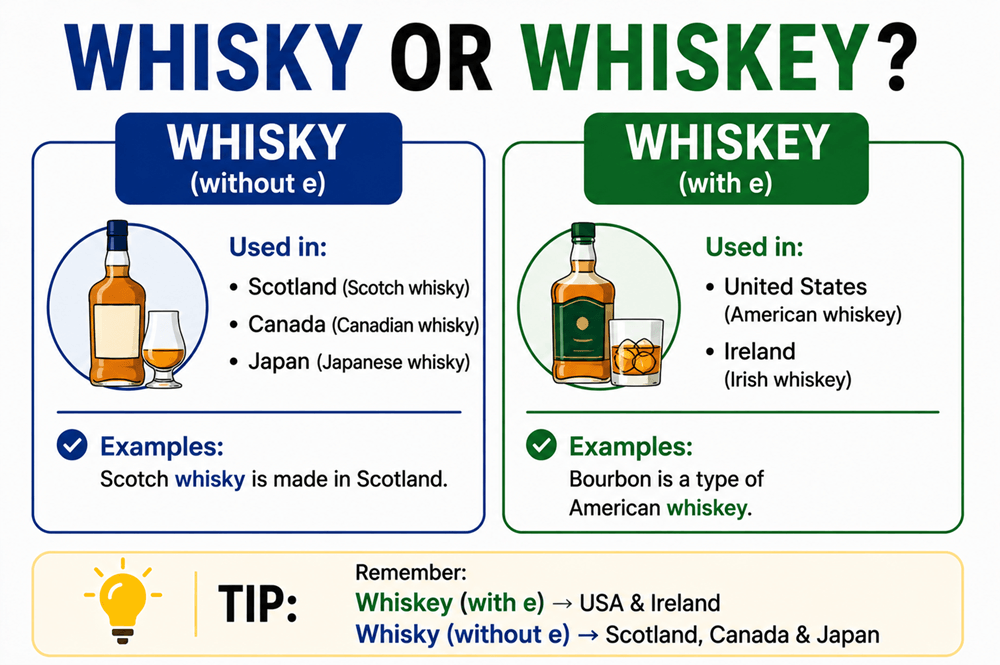
Whisky and whiskey are both correct spellings, but they are used in different regions and traditions. Use whiskey when talking about American or Irish whiskey. Use whisky when talking about Scotch, Canadian, or Japanese whisky. The easiest rule is this: whiskey usually has an e in the United States and Ireland, while whisky usually has no e in Scotland, Canada, and Japan.
Quick Answer
Use whiskey with an e for American and Irish styles.
- Correct: Bourbon is a type of American whiskey.
- Correct: Irish whiskey is often known for its smooth taste.
- Correct: He ordered a whiskey at the bar.
Use whisky without an e for Scotch, Canadian, and Japanese styles.
- Correct: Scotch whisky is made in Scotland.
- Correct: Canadian whisky is often blended.
- Correct: Japanese whisky has become popular around the world.
The simple rule is this: whiskey is common in the United States and Ireland. Whisky is common in Scotland, Canada, Japan, and many international whisky traditions.
Whisky or Whiskey: What Is the Difference?
The difference between whisky and whiskey is spelling, not the basic meaning. Both words refer to a distilled alcoholic drink usually made from grain, aged in barrels, and produced in different styles around the world. The spelling changes depending on region, tradition, label style, and sometimes the producer’s preference.
Whiskey with an e is the usual spelling in American English when speaking generally. It is also the standard spelling for Irish whiskey. That is why you usually see phrases like American whiskey, bourbon whiskey, rye whiskey, and Irish whiskey.
Whisky without an e is the usual spelling for Scotch whisky, Canadian whisky, and Japanese whisky. If the bottle is from Scotland, Canada, or Japan, whisky is usually the correct spelling.
| Spelling | Common Use | Example |
|---|---|---|
| Whiskey | United States and Ireland | Irish whiskey is spelled with an e. |
| Whisky | Scotland, Canada, Japan | Scotch whisky is spelled without an e. |
If you are not sure which spelling to use, check the country, category, or bottle label. The correct spelling often follows the tradition of the place where the drink is made.
What Does Whiskey Mean?
Whiskey is the spelling commonly used in the United States and Ireland. It refers to a spirit made from fermented grain mash and aged in wooden barrels. Different grains may be used, including corn, rye, barley, and wheat.
Examples:
- Bourbon is an American whiskey made mainly from corn.
- Rye whiskey has a spicier flavor than many other styles.
- Irish whiskey is usually spelled with an e.
- The bartender recommended a whiskey cocktail.
In American writing, whiskey is usually the default spelling when talking about the drink in general. If someone says “I like whiskey,” many American readers will expect the spelling with an e.
Whiskey is also used in common phrases such as:
- whiskey sour
- whiskey glass
- whiskey barrel
- whiskey distillery
- American whiskey
- Irish whiskey
For a U.S.-focused website, whiskey is usually the best spelling when speaking generally, unless you are referring specifically to Scotch, Canadian, or Japanese whisky.
What Does Whisky Mean?
Whisky means the same basic drink as whiskey, but the spelling without the e is used in several major whisky-producing traditions. It is especially associated with Scotland, Canada, and Japan.
Examples:
- Scotch whisky must be made in Scotland.
- Canadian whisky is often lighter and smoother in style.
- Japanese whisky is admired for its careful blending and balance.
- The bottle was labeled as single malt Scotch whisky.
The most familiar phrase with this spelling is Scotch whisky. Writing Scotch whiskey is usually considered incorrect because Scotch follows the Scottish spelling: whisky, without the e.
Whisky also appears in phrases such as:
- Scotch whisky
- single malt whisky
- blended whisky
- Canadian whisky
- Japanese whisky
- whisky distillery
If the drink is from a country or tradition that uses the no-e spelling, use whisky.
Is Whisky Wrong?
Whisky is not wrong. It is the correct spelling in many important whisky traditions. It is the standard spelling for Scotch whisky, Canadian whisky, and Japanese whisky. It is also used by many international writers and brands.
However, whisky may look unusual to some American readers if you are talking about American whiskey in a general way.
Compare these examples:
- Correct: Scotch whisky is made in Scotland.
- Correct: Canadian whisky is often blended.
- Less expected in U.S. writing: He ordered a whisky at the bar.
- More expected in U.S. writing: He ordered a whiskey at the bar.
The spelling depends on context. If you mean Scotch, Canadian, or Japanese styles, whisky is correct. If you mean American or Irish styles, whiskey is usually correct.
Is Whiskey Wrong?
Whiskey is not wrong. It is the normal spelling in American and Irish usage. You should use it for American whiskey, Irish whiskey, bourbon whiskey, Tennessee whiskey, and rye whiskey.
Examples:
- Jack Daniel’s is commonly described as Tennessee whiskey.
- Bourbon whiskey is strongly associated with Kentucky.
- Irish whiskey has a long history in Ireland.
- Rye whiskey is made with a high percentage of rye grain.
However, whiskey is not usually the right spelling for Scotch. You should write Scotch whisky, not Scotch whiskey, when referring to the Scottish product.
- Correct: Scotch whisky
- Usually incorrect: Scotch whiskey
When in doubt, follow the spelling used by the country or product category.
When to Use Whiskey
Use whiskey when you are talking about American or Irish whiskey. This is the spelling most American readers expect in general writing.
Examples:
- She bought a bottle of Irish whiskey.
- The recipe calls for a splash of whiskey.
- Bourbon whiskey must meet specific production rules.
- The bar serves several kinds of American whiskey.
Use whiskey in phrases such as:
- Irish whiskey
- American whiskey
- bourbon whiskey
- Tennessee whiskey
- rye whiskey
- whiskey sour
For general U.S. writing, whiskey is usually the safest default. That means a sentence like “He enjoys whiskey” should usually use the e spelling if the audience is American.
When to Use Whisky
Use whisky when you are talking about Scotch, Canadian, or Japanese whisky. This spelling follows the traditions of those regions.
Examples:
- He prefers Scotch whisky from Islay.
- The shop carries Canadian whisky and Japanese whisky.
- Single malt whisky is often associated with Scotland.
- The distillery produces blended whisky.
Use whisky in phrases such as:
- Scotch whisky
- single malt whisky
- blended Scotch whisky
- Canadian whisky
- Japanese whisky
Even in American writing, you should keep whisky when the category requires it. A U.S. writer may write whiskey in general, but still write Scotch whisky when referring to Scotch.
Whiskey or Whisky in American English?
In American English, the general spelling is usually whiskey. If someone is writing about the drink in a broad way, whiskey with an e is normally preferred.
Examples:
- He ordered a whiskey after dinner.
- The store sells several kinds of whiskey.
- The cocktail includes lemon juice, sugar, and whiskey.
However, American writers should still use whisky for specific international categories that use that spelling.
- Correct: She bought Scotch whisky.
- Correct: He compared Japanese whisky with American whiskey.
- Correct: The tasting included Canadian whisky and Irish whiskey.
In other words, American English uses whiskey as the general default, but category names can override that default.
Whiskey or Whisky in British English?
In British English, whisky is common, especially when talking about Scotch whisky. However, British writers may still use whiskey when referring specifically to Irish or American whiskey.
Examples:
- He prefers Scotch whisky.
- The shop sells Irish whiskey.
- The article compares American whiskey with Scotch whisky.
This shows an important point: the spelling is not only about the writer’s country. It is also about the drink’s origin. A British writer may use both spellings in the same article if discussing different types.
Whiskies or Whiskeys?
The plural form depends on the spelling you use. If the singular is whisky, the plural is usually whiskies. If the singular is whiskey, the plural is usually whiskeys.
| Singular | Plural | Example |
|---|---|---|
| whisky | whiskies | The shop sells many Scotch whiskies. |
| whiskey | whiskeys | The bar offers several Irish whiskeys. |
Examples:
- They tasted three Scotch whiskies.
- The menu listed several American whiskeys.
- The article compared Japanese whiskies and Irish whiskeys.
If you are writing about multiple bottles or types from different traditions, you may need both plural forms in the same piece.
Common Mistakes With Whisky and Whiskey
The most common mistake is assuming that only one spelling is correct everywhere. Both spellings are correct, but the best choice depends on region and style.
Another common mistake is writing Scotch whiskey. Since Scotch uses the Scottish spelling, the correct phrase is usually Scotch whisky.
Incorrect:
- He ordered a Scotch whiskey.
- The article discussed Scottish whiskey.
Correct:
- He ordered a Scotch whisky.
- The article discussed Scottish whisky.
Another mistake is writing Irish whisky. Since Ireland usually uses the spelling with an e, the standard phrase is Irish whiskey.
Incorrect:
- She bought Irish whisky.
Correct:
- She bought Irish whiskey.
A final mistake is being inconsistent when writing about one category. If you are writing about bourbon, use whiskey consistently. If you are writing about Scotch, use whisky consistently.
Examples of Whiskey in Sentences
Here are examples of whiskey used correctly:
- Bourbon is a type of American whiskey.
- Irish whiskey is often spelled with an e.
- She ordered a whiskey sour.
- The distillery makes rye whiskey.
- He poured a small glass of whiskey.
- The recipe uses whiskey, honey, and lemon.
- Tennessee whiskey has a distinctive style.
- The bar offers several American whiskeys.
In these sentences, whiskey fits American, Irish, or general U.S. usage.
Examples of Whisky in Sentences
Here are examples of whisky used correctly:
- Scotch whisky is made in Scotland.
- Japanese whisky has earned international attention.
- The bottle was labeled as Canadian whisky.
- Single malt whisky is usually associated with Scotland.
- The shop sells several rare Scotch whiskies.
- He compared Japanese whisky with Scotch whisky.
- The whisky was aged in oak barrels.
- She visited a whisky distillery during her trip.
In these sentences, whisky fits Scottish, Canadian, Japanese, or no-e traditions.
How to Remember Whisky or Whiskey
A simple way to remember the difference is this:
- Whiskey with e = United States and Ireland
- Whisky without e = Scotland, Canada, and Japan
One popular memory trick is to notice that United States and Ireland both have an e in their names, and they usually use whiskey with an e. Scotland, Canada, and Japan do not have an e, and they usually use whisky without one.
This trick is not a perfect linguistic rule, but it is easy to remember:
- United States → whiskey
- Ireland → whiskey
- Scotland → whisky
- Canada → whisky
- Japan → whisky
If you are writing generally for an American audience, use whiskey. If you are naming Scotch, Canadian, or Japanese styles, use whisky.
Final Answer
Whisky and whiskey are both correct spellings. Use whiskey with an e for American and Irish styles, including bourbon whiskey, rye whiskey, Tennessee whiskey, and Irish whiskey. Use whisky without an e for Scotch, Canadian, and Japanese styles.
The easiest rule is simple: whiskey is common in the United States and Ireland, while whisky is common in Scotland, Canada, and Japan. For a U.S.-focused website like WordBriefs, use whiskey as the general spelling, but keep whisky when referring to Scotch, Canadian, or Japanese whisky.