E.g. or I.e.: Difference, Correct Usage, Examples, Punctuation, and Memory Tips Explained
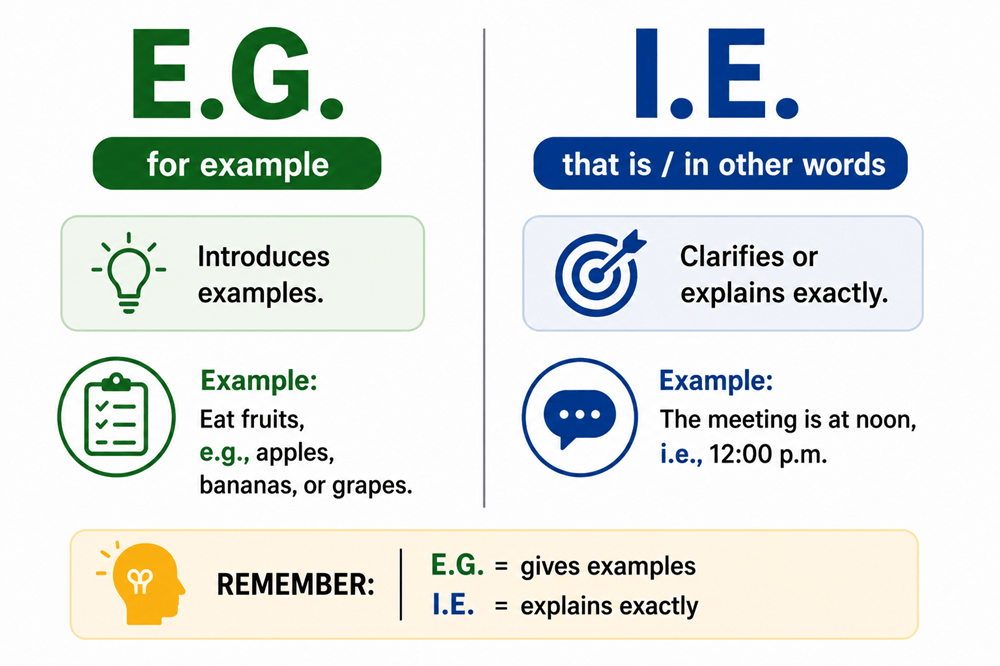
E.g. and i.e. are both Latin abbreviations, but they do not mean the same thing. E.g. means for example. Use it when you are giving one or more examples. I.e. means that is or in other words. Use it when you are clarifying, restating, or narrowing the meaning of something.
Quick Answer
Use e.g. when you mean for example.
- Bring a snack, e.g., fruit, crackers, or yogurt.
- She enjoys outdoor activities, e.g., hiking and kayaking.
- Choose a warm color, e.g., red, orange, or yellow.
Use i.e. when you mean that is or in other words.
- The meeting is at noon, i.e., 12:00 p.m.
- He is an only child, i.e., he has no siblings.
- The deadline is final, i.e., no late work will be accepted.
The simple rule is: e.g. gives examples; i.e. explains exactly what you mean.
E.g. or I.e.: What Is the Difference?
The difference between e.g. and i.e. is purpose. E.g. introduces examples, but it does not list every possible item. I.e. gives a clearer or more exact version of the idea.
| Abbreviation | Meaning | Use | Example |
|---|---|---|---|
| E.g. | For example | Introduces examples | Try a fruit, e.g., apples or pears. |
| I.e. | That is / in other words | Clarifies or restates | Try a pome fruit, i.e., apples or pears. |
If you are adding examples from a larger group, use e.g. If you are saying the same idea more clearly or specifically, use i.e.
What Does E.g. Mean?
E.g. comes from the Latin phrase exempli gratia, which means for example. You do not need to remember the Latin phrase to use it correctly. Just remember that e.g. points to examples.
Examples:
- You can use a simple greeting, e.g., “Hello” or “Good morning.”
- Some pets, e.g., cats and dogs, need regular vet care.
- Wear comfortable shoes, e.g., sneakers or walking sandals.
- Use a strong verb, e.g., “create,” “build,” or “solve.”
In each sentence, e.g. introduces examples. It does not mean the list is complete. If you write “snacks, e.g., fruit and crackers,” you are naming possible snacks, not saying fruit and crackers are the only snacks.
What Does I.e. Mean?
I.e. comes from the Latin phrase id est, which means that is. In everyday writing, you can think of i.e. as meaning in other words or to be exact.
Examples:
- The event is on the first weekday, i.e., Monday.
- She wants a single-color design, i.e., no patterns or gradients.
- The item is nonrefundable, i.e., you cannot return it for your money back.
- He works remotely, i.e., he does not go into an office.
In each sentence, i.e. gives a precise explanation. It does not introduce random examples. It narrows the meaning so the reader knows exactly what is meant.
Spelling and Punctuation: Should You Use Periods?
In American English, the standard forms are usually written with periods:
- e.g.
- i.e.
You may sometimes see eg and ie without periods, especially in casual writing, notes, charts, or British-influenced styles. However, for polished writing, e.g. and i.e. with periods look more standard and clear.
Because these abbreviations can look formal, many writers choose plain English instead:
- Instead of e.g., write for example.
- Instead of i.e., write that is or in other words.
For WordBriefs-style writing, plain English is often easier for readers. But if you do use the abbreviations, use them correctly.
Comma Rules With E.g. and I.e.
In American English, a comma usually comes after e.g. or i.e.
- Correct: Choose a citrus fruit, e.g., orange or lemon.
- Correct: Choose one citrus fruit, i.e., orange.
A comma often comes before the abbreviation too, especially when it appears in the middle of a sentence.
- Bring a writing tool, e.g., a pen or pencil.
- The answer must be exact, i.e., no rounding.
Some style guides allow different punctuation, but this comma pattern is safe for most everyday American writing.
When to Use E.g.
Use e.g. when the items after it are examples, not a full definition.
- Eat more leafy greens, e.g., spinach, kale, or lettuce.
- Try a calming activity, e.g., reading, walking, or stretching.
- Use a polite phrase, e.g., “please” or “thank you.”
A helpful test is to replace e.g. with for example. If the sentence still makes sense, e.g. is probably correct.
- Try a calming activity, for example, reading.
That works, so e.g. is right.
When to Use I.e.
Use i.e. when the words after it explain exactly what you mean.
- The package arrives tomorrow, i.e., Tuesday.
- Only immediate family may attend, i.e., parents, siblings, and children.
- The room is unavailable, i.e., no one can reserve it.
A helpful test is to replace i.e. with in other words. If the sentence still makes sense, i.e. is probably correct.
- The room is unavailable, in other words, no one can reserve it.
That works, so i.e. is right.
Common Mistakes
The most common mistake is using i.e. when the sentence needs examples.
Incorrect:
- Bring a drink, i.e., water, tea, or juice.
Correct:
- Bring a drink, e.g., water, tea, or juice.
Another mistake is using e.g. when the sentence needs a precise explanation.
Incorrect:
- The appointment is at midday, e.g., 12:00 p.m.
Correct:
- The appointment is at midday, i.e., 12:00 p.m.
Midday is not being followed by one example among many. It is being clarified as 12:00 p.m., so i.e. is correct.
How to Remember E.g. and I.e.
Use these memory tips:
- E.g. starts with e, like example.
- I.e. starts with i, like in other words.
- E.g. gives possible examples.
- I.e. gives the exact meaning.
A simple memory sentence is: E.g. gives examples; i.e. identifies exactly.
You can also use this quick test:
- If you can say for example, use e.g.
- If you can say in other words, use i.e.
Final Answer
E.g. means for example. Use it before examples. Example: Choose a color, e.g., blue or green.
I.e. means that is or in other words. Use it before a clarification or exact explanation. Example: Choose the primary color, i.e., blue.
To remember the difference, connect e.g. with example and i.e. with in other words. If you are listing examples, use e.g. If you are explaining exactly what you mean, use i.e.