Complimentary or Complementary: Meanings, Spelling Differences, and Easy Ways to Remember
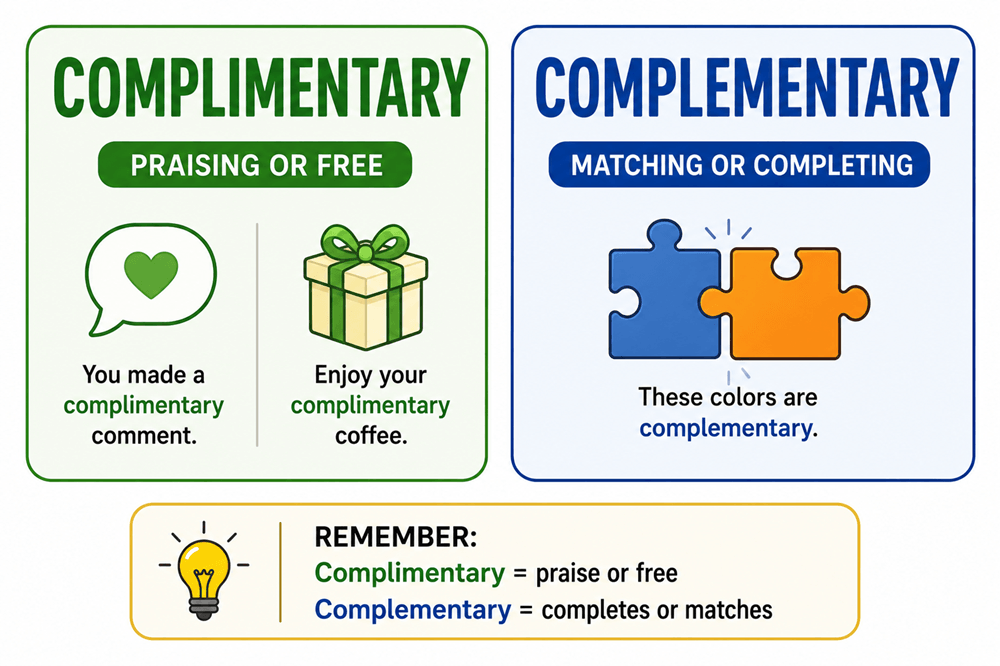
If you are choosing between complimentary or complementary, the correct word depends on the meaning. Complimentary means praising, flattering, or free of charge. Complementary means completing, matching, or working well together. The words sound almost the same, but they are not interchangeable.
Complimentary or Complementary: What Is the Difference?
Complimentary comes from compliment. A compliment is praise, so complimentary can mean full of praise. It can also mean given for free, as in complimentary breakfast or complimentary tickets.
Complementary comes from complement. A complement is something that completes or improves something else. So complementary means matching, balancing, completing, or working well together.
For example:
Correct: She made a complimentary remark about your work.
Incorrect: She made a complementary remark about your work.
Here, the meaning is praise, so complimentary is correct.
Now look at this sentence:
Correct: Blue and orange are complementary colors.
Incorrect: Blue and orange are complimentary colors.
Here, the meaning is that the colors balance or complete each other, so complementary is correct.
What Does Complimentary Mean?
Complimentary is an adjective with two common meanings. First, it can mean praising or expressing approval.
For example:
The review was highly complimentary of the new restaurant.
This means the review praised the restaurant.
You might also write:
Her tone was warm and complimentary.
This means her tone sounded approving, kind, or flattering.
Second, complimentary can mean free of charge. This meaning appears often in hotels, events, restaurants, travel, customer service, and business writing.
For example:
The hotel offers complimentary breakfast.
This means breakfast is included for free.
You received two complimentary tickets to the show.
This means the tickets were given without charge.
What Does Complementary Mean?
Complementary means that two or more things go well together, complete each other, or improve each other by being combined.
For example:
The sofa and rug have complementary colors.
This means the colors work well together visually.
You might also write:
The two team members had complementary skills.
This means one person’s strengths balanced or completed the other person’s strengths.
Complementary is common in design, color theory, fashion, business, medicine, relationships, teamwork, and planning. It often appears when two parts fit together in a useful or balanced way.
Why Complimentary and Complementary Are Easy to Confuse
Complimentary and complementary are confusing because they sound nearly identical. The spelling difference is only one vowel:
complimentary has i
complementary has e
That small vowel change creates a big meaning change. If you hear the word out loud, you may not know which spelling is intended unless the context makes it clear.
The best way to choose is to look at the base word. If the sentence is about a compliment, use complimentary. If the sentence is about a complement, use complementary.
A Simple Way to Remember Complimentary
The easiest memory trick is:
Complimentary has I because I like your work.
That i can remind you of praise. When you compliment someone, you are saying something kind or approving.
You can also remember:
A compliment is praise, so complimentary can mean praising.
For example:
That was a complimentary comment.
This means the comment praised someone or something.
For the “free” meaning, remember this phrase:
A complimentary gift is a polite gift.
Businesses often use complimentary to make “free” sound more gracious, generous, or professional.
A Simple Way to Remember Complementary
The easiest memory trick for complementary is:
Complementary has E because it completes.
Both complementary and complete use e. That is your spelling clue.
You can also remember:
A complement completes.
If one thing makes another thing feel fuller, better, more balanced, or more complete, the word you need is complementary.
For example:
The wine and cheese are complementary.
This means they pair well together and improve each other.
Complimentary for Praise
Use complimentary when the sentence is about kind words, praise, approval, or flattery.
For example:
The teacher wrote a complimentary note about your essay.
His comments were complimentary without sounding fake.
The article was complimentary toward the actor’s performance.
You received a complimentary review from your manager.
In these examples, complimentary means positive or praising. The word is connected to giving compliments.
Complimentary for Free Items
Use complimentary when something is provided at no extra cost.
For example:
The hotel provides complimentary coffee in the lobby.
You received a complimentary upgrade at check-in.
The company offered complimentary samples to new customers.
Guests were given complimentary drinks before dinner.
This use can feel more polished than simply saying free. That is why it often appears in hospitality, customer service, and advertising.
Complementary for Things That Work Together
Use complementary when two things match, balance, or complete each other.
For example:
The curtains and wall color are complementary.
The partners brought complementary strengths to the business.
The two courses offer complementary information.
The flavors were complementary without being too similar.
In these examples, the meaning is not praise and not free. The meaning is connection, balance, and completion.
Complementary Colors
One of the most common uses of complementary is in the phrase complementary colors. Complementary colors are colors that create strong contrast and balance when placed together.
For example:
Red and green are complementary colors.
Blue and orange create a complementary color scheme.
The designer used complementary colors to make the poster stand out.
This phrase always uses complementary, not complimentary. Colors do not give each other compliments. They complete or balance each other visually.
Complimentary vs Complementary in Side-by-Side Examples
Side-by-side examples make the difference clearer:
Correct: The hotel offered complimentary breakfast.
Incorrect: The hotel offered complementary breakfast.
Correct: The breakfast and coffee were complementary flavors.
Incorrect: The breakfast and coffee were complimentary flavors.
Correct: She gave you a complimentary smile.
Incorrect: She gave you a complementary smile.
Correct: Their skills were complementary.
Incorrect: Their skills were complimentary.
Correct: The report was complimentary about your leadership.
Incorrect: The report was complementary about your leadership.
Correct: The two products are complementary and work best together.
Incorrect: The two products are complimentary and work best together.
How to Check Which Word You Need
Before choosing between complimentary and complementary, ask what the sentence means.
If it means praising, use complimentary.
Your boss made a complimentary comment.
If it means free, use complimentary.
The guests received complimentary parking.
If it means matching, balancing, or completing, use complementary.
The two designs are complementary.
This quick check works in most everyday sentences. Praise or free gift means complimentary. Completion or good pairing means complementary.
The Final Answer on Complimentary or Complementary
Complimentary means praising or free of charge. Use it for complimentary comments, complimentary reviews, complimentary breakfast, complimentary tickets, and complimentary gifts.
Complementary means completing, matching, balancing, or working well together. Use it for complementary colors, complementary skills, complementary flavors, complementary products, and complementary ideas.
To remember the difference, use these two clues: complimentary has I because I praise you, and complementary has E because it completes. If the meaning is praise or free, choose complimentary. If the meaning is balance or completion, choose complementary.