Leach or Leech: Meanings, Spelling Differences, and Easy Ways to Remember Clearly
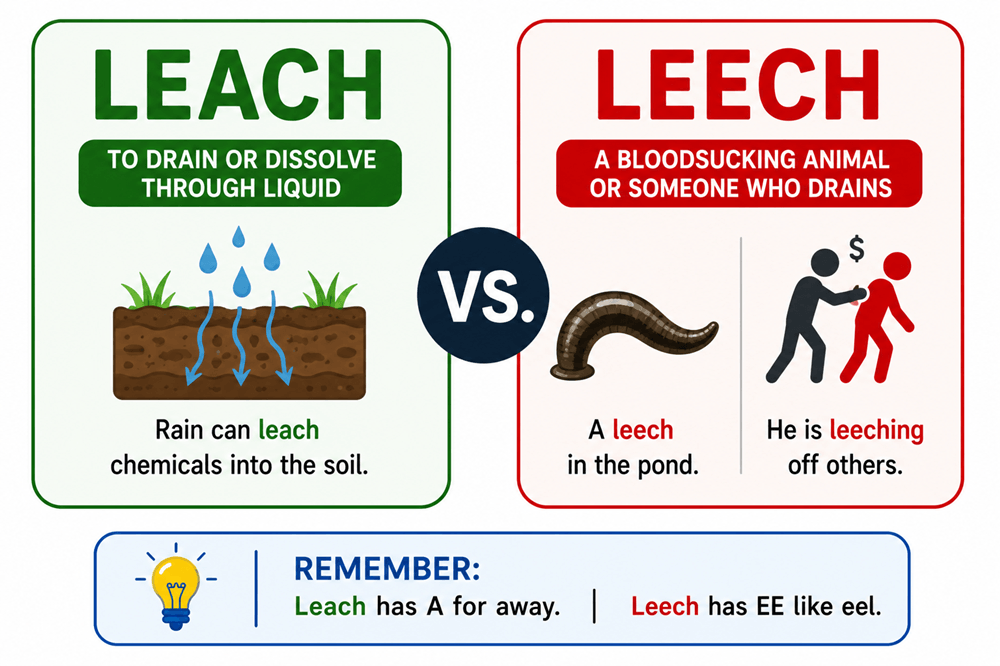
If you are choosing between leach or leech, the correct word depends on the meaning. Leach usually means to drain, dissolve, or remove something through liquid, especially when chemicals or minerals move through soil, water, or another material. Leech usually means a bloodsucking worm or a person who takes from others without giving back.
Leach or Leech: What Is the Difference?
Leach and leech sound almost the same, but they mean different things. The spelling difference matters because one word is usually about substances moving through liquid, while the other is about a creature or a person who drains something from someone else.
Use leach when something is washed out, dissolved, drained, or carried away by liquid.
Use leech when you mean the worm-like animal that sucks blood, or when describing someone who takes advantage of another person.
For example:
Correct: Chemicals can leach into the soil after heavy rain.
Incorrect: Chemicals can leech into the soil after heavy rain.
And:
Correct: A leech attached itself to his leg in the pond.
Incorrect: A leach attached itself to his leg in the pond.
The simplest rule is this: leach is about liquid movement, and leech is about draining life, blood, money, energy, or support.
What Does Leach Mean?
Leach is usually a verb. It means to remove, drain, dissolve, or carry away a substance by the action of liquid passing through something.
For example:
Rainwater can leach nutrients from the soil.
This means rainwater can carry nutrients away from the soil as it moves through it.
You might also write:
Plastic containers may leach chemicals when exposed to heat.
Here, leach means chemicals may move out of the plastic and into food, liquid, or the surrounding environment.
Leach is common in science, gardening, environmental writing, cooking, chemistry, farming, and discussions about pollution. It often appears when a substance moves slowly from one material into another.
Common Uses of Leach
You may see leach in phrases related to soil, water, food, chemicals, and materials.
Leach into the soil means a substance moves into the ground through water.
The fertilizer began to leach into the soil after the storm.
Leach out means a substance is gradually removed or washed away.
Too much water can leach out important minerals.
Leach from means a substance moves out of something.
Dye can leach from cheap fabric during washing.
Leach through means liquid carries something through a material.
The minerals leached through the layers of rock.
In all these examples, leach is connected to movement, liquid, removal, or transfer.
What Does Leech Mean?
Leech is usually a noun. A leech is a small worm-like animal that can attach itself to another creature and feed on blood. Leeches are often found in wet places such as ponds, lakes, marshes, and slow-moving water.
For example:
A leech clung to his ankle after he walked through the swamp.
This means a bloodsucking creature attached itself to him.
Leech can also describe a person who takes from someone else without giving anything useful in return.
For example:
He acted like a leech, always borrowing money and never helping anyone.
In this sentence, leech is figurative. It does not mean the person is an actual animal. It means the person drains money, time, support, attention, or energy from others.
Leech as a Verb
Leech can also be used as a verb. As a verb, it means to take from someone in a draining or parasitic way.
For example:
She felt like the project was leeching all her energy.
This means the project was draining her energy.
You might also write:
He tried to leech off his friends instead of finding work.
Here, leech off means to depend on others unfairly or take advantage of their resources.
This use is often negative. If someone is described as leeching off another person, the sentence usually suggests selfishness, dependence, or exploitation.
Why Leach and Leech Are Easy to Confuse
Leach and leech are easy to confuse because they sound alike. Both have a long “ee” sound, and both can involve the idea of something being drawn out or drained.
That meaning overlap makes the confusion even stronger. When chemicals leach from a material, something is being drawn out. When a leech feeds, it also draws something out. The difference is the context.
Leach usually belongs with substances, liquids, soil, nutrients, minerals, chemicals, and materials.
Leech belongs with the animal, blood, exploitation, dependence, and draining someone’s energy or resources.
The spelling gives you a clue. Leach has a, and something that leaches often moves away. Leech has double e, like eel, another long slippery creature in water.
A Simple Way to Remember Leach
The easiest memory trick is:
Leach has A for away.
When something leaches, it often moves away from where it started. Nutrients leach away from soil. Chemicals leach away from plastic. Minerals leach away through water.
You can also remember:
Leach is what liquids do to materials.
If the sentence is about water, rain, soil, minerals, chemicals, or dissolved substances, leach is probably the word you need.
Another useful phrase is:
Rain can leach things away.
This connects the a in leach with away, giving you both the spelling and the meaning.
A Simple Way to Remember Leech
The easiest memory trick for leech is:
A leech is like an eel with extra cling.
This works visually because leech has double e, and eel also has double e. Both words can make you think of long, slippery water creatures.
You can also remember:
Leech has EE because it feeds.
This helps you connect the spelling with the bloodsucking animal. A leech feeds by attaching to another creature, and a figurative leech feeds off someone else’s time, money, kindness, or work.
If the sentence is about a creature, a parasite, or someone who takes advantage, choose leech.
Leach vs Leech in Side-by-Side Examples
Side-by-side examples make the difference clearer:
Correct: The chemicals may leach into the water.
Incorrect: The chemicals may leech into the water.
Correct: A leech was stuck to his foot.
Incorrect: A leach was stuck to his foot.
Correct: Heavy rain can leach nutrients from the garden soil.
Incorrect: Heavy rain can leech nutrients from the garden soil.
Correct: He acted like a leech by constantly asking for money.
Incorrect: He acted like a leach by constantly asking for money.
Correct: The color started to leach from the fabric.
Incorrect: The color started to leech from the fabric.
Correct: That friendship felt one-sided because he kept leeching off your kindness.
Incorrect: That friendship felt one-sided because he kept leaching off your kindness.
The rule is practical: substances leach, but parasites leech.
Common Phrases With Leach
Here are common phrases where leach is the correct word:
Leach into the ground
Leach out of plastic
Leach nutrients from soil
Leach chemicals into water
Leach minerals through rock
Leach color from fabric
These phrases usually involve liquid, movement, dissolving, or transfer. If something is being carried away or drawn out by water or another liquid, choose leach.
Common Phrases With Leech
Here are common phrases where leech is the correct word:
A bloodsucking leech
A leech in the pond
Leech off someone
Leech money from family
Leech energy from a group
Act like a leech
These phrases usually involve a creature or a person who drains something from others. If the meaning is parasitic, literal or figurative, choose leech.
What About “Leech Off”?
Leech off is a common phrase that means to take from someone else unfairly, often by depending on their money, work, kindness, or support.
For example:
He tried to leech off his parents instead of taking responsibility.
The arrangement felt unfair because one person was leeching off everyone else.
This phrase uses leech, not leach, because the image is of a parasite draining something from another living being.
How to Check Which Word You Need
Before choosing between leach and leech, ask what the sentence is describing.
If you mean liquid carrying something away, use leach.
The rain leached minerals from the soil.
If you mean a bloodsucking animal, use leech.
A leech attached itself to the swimmer.
If you mean someone who takes advantage of others, use leech.
He was tired of people trying to leech off his success.
This quick check works because leach is usually environmental, chemical, or material. Leech is usually biological, emotional, social, or figurative.
The Final Answer on Leach or Leech
Leach means to drain, dissolve, wash out, or carry away through liquid. Use it for chemicals, nutrients, minerals, colors, soil, water, and materials.
Leech means a bloodsucking worm-like animal or a person who drains resources, energy, money, or support from others. It can also be a verb meaning to exploit or take from someone unfairly.
To remember the difference, use these two clues: leach has A for away, and leech has EE like eel. If liquid carries something away, use leach. If something acts like a parasite, use leech.