Toward or Towards: Correct Meaning, Usage, and American Versus British English Rules
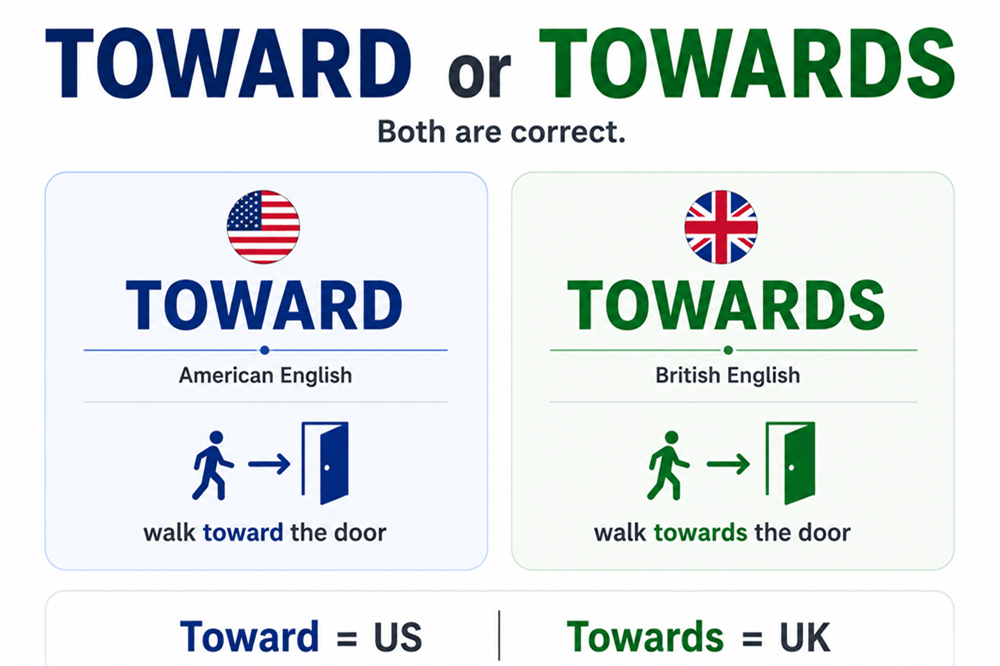
Toward and towards are both correct words, and they usually mean the same thing. The main difference is regional preference. Toward is more common in American English, while towards is more common in British English. Use toward for most U.S. writing and towards if you are following British English style.
Quick Answer
Toward and towards are both correct. They can both mean in the direction of, nearer to, in relation to, or helping to achieve something.
- American English: She walked toward the door.
- British English: She walked towards the door.
The meaning is the same. The spelling choice depends mostly on your audience.
Toward or Towards: What Is the Difference?
The difference between toward and towards is not meaning. It is mainly a style and regional spelling difference.
In American English, toward without the final s is usually preferred. You will often see it in American books, newspapers, websites, school writing, business writing, and everyday communication.
In British English, towards with the final s is more common. You may also see it in writing from countries that often follow British spelling patterns.
| Word | Where It Is Common | Example |
|---|---|---|
| Toward | American English | He moved toward the exit. |
| Towards | British English | He moved towards the exit. |
If you are writing for American readers, toward will usually look more natural. If you are writing for British readers, towards may feel more familiar.
What Does Toward Mean?
Toward is usually used as a preposition. It can show direction, movement, attitude, purpose, or progress.
Most often, toward means in the direction of.
- She walked toward the window.
- The car moved toward the bridge.
- He turned toward the sound.
- The child ran toward her mother.
Toward can also mean in relation to someone or something.
- His attitude toward work has improved.
- She was kind toward everyone in the group.
- The policy shows a new approach toward public safety.
It can also mean helping to reach a goal.
- She saved money toward a new car.
- The donation went toward school supplies.
- Every small step counts toward your progress.
In American English, these sentences would usually use toward without the final s.
What Does Towards Mean?
Towards has the same meaning as toward. It can also show direction, attitude, relation, or progress.
In British English, towards is often the more natural spelling.
- She walked towards the window.
- The car moved towards the bridge.
- He turned towards the sound.
- The child ran towards her mother.
It can also describe attitude or feeling.
- His attitude towards work has improved.
- She was kind towards everyone in the group.
- The policy shows a new approach towards public safety.
And it can describe contribution or progress.
- She saved money towards a new car.
- The donation went towards school supplies.
- Every small step counts towards your progress.
The meaning does not change when you add the final s. The difference is mainly spelling style.
Is Toward Wrong?
Toward is not wrong. It is the preferred form in American English.
If your readers are mostly in the United States, toward is usually the better choice. It looks clean, standard, and familiar in American writing.
Examples:
- The dog ran toward the gate.
- She felt grateful toward her teacher.
- The money will go toward medical expenses.
- He took one step toward solving the problem.
These examples are natural in American English.
Is Towards Wrong?
Towards is not wrong either. It is commonly used in British English.
If your readers are in the United Kingdom or if your writing follows British spelling, towards is usually the better choice.
Examples:
- The dog ran towards the gate.
- She felt grateful towards her teacher.
- The money will go towards medical expenses.
- He took one step towards solving the problem.
These examples are natural in British English.
Toward and Towards Mean the Same Thing
Unlike some confusing word pairs, toward and towards do not usually have separate meanings. You do not need to choose one for physical movement and the other for emotional attitude. Both words can be used in the same situations.
For example, both of these sentences are correct:
- She walked toward the river.
- She walked towards the river.
Both mean that she moved in the direction of the river.
These are also both correct:
- He showed kindness toward his neighbors.
- He showed kindness towards his neighbours.
Both describe a feeling, attitude, or behavior directed at other people. The spelling changes, but the meaning stays the same.
Examples of Toward in Sentences
Here are natural examples of toward in American English:
- She walked toward the stage with confidence.
- The clouds moved toward the mountains.
- He has a positive attitude toward learning.
- The company is working toward a better solution.
- The money will go toward rent this month.
- They took a major step toward peace.
- Her comments were directed toward the whole team.
- The road curves toward the coast.
In each sentence, toward shows direction, relation, purpose, or progress.
Examples of Towards in Sentences
Here are natural examples of towards in British English:
- She walked towards the stage with confidence.
- The clouds moved towards the mountains.
- He has a positive attitude towards learning.
- The company is working towards a better solution.
- The money will go towards rent this month.
- They took a major step towards peace.
- Her comments were directed towards the whole team.
- The road curves towards the coast.
These sentences mean the same thing as the American English examples. The final s simply reflects a different spelling preference.
Toward or Towards in Formal Writing
In formal writing, the best choice depends on the style guide or audience. If your writing follows American English, use toward. If your writing follows British English, use towards.
For American formal writing:
- The organization is moving toward a long-term strategy.
- The study contributes toward a better understanding of the issue.
For British formal writing:
- The organisation is moving towards a long-term strategy.
- The study contributes towards a better understanding of the issue.
The most important rule is consistency. Do not switch between toward and towards without a reason in the same article, essay, email, or report.
Toward or Towards a Goal?
Both toward a goal and towards a goal are correct. The phrase means making progress in the direction of a goal.
American English:
- Every lesson moves you toward your goal.
- She is working toward a degree.
- They are saving toward a house.
British English:
- Every lesson moves you towards your goal.
- She is working towards a degree.
- They are saving towards a house.
This use is common in personal development, education, business, finance, and planning.
Common Mistakes to Avoid
The biggest mistake is thinking that one form is always correct and the other is always wrong. That is not true. Toward and towards are both standard words.
Another mistake is switching between both forms in the same piece of writing.
Inconsistent:
- She walked toward the office and then turned towards the elevator.
Better in American English:
- She walked toward the office and then turned toward the elevator.
Better in British English:
- She walked towards the office and then turned towards the elevator.
You should also avoid trying to create a meaning difference where there usually is none. In most everyday writing, toward and towards mean the same thing.
How to Remember Toward or Towards
Here is a simple memory tip:
Toward is shorter, and American English often prefers shorter forms.
Towards has an extra s, and British English commonly uses that form.
You can remember it this way:
- Toward = American English
- Towards = British English
If you are not sure which one to use, choose the form that matches the rest of your spelling style. If you write color, gray, and canceled, use toward. If you write colour, grey, and cancelled, use towards.
Final Answer
Toward and towards are both correct and usually mean the same thing. Use toward in American English and towards in British English. The best choice depends on your audience, your spelling style, and consistency throughout your writing.