Beside or Besides: Meanings, Grammar Differences, and Simple Ways to Remember Them
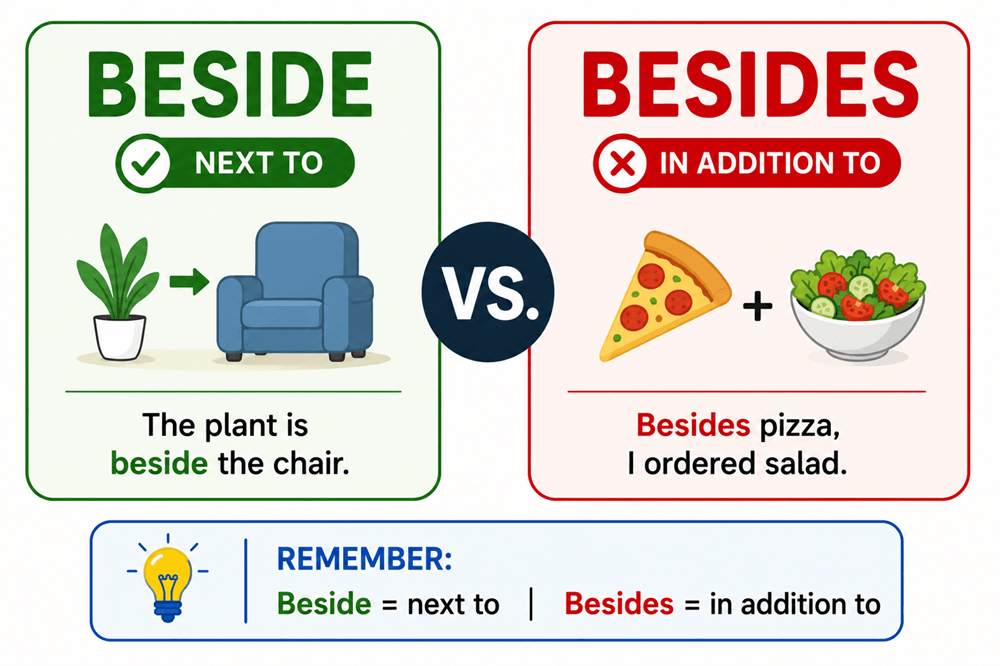
If you are choosing between beside or besides, the difference is usually simple. Beside means “next to” or “at the side of.” Besides usually means “in addition to,” “apart from,” or “anyway.” You sit beside someone, but you might say besides, there is another reason to leave.
Beside or Besides: What Is the Difference?
Beside is mostly about physical position. It tells you that one thing is next to another thing.
Besides is mostly about addition or exception. It adds another point, reason, person, or thing to the sentence.
For example:
Correct: You sat beside your friend at lunch.
Incorrect: You sat besides your friend at lunch.
In that sentence, you mean “next to,” so beside is correct.
Now look at this sentence:
Correct: Besides your friend, who else came to lunch?
Incorrect: Beside your friend, who else came to lunch?
Here, you mean “in addition to your friend,” so besides is correct.
The extra s changes the meaning. Beside points to location. Besides adds something else.
What Does Beside Mean?
Beside is a preposition. It usually means next to, by the side of, or near. You use it when describing where something or someone is placed.
For example:
The lamp is beside the bed.
This means the lamp is next to the bed.
You might also write:
You stood beside the window and watched the rain.
Here, beside tells where you stood. You were next to the window.
Beside can describe people, objects, buildings, furniture, places, and positions. If two things are side by side, beside is often the word you need.
Common Examples With Beside
Here are common sentences where beside is correct:
You placed the keys beside the door.
The child sat beside her mother.
A small table stood beside the sofa.
He walked beside you the whole way home.
The notebook was lying beside the computer.
The dog slept beside the fireplace.
In every sentence, beside means next to. That is the main clue.
What Does Besides Mean?
Besides can work as a preposition or an adverb. Its most common meanings are in addition to, apart from, other than, or anyway.
For example:
Besides coffee, you also ordered tea.
This means you ordered tea in addition to coffee.
You might also write:
No one besides you knew the answer.
Here, besides means “except for” or “apart from.”
Besides can also introduce an extra reason or point:
You should bring a jacket. Besides, it may rain later.
In this sentence, besides means “also” or “anyway.” It adds another reason.
Common Examples With Besides
Here are common sentences where besides is correct:
Besides math, you also enjoy history.
Who else is coming besides your sister?
There was nothing to do besides wait.
Besides, you already promised to help.
No one besides the manager had a key.
Besides the price, the quality was also a problem.
In these examples, besides is not mainly about physical location. It adds, excludes, or introduces another point.
Why Beside and Besides Are Easy to Confuse
Beside and besides are easy to confuse because they look almost the same. The only spelling difference is the final s. They also come from related ideas. If something is “beside” something else, it is near it. If something is “besides” another thing, it can feel like it is being added alongside it in thought.
That connection makes sense, but modern usage separates them clearly.
Beside usually answers the question where?
Besides usually answers the question what else?
For example:
Where is the chair? It is beside the desk.
What else do you need? Besides a chair, you need a desk.
That simple question trick can help you choose the right word quickly.
A Simple Way to Remember Beside
The easiest memory trick is:
Beside means by the side.
The word beside even contains the idea of side. If someone or something is beside you, it is by your side.
You can remember it with this phrase:
Beside has side inside it.
This works because beside is about position. If you can replace the word with next to, choose beside.
For example:
You sat beside me.
You can test it:
You sat next to me.
That works, so beside is correct.
A Simple Way to Remember Besides
The easiest memory trick for besides is:
Besides adds something.
The final s can remind you of something more. When you use besides, you are often adding another person, thing, reason, detail, or idea.
For example:
Besides pizza, you ordered salad.
This means pizza was not the only thing. Salad was added.
You can also remember:
Besides means “also” or “apart from.”
If you can replace the word with in addition to, apart from, or also, choose besides.
Beside vs Besides in Side-by-Side Examples
Side-by-side examples make the difference clearer:
Correct: The phone is beside the notebook.
Incorrect: The phone is besides the notebook.
Correct: Besides the notebook, you also need a pen.
Incorrect: Beside the notebook, you also need a pen.
Correct: She sat beside her brother.
Incorrect: She sat besides her brother.
Correct: Besides her brother, her cousin was there too.
Incorrect: Beside her brother, her cousin was there too.
Correct: The house beside the river is old.
Incorrect: The house besides the river is old.
Correct: Besides the old house, there are three cabins nearby.
Incorrect: Beside the old house, there are three cabins nearby.
The rule stays the same. Use beside for location. Use besides for addition, exception, or another point.
Beside Meaning “Compared With”
Beside can also appear in the phrase beside the point. This means something is not relevant to the main issue.
For example:
Your excuse is beside the point.
This does not mean the excuse is physically next to the point. It means the excuse is not connected to what matters most.
You may also see beside himself or beside herself, meaning extremely emotional, upset, excited, or overwhelmed.
For example:
She was beside herself with worry.
These are fixed expressions, and they use beside, not besides.
Besides Meaning “Anyway”
Besides can also introduce an extra argument, reason, or afterthought. In this use, it often begins a sentence.
For example:
You should not drive tonight. Besides, you are too tired.
Here, besides means something like also or anyway. It adds another reason not to drive.
More examples:
The restaurant is too expensive. Besides, it is already closed.
You do not need another coat. Besides, your closet is full.
The plan sounds risky. Besides, no one has approved it yet.
When besides starts a sentence this way, it usually needs a comma after it.
What About “Besides That”?
Besides that is a common phrase that means apart from that or in addition to that.
For example:
The room was cold. Besides that, it was comfortable.
This means the room was comfortable except for the cold temperature.
You might also write:
The job pays well. Besides that, the schedule is flexible.
Here, besides that adds another positive point.
Because this phrase is about addition or exception, it uses besides, not beside.
Can Besides Ever Mean Beside?
In older or literary English, besides has sometimes been used in ways close to beside, but that is not the best choice for normal modern writing. Today, if you mean next to, use beside.
For example:
Clear: The chair is beside the table.
Awkward: The chair is besides the table.
The second sentence may confuse readers because besides usually means in addition to. To avoid confusion, keep the distinction simple.
How to Check Which Word You Need
Before choosing between beside and besides, ask what you mean.
If you mean next to, use beside.
The bag is beside the chair.
You walked beside the lake.
She stood beside you in line.
If you mean in addition to, apart from, except for, or also, use besides.
Besides the bag, you brought a suitcase.
No one besides you understood it.
Besides, the weather was getting worse.
This quick check works in almost every everyday sentence.
The Final Answer on Beside or Besides
Beside means next to or at the side of. Use it when talking about physical position or fixed phrases like beside the point and beside yourself.
Besides means in addition to, apart from, except for, or also. Use it when adding another item, reason, idea, or exception.
To remember the difference, use these two clues: beside has side inside it, and besides adds something. If the word means next to, choose beside. If the word means also or in addition to, choose besides.