Is Gotten a Word? Gotten vs. Got Explained
Yes, gotten is a word.
It is a standard past-participle form of get, especially in American English.
Examples:
- She has gotten much better at cooking.
- We had gotten lost before reaching the hotel.
- He has gotten several job offers.
- The weather has gotten colder.
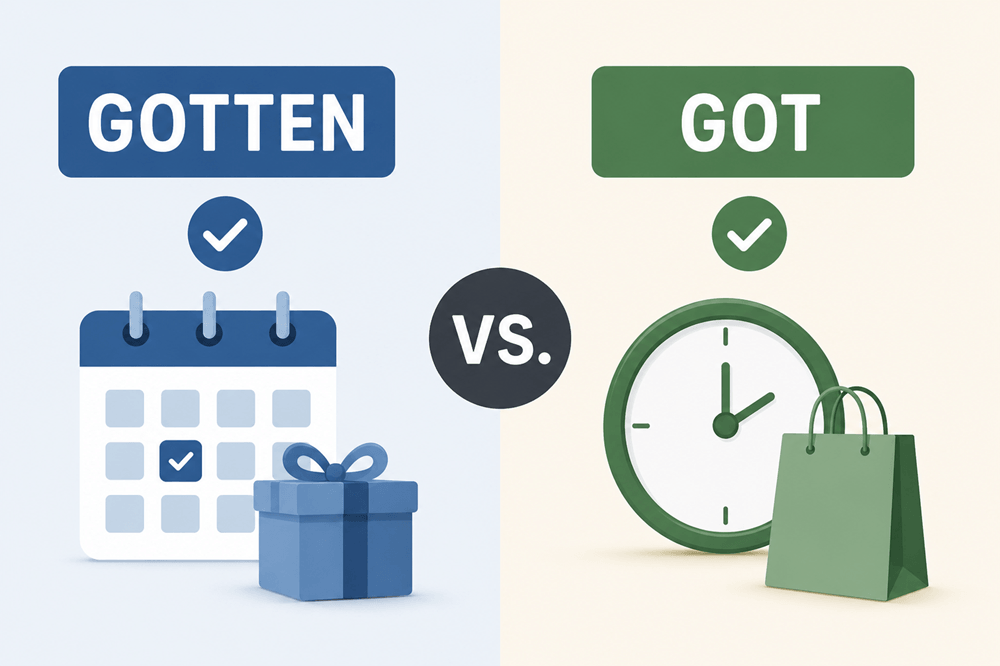
In British English, got is generally used where Americans often use gotten. Cambridge gives the principal British forms as get, got, got, while noting that gotten is common in American English.
Quick Answer
The basic verb forms are:
- Present: get
- Past tense: got
- Past participle in American English: gotten or got
- Past participle in British English: usually got
Examples:
- Yesterday, I got a package.
- I have gotten three packages this week.
- The situation has gotten worse.
Merriam-Webster defines gotten as the past participle of get, confirming that it is a standard word rather than a spelling error.
A simple memory rule is:
Use got for the simple past. Use gotten after have, has, or had when following American usage.
What Does Gotten Mean?
Gotten can express several meanings because the verb get has many uses.
Depending on the sentence, it may mean:
- received
- obtained
- acquired
- become
- arrived
- developed
- reached a condition
Examples:
- She has gotten permission to leave early.
She has received permission. - He has gotten a new computer.
He has obtained a new computer. - The room has gotten warmer.
The room has become warmer. - We had gotten home before the storm began.
We had arrived home.
The surrounding words show which meaning is intended.
Is Gotten Proper English?
Yes. Gotten is proper standard English, particularly in the United States and Canada.
It appears in dictionaries and is commonly used in both speech and writing. Merriam-Webster and Cambridge identify it as a past participle of get, while Collins labels it especially as a U.S. form.
It is not merely:
- slang
- a misspelling
- childish language
- an incorrect form of got
However, it may sound distinctly American to readers accustomed to British English.
Gotten vs. Got
The main difference depends on grammar, region, and meaning.
| Form | Main Use | Example |
|---|---|---|
| Got | Simple past tense | I got your message yesterday. |
| Gotten | American past participle | I have gotten your messages. |
| Got | British past participle | I have got your messages. |
| Got | Possession in “have got” | I have got a car. |
Got as the simple past
Use got for an action completed in the past.
Examples:
- I got your email yesterday.
- She got home at six.
- They got a new puppy last month.
- The weather got colder overnight.
Do not use gotten as the ordinary simple past.
Incorrect:
- I gotten your email yesterday.
Correct:
- I got your email yesterday.
Gotten as a past participle
Use gotten after an auxiliary verb such as have, has, or had in American English.
Examples:
- I have gotten your email.
- She has gotten much stronger.
- They had gotten home before midnight.
- Things have gotten complicated.
A past participle helps form perfect verb tenses. It does not normally replace got in a simple past-tense sentence.
Have Gotten vs. Have Got
Both expressions can be correct, but they may communicate different ideas in American English.
Have gotten
Have gotten often emphasizes receiving, obtaining, becoming, or changing.
Examples:
- I have gotten a new job.
- She has gotten better.
- The children have gotten tired.
- We have gotten several responses.
Have got
Have got commonly expresses possession, necessity, or a present condition.
Examples:
- I have got a new job.
I have a new job. - She has got blue eyes.
She has blue eyes. - We have got to leave.
We must leave.
Collins notes that American usage often uses gotten for receiving, becoming, or arriving while keeping got in expressions of possession.
Compare:
- I have got a car.
I possess a car. - I have gotten a car.
I have acquired a car.
The difference may be subtle, but it can clarify whether you mean possession or acquisition.
American and British English
The use of gotten is one of the noticeable grammatical differences between American and British English.
American English
American speakers commonly use:
- have gotten
- has gotten
- had gotten
Examples:
- He has gotten taller.
- We have gotten used to the noise.
- She had gotten there first.
British English
British speakers generally use:
- have got
- has got
- had got
Examples:
- He has got taller.
- We have got used to the noise.
- She had got there first.
Cambridge describes get as an irregular verb with the British forms get, got, got, while specifically noting that gotten is common in American English.
Neither variety is inherently better. The best choice depends on the English style you are using.
Gotten in a Sentence
Examples of standard American usage include:
- The traffic has gotten worse.
- I have gotten several messages today.
- She has gotten interested in photography.
- We had gotten halfway home when the car stopped.
- The baby has gotten much bigger.
- He has gotten used to waking up early.
- Their relationship has gotten stronger.
- The explanation has gotten clearer.
In each example, gotten follows has, have, or had.
Is It “Had Gotten” or “Had Got”?
Both forms are possible, depending on regional style.
American English:
- We had gotten lost.
- She had gotten tired.
- He had gotten the answer wrong.
British English:
- We had got lost.
- She had got tired.
- He had got the answer wrong.
The phrase had gotten is the past perfect form commonly used in American English.
Is It “Has Gotten Better” or “Has Got Better”?
Both are correct.
American English commonly uses:
- She has gotten better.
British English commonly uses:
- She has got better.
Both mean that her condition, ability, or performance has improved.
Examples:
- His writing has gotten better with practice.
- Her health has got better since the treatment began.
Choose the form that matches your regional or editorial style.
Is It “Gotten Used To” or “Got Used To”?
Both can be grammatical, but they describe different time structures.
Got used to
Simple past:
- I got used to the cold weather.
This describes a completed adjustment in the past.
Have gotten used to
Present perfect in American English:
- I have gotten used to the cold weather.
This emphasizes the adjustment that has occurred over time and remains relevant now.
British English would more commonly use:
- I have got used to the cold weather.
Is Gotten Formal?
Gotten is standard, but get is often conversational and can be vague.
For example:
- She has gotten a promotion.
This is perfectly acceptable.
In more formal writing, a more precise verb may sometimes be stronger:
- She has received a promotion.
- She has earned a promotion.
- She has obtained approval.
- Conditions have deteriorated.
Do not replace gotten merely because you think it is incorrect. Replace it only when another word communicates the meaning more precisely.
Common Mistakes
Using gotten as the simple past
Incorrect:
- Yesterday, I gotten a letter.
Correct:
- Yesterday, I got a letter.
Forgetting the helping verb
Incorrect:
- She gotten much better.
Correct:
- She has gotten much better.
- She got much better.
Writing “have gotton”
Incorrect:
- I have gotton used to it.
Correct:
- I have gotten used to it.
The ending is -ten, not -ton.
Assuming gotten is always wrong
Incorrect assumption:
- Gotten is not a real word.
More accurate:
- Gotten is a standard American past participle of get.
Mixing regional styles unnecessarily
Inconsistent:
- She has got better, but the situation has gotten worse.
Consistent American style:
- She has gotten better, but the situation has gotten worse.
Consistent British style:
- She has got better, but the situation has got worse.
How to Remember Got and Gotten
Use the time structure as your clue.
No helping verb
Use got:
- I got the message.
- She got tired.
- They got home.
After have, has, or had in American English
Use gotten when you mean obtained, received, arrived, or become:
- I have gotten the message.
- She has gotten tired.
- They had gotten home.
A simple memory sentence is:
Yesterday I got it; since then, I have gotten it.
Final Answer
Yes, gotten is a word.
It is a standard past-participle form of get, especially in American English.
Correct American examples:
- She has gotten better.
- We have gotten several responses.
- They had gotten lost.
Use got for the simple past:
- She got better yesterday.
- We got several responses.
- They got lost.
British English usually uses got instead of gotten as the past participle.
Remember:
Got is the simple past. Gotten is a standard American past participle.