Quiet or Quite: What’s the Difference?
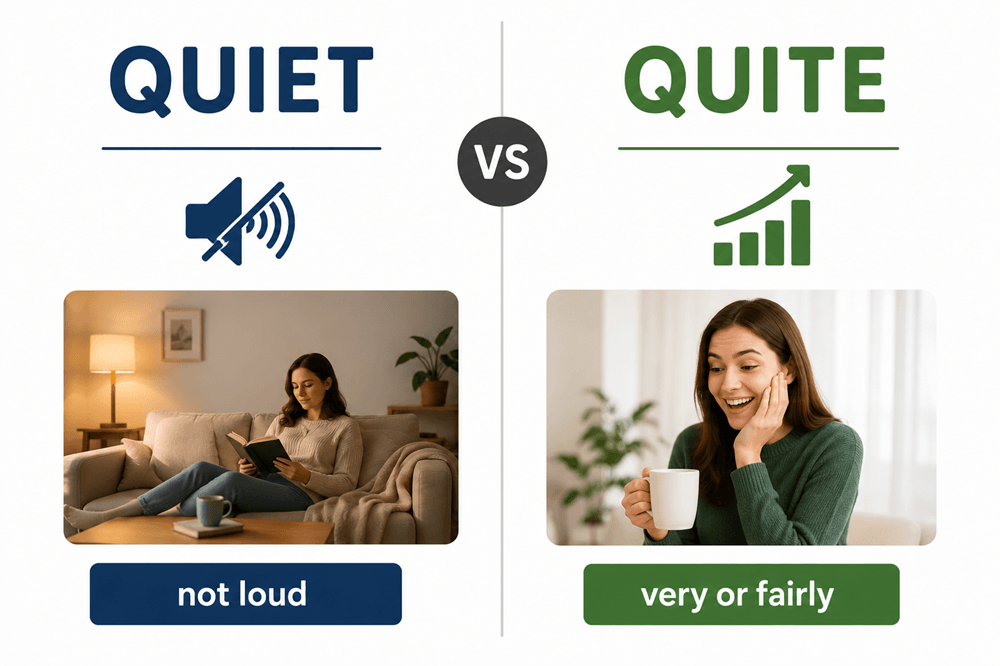
Quiet and quite are both real words, but they mean different things.
Quiet means low in sound, calm, or not noisy.
Quite means very, completely, fairly, or to a noticeable degree.
Examples:
Correct: The room was quiet.
Correct: The movie was quite interesting.
Correct: Please be quiet during the test.
Correct: I am quite sure this is the right answer.
The spelling difference is small, but the meaning changes completely. If you mean silence, use quiet. If you mean very, fairly, or completely, use quite.
Quiet Meaning
Quiet is usually an adjective. It describes something or someone that is not loud.
Examples:
The library is quiet.
She has a quiet voice.
The baby finally became quiet.
It was a quiet evening at home.
Quiet can describe places, people, sounds, moods, or situations.
More examples:
a quiet room
a quiet street
a quiet child
a quiet conversation
a quiet morning
In each phrase, quiet means calm, peaceful, or not noisy.
Quite Meaning
Quite is an adverb. It changes the meaning of an adjective or another adverb.
It can mean very, fairly, rather, or completely, depending on the sentence.
Examples:
The answer is quite simple.
She was quite happy with the result.
That book is quite long.
I am quite certain.
This soup is quite good.
In these examples, quite adds emphasis. It tells us how simple, happy, long, certain, or good something is.
Quiet vs Quite: The Main Difference
The main difference is meaning.
Quiet means not loud.
Quite means very, fairly, or completely.
Examples:
The classroom was quiet.
The classroom was quite full.
The first sentence means the classroom was not noisy.
The second sentence means the classroom was very or fairly full.
More examples:
Correct: He is a quiet person.
Correct: He is quite friendly.
Correct: The hotel was quiet at night.
Correct: The hotel was quite expensive.
Correct: Please keep your phone quiet.
Correct: This phone is quite useful.
How to Spell Quiet and Quite
The spelling difference is easy to miss.
Quiet is spelled:
Q-U-I-E-T
Quite is spelled:
Q-U-I-T-E
The letters are almost the same, but the last two letters are in a different order.
Quiet ends with -et.
Quite ends with -te.
A simple way to remember it:
Quiet has et, like the end of silent.
Quite has te, like the end of complete.
That can help because quiet is connected to silence, while quite can sometimes mean completely.
Quiet Examples
Use quiet when talking about silence, calmness, or low noise.
Examples:
The house was quiet after everyone left.
Please be quiet while the baby sleeps.
He spoke in a quiet voice.
The neighborhood is usually quiet at night.
She enjoys quiet places where she can read.
The word quiet can also describe a person who does not talk much.
Examples:
He is quiet around new people.
She was a quiet student in class.
A quiet person is not necessarily shy, but they may speak less or prefer calm surroundings.
Quite Examples
Use quite when you want to add emphasis.
Examples:
The test was quite difficult.
I am quite tired today.
The dress is quite pretty.
He was quite surprised by the news.
That explanation was quite helpful.
In American English, quite often means “very” or “really.”
Example:
That was quite good.
This usually means the thing was very good or noticeably good.
In British English, quite can sometimes mean “fairly” or “rather,” depending on the context.
Example:
The movie was quite good.
This could mean “fairly good” or “pretty good,” not always extremely good.
For simple writing, think of quite as a word that adds degree or emphasis.
Common Mistakes
A common mistake is using quite when you mean quiet.
Incorrect: Please be quite.
Correct: Please be quiet.
Incorrect: The room was very quite.
Correct: The room was very quiet.
Incorrect: She has a quite voice.
Correct: She has a quiet voice.
Another common mistake is using quiet when you mean quite.
Incorrect: I am quiet sure.
Correct: I am quite sure.
Incorrect: That was quiet interesting.
Correct: That was quite interesting.
Incorrect: The answer is quiet easy.
Correct: The answer is quite easy.
If the word means “not loud,” choose quiet. If it means “very” or “fairly,” choose quite.
Quiet as a Verb and Noun
Quiet can also be used as a verb or noun.
As a verb, quiet means to make something calm or less noisy.
Examples:
The teacher tried to quiet the class.
The music helped quiet his mind.
As a noun, quiet means silence or calm.
Examples:
I need some peace and quiet.
The quiet of the morning felt relaxing.
Even in these forms, quiet is still connected to silence or calmness.
Quite Is Not a Noun or Adjective
Quite is an adverb. It does not describe noise. It describes degree.
Correct:
The room is quite quiet.
This sentence uses both words correctly.
Quite tells us how quiet the room is.
Quiet describes the room’s low noise level.
More examples:
The child was quite quiet during dinner.
The town is quite quiet in winter.
The office was quite quiet after lunch.
This is a useful pattern to remember:
quite quiet = very quiet
Memory Trick
Here is an easy way to remember the difference:
Quiet has et at the end. Think: quiet = no noise.
Quite has te at the end. Think: quite = to a degree.
You can also remember this sentence:
A quiet room can be quite peaceful.
In that sentence:
quiet means not noisy
quite means very or fairly
Quick Test
Choose the correct word:
The library was very ___.
Answer: quiet
I am ___ happy with my grade.
Answer: quite
Please stay ___ during the movie.
Answer: quiet
That question was ___ difficult.
Answer: quite
The garden was calm and ___.
Answer: quiet
Final Answer
Quiet and quite are both correct words, but they are not interchangeable.
Use quiet when you mean silent, calm, peaceful, or not noisy.
Use quite when you mean very, fairly, rather, or completely.
Correct: The room was quiet.
Correct: The room was quite small.
Correct: She is a quiet person.
Correct: She is quite smart.
The easiest way to remember the difference is: quiet is about sound, and quite is about degree.