Aunty or Auntie: Correct Spelling, Meaning, Regional Difference, and Examples Explained Clearly
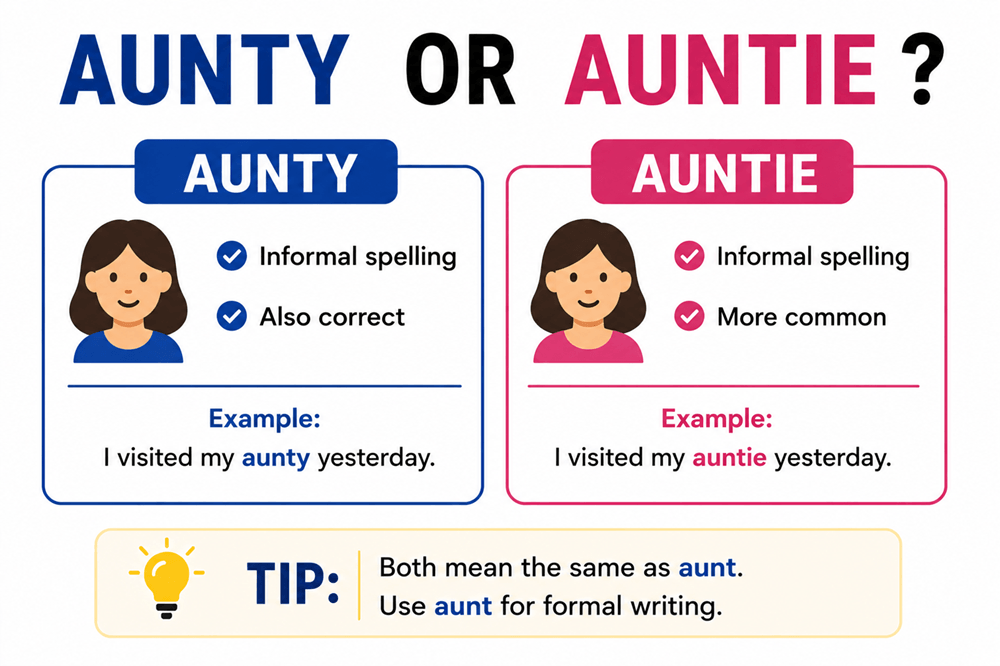
Auntie and aunty are both correct informal words for aunt. They usually mean a woman who is your parent’s sister, your uncle’s wife, or a close family friend treated like an aunt. Auntie is the more common and widely recognized spelling in many contexts, while aunty is also used, especially in casual, affectionate, and regional English. The easiest rule is this: use aunt for formal writing, and use auntie or aunty for a warm, familiar tone.
Quick Answer
Use auntie when you want the more familiar and widely recognized informal spelling.
- Correct: My auntie always sends birthday cards.
- Correct: The children love visiting Auntie May.
- Correct: She grew up close to her auntie.
Use aunty when that spelling is natural in your family, culture, or region.
- Correct: Aunty Rose made dinner for everyone.
- Correct: The kids ran to hug their aunty.
- Correct: She calls her mother’s best friend Aunty.
The simple rule is this: auntie and aunty are both informal. Aunt is the standard formal word.
Aunty or Auntie: What Is the Difference?
The difference between aunty and auntie is mostly spelling, tone, and regional preference. Both words are affectionate forms of aunt. They often sound warmer, softer, or more personal than the plain word aunt.
Auntie is often the more common spelling in general writing. It looks familiar to many readers and is widely used in family conversations, children’s books, stories, captions, and casual messages.
Aunty is also correct. It may be preferred in some families, regions, and cultural communities. It is common in many informal and affectionate uses, especially when the word is used as a family title.
| Word | Main Use | Example |
|---|---|---|
| Aunt | Standard formal word | My aunt lives in Texas. |
| Auntie | Informal, affectionate, widely recognized | My auntie lives in Texas. |
| Aunty | Informal, affectionate, regional or family-preferred | My aunty lives in Texas. |
If you are writing a formal document, use aunt. If you are writing something personal, warm, or conversational, auntie or aunty can work.
What Does Auntie Mean?
Auntie is an affectionate or informal word for aunt. It can refer to your parent’s sister, your uncle’s wife, or a woman who has a close aunt-like role in your life.
Examples:
- My auntie picked me up after school.
- Auntie Lisa brought cookies for the children.
- She spent every summer with her auntie.
- The baby smiled when Auntie walked into the room.
Auntie often sounds loving, familiar, and family-centered. A young child might say auntie because it feels easier or sweeter than aunt. Adults may also use it when they want to sound affectionate rather than formal.
Auntie can also be used as a respectful or friendly title for an older woman who is not a biological aunt. In many families and communities, close family friends may be called Auntie even when there is no blood relationship.
- Auntie Grace is my mother’s closest friend.
- The neighbors called her Auntie because she cared for everyone.
In these examples, auntie shows closeness, respect, or affection.
What Does Aunty Mean?
Aunty means the same basic thing as auntie. It is also an informal or affectionate form of aunt. The spelling is different, but the meaning is usually the same.
Examples:
- My aunty lives near the beach.
- Aunty June taught me how to bake.
- The children gave their aunty a handmade card.
- She visits her aunty every weekend.
Aunty may feel especially natural if that is the spelling your family, culture, or region uses. Some people strongly prefer aunty because it matches how they grew up seeing or hearing the word.
Like auntie, aunty can also be used for women who are not related by blood but are treated like family.
- Aunty Maria was not related to them, but she helped raise them.
- Everyone in the neighborhood called her Aunty.
In this use, aunty can show respect, warmth, and community connection.
Is Auntie Correct?
Yes, auntie is correct. It is a common informal spelling and is widely understood. It is especially useful in personal stories, casual writing, family captions, children’s dialogue, and affectionate messages.
Examples:
- My auntie gave me the best advice.
- Auntie Claire is coming for dinner.
- The kids made a card for their auntie.
Auntie is not usually the best choice for very formal writing. In formal documents, biographies, school reports, legal writing, or professional contexts, aunt is usually better.
- Informal: My auntie lives in Chicago.
- Formal: My aunt lives in Chicago.
Both are grammatically correct, but they create different tones.
Is Aunty Correct?
Yes, aunty is also correct. It is an accepted informal spelling of aunt. It may be less common than auntie in some types of writing, but it is not wrong.
Examples:
- Aunty helped decorate the house.
- My aunty calls every Sunday.
- The family gathered at Aunty Ruth’s home.
The spelling aunty often appears in casual, affectionate, and regional English. If your family uses aunty, there is no need to change it to auntie in personal writing.
However, if you are writing for a broad audience and want the spelling that many readers will recognize most quickly, auntie may be the safer informal choice.
When to Use Aunt
Use aunt when you want the standard, formal, or neutral word. It is the best choice for school writing, family records, professional bios, formal introductions, and clear factual sentences.
Examples:
- My aunt works as a nurse.
- Her aunt helped raise her after the move.
- He visited his aunt during the holidays.
- The invitation was sent to my aunt and uncle.
Aunt works in every context. It is not too casual, too regional, or too affectionate. If you are unsure which word to choose in formal writing, choose aunt.
When to Use Auntie
Use auntie when you want a warm, familiar, or affectionate tone. It works well in casual writing, family messages, personal stories, dialogue, birthday captions, and children’s writing.
Examples:
- Happy birthday to the best auntie.
- Auntie Nora always made everyone laugh.
- The children waited by the window for their auntie.
- She loved spending weekends with Auntie Jo.
Auntie is also a good choice when writing dialogue for a child or a close family setting.
- “Auntie, can I sit next to you?” the little girl asked.
This sounds more natural and tender than the formal word aunt.
When to Use Aunty
Use aunty when that spelling matches your family’s style, your cultural background, or the voice of the person speaking. It is especially suitable for personal writing, dialogue, informal captions, and affectionate family references.
Examples:
- Aunty made the best soup.
- We spent the weekend at Aunty’s house.
- The children ran to greet Aunty at the door.
- She still calls her mother’s friend Aunty.
Aunty can feel personal and culturally natural in many communities. If a person is known as Aunty, that spelling should be respected.
Auntie or Aunty as a Name Title
When auntie or aunty is used before a name, it often works like a family title. In that case, it is usually capitalized.
- Auntie Rose
- Auntie May
- Aunty Linda
- Aunty Grace
Examples:
- Auntie Rose brought flowers.
- Aunty Linda called after dinner.
- The children made a card for Auntie May.
When the word is used generally, it is usually lowercase.
- My auntie is kind.
- Her aunty lives nearby.
- They visited their auntie after school.
The same capitalization rule applies to aunt. Write Aunt Sarah when it is a title before a name, but write my aunt Sarah or my aunt in ordinary use.
Auntie’s or Aunty’s?
Auntie’s and aunty’s are possessive forms. They show that something belongs to an auntie or aunty.
Examples:
- We went to Auntie’s house.
- Aunty’s garden is full of flowers.
- The children slept in their auntie’s guest room.
- She borrowed her aunty’s recipe book.
If you are using auntie, the possessive is auntie’s. If you are using aunty, the possessive is aunty’s.
| Base Word | Possessive | Example |
|---|---|---|
| auntie | auntie’s | auntie’s house |
| aunty | aunty’s | aunty’s house |
Aunties or Aunties? Auntys or Aunties?
The plural of auntie is aunties. The plural of aunty is also usually aunties, because words ending in consonant plus y usually change y to ies.
- One auntie, two aunties.
- One aunty, two aunties.
Examples:
- All my aunties came to the party.
- The children were spoiled by their aunties.
- She has three aunties on her mother’s side.
Auntys is not the standard plural spelling. If you need the plural, use aunties.
Common Mistakes With Aunty and Auntie
The most common mistake is thinking that only one spelling can be correct. Both auntie and aunty can be correct informal forms of aunt. The better choice depends on tone, audience, and personal preference.
Another mistake is using auntie or aunty in writing that should sound formal.
Too casual:
- My auntie is listed as my emergency contact.
More formal:
- My aunt is listed as my emergency contact.
A third mistake is forgetting to capitalize the word when it is used as part of a name title.
Incorrect:
- auntie Rose is coming today.
Correct:
- Auntie Rose is coming today.
If the word comes before a name as a title, capitalize it.
Examples of Auntie in Sentences
Here are examples of auntie used correctly:
- My auntie taught me how to sew.
- Auntie Karen always remembers my birthday.
- The children stayed with their auntie during the weekend.
- She called her mother’s closest friend Auntie.
- Auntie brought homemade cookies to the picnic.
- He smiled when his auntie walked into the room.
- The baby reached for Auntie’s necklace.
- My auntie gives the best advice.
In these sentences, auntie sounds warm, familiar, and affectionate.
Examples of Aunty in Sentences
Here are examples of aunty used correctly:
- My aunty lives across town.
- Aunty Sarah made tea for everyone.
- The children spent the afternoon at Aunty’s house.
- She called the family friend Aunty out of respect.
- Aunty smiled and waved from the porch.
- He brought flowers for his aunty.
- They visited Aunty before going home.
- My aunty helped plan the party.
In these sentences, aunty has the same basic meaning as auntie. It simply follows a different informal spelling preference.
How to Remember Aunty or Auntie
A simple way to remember the difference is this:
- Aunt = standard and formal
- Auntie = common affectionate spelling
- Aunty = also affectionate, often regional or personal
You can also remember that auntie ends in -ie, which often gives words a friendly or affectionate feeling, as in doggie or sweetie. That makes auntie easy to recognize as a warm family word.
For careful writing, ask yourself what tone you want:
- Formal tone: aunt
- Warm familiar tone: auntie
- Family or regional preference: aunty
Final Answer
Auntie and aunty are both correct informal words for aunt. Auntie is often the more common and widely recognized spelling, while aunty is also accepted and may be preferred in certain families, regions, or cultural communities. Both words sound warmer and more affectionate than aunt.
The easiest rule is simple: use aunt for formal writing, use auntie for a familiar and widely recognized informal spelling, and use aunty when that spelling fits your family, culture, or personal voice.