Flip or Flop: Meaning Difference, Phrase Usage, Verb Forms, and Examples Explained
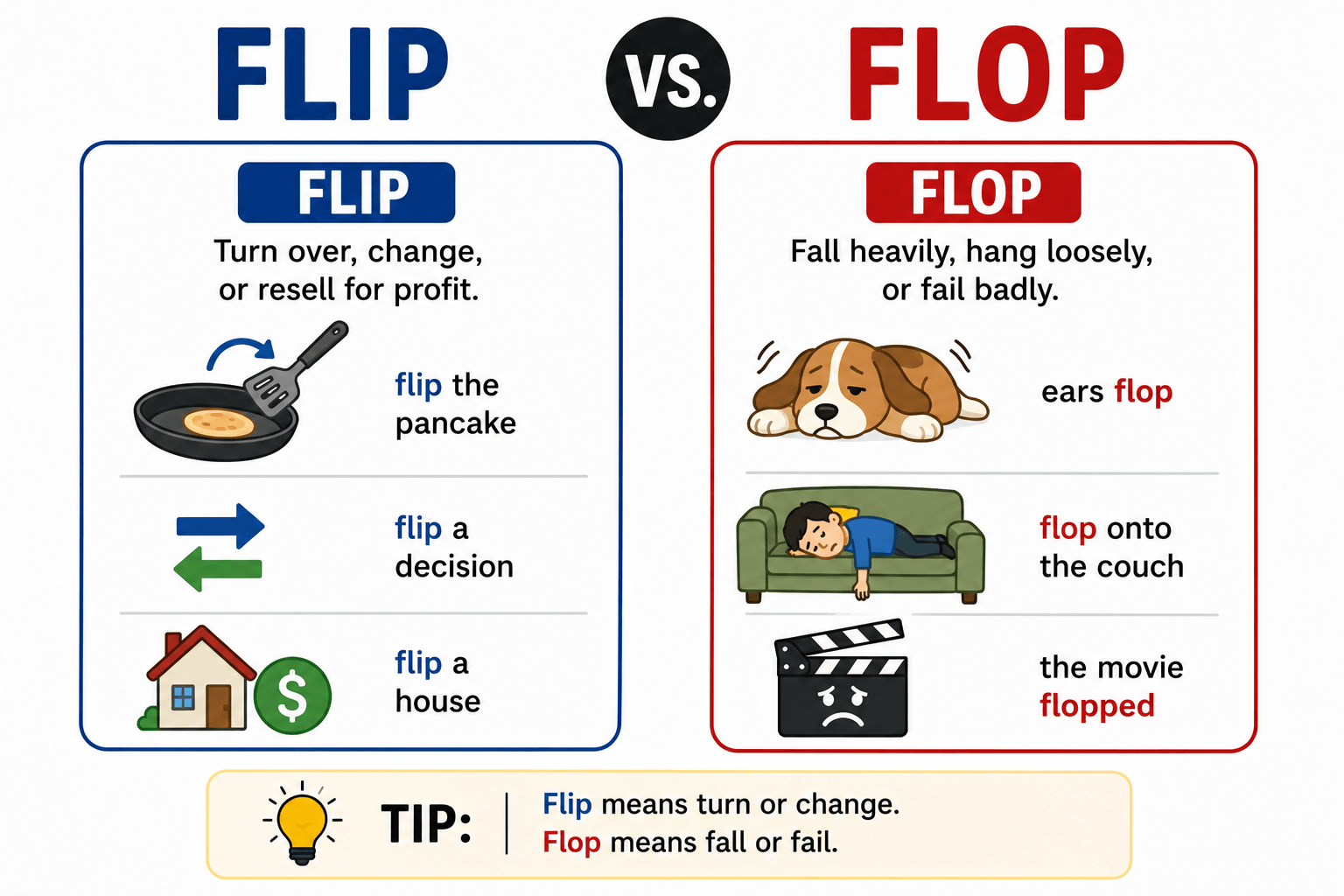
Flip and flop are both correct words, but they do not mean the same thing. Use flip when something turns over, changes quickly, is resold for profit, or moves with a quick turning action. Use flop when something falls heavily, hangs loosely, or fails badly. The phrase flip or flop often suggests a risky result: something may succeed, or it may fail.
Quick Answer
Use flip when something turns over, changes position, or is resold for profit.
- She will flip the pancake.
- He plans to flip the house after renovating it.
- The gymnast did a back flip.
Use flop when something falls, drops loosely, or fails.
- The dog’s ears flop when it runs.
- He was so tired that he flopped onto the couch.
- The movie was a box office flop.
The simple rule is: flip means turn or change quickly. Flop means fall, hang loosely, or fail.
Flip or Flop: What Is the Difference?
The difference between flip and flop is mostly action and result. Flip usually suggests movement, turning, switching, or transformation. Flop usually suggests falling, drooping, weakness, or failure.
Flip can be a verb or a noun. As a verb, it can mean to turn something over, move quickly, change suddenly, or sell something after improving it. As a noun, it can mean a turning movement, a quick change, or a physical trick.
Flop can also be a verb or a noun. As a verb, it can mean to fall heavily, drop loosely, or fail. As a noun, it can mean a failure, especially a movie, show, product, business idea, or plan that does not succeed.
| Word | Main Meaning | Example |
|---|---|---|
| Flip | Turn over, switch, change, or resell | She will flip the card. |
| Flop | Fall heavily, hang loosely, or fail | The plan was a flop. |
If your sentence is about turning something over, use flip. If your sentence is about something failing or falling heavily, use flop.
What Does Flip Mean?
Flip most often means to turn something over quickly. You can flip a pancake, flip a coin, flip a card, flip a switch, or flip through pages.
Examples:
- Please flip the card over.
- She tried to flip the pancake without breaking it.
- He used his thumb to flip the switch.
- The child watched the coin flip in the air.
- She began to flip through the magazine.
Flip can also mean to change something quickly. Someone may flip their opinion, mood, decision, or position.
- He seemed to flip from calm to angry in seconds.
- The vote could flip the final result.
- She decided to flip her schedule around.
In these examples, flip suggests a quick turn, change, or reversal.
What Does Flop Mean?
Flop means to fall, drop, or collapse in a loose or heavy way. It often suggests that something has little control, strength, or stiffness.
Examples:
- He flopped onto the bed after work.
- The wet towel flopped onto the floor.
- The puppy’s ears flop as it runs.
- She let her bag flop beside the chair.
Flop can also mean to fail badly. This use is common when talking about entertainment, business, products, plans, or public reactions.
- The movie was a flop.
- The new product flopped after launch.
- His first business idea was a complete flop.
- The joke flopped because nobody laughed.
In these examples, flop means failure, disappointment, or weak performance.
Flip as a Verb
As a verb, flip can describe physical movement, quick change, or financial resale.
Examples:
- She will flip the omelet.
- He tried to flip the mattress by himself.
- The gymnast can flip in the air.
- The investor wants to flip the property.
- The company hopes to flip public opinion.
When people talk about real estate, flip often means to buy a property, improve it, and sell it for profit.
- They bought an old house to flip.
- She learned how to flip homes for extra income.
This meaning is very common in home improvement, real estate, and investment writing.
Flop as a Verb
As a verb, flop can describe loose falling or failure.
Examples:
- He flopped into the chair.
- The hat flopped over his eyes.
- The flowers flopped in the heat.
- The campaign flopped after one week.
- The show flopped with critics and audiences.
When flop means fail, it usually sounds informal. It is common in headlines, reviews, casual conversation, and entertainment writing.
Flip as a Noun
Flip can also be a noun. A flip can be a turning movement, a gymnastic trick, or a quick change.
Examples:
- She did a perfect back flip.
- The coin landed after one flip.
- The decision was a sudden flip.
- The house flip took six months.
In business or real estate, a flip can refer to a project where something is bought, improved, and sold again.
- The home flip made a profit.
- That was their first successful flip.
Flop as a Noun
Flop can be a noun meaning a failure. This use is common for movies, shows, books, products, events, and plans.
Examples:
- The movie was a flop.
- The party was a complete flop.
- The new app turned into a flop.
- His first attempt was a flop, but he tried again.
A flop can also describe a loose fall or movement.
- He landed on the couch with a tired flop.
- The fish made one final flop in the bucket.
What Does “Flip or Flop” Mean?
The phrase flip or flop often suggests uncertainty. It can describe a situation where something might succeed or fail. The word flip can suggest a successful turnaround, while flop suggests failure.
Examples:
- The renovation could flip or flop depending on the budget.
- The new product may flip or flop once customers try it.
- The plan was risky; it could flip or flop.
This phrase is especially natural when discussing business ideas, home projects, creative work, investments, or anything with an uncertain outcome.
Flip-Flop as a Separate Word
Flip-flop is different from flip or flop. With a hyphen, flip-flop can mean a type of sandal or a sudden change in opinion.
Examples:
- She wore flip-flops to the beach.
- The politician was accused of a flip-flop on the issue.
- He tends to flip-flop when making decisions.
Use flip-flop for sandals or repeated changes in position. Use flip and flop separately when talking about turning, falling, success, or failure.
Examples of Flip in Sentences
Here are natural examples of flip used correctly:
- She used a spatula to flip the burger.
- He watched the coin flip through the air.
- The athlete performed a front flip.
- They hope to flip the house by summer.
- The teacher asked him to flip to page twenty.
- The result could flip after the final vote.
- She made a quick flip in her opinion.
- He bought the table cheaply and planned to flip it online.
These examples show turning, changing, moving, or reselling.
Examples of Flop in Sentences
Here are natural examples of flop used correctly:
- He flopped onto the sofa after practice.
- The dog’s ears flop when it runs.
- The play was a surprising flop.
- The product flopped because it was too expensive.
- The wet paper began to flop over the edge of the table.
- The joke flopped in front of the crowd.
- The team’s new strategy was a flop.
- She let herself flop into the chair.
These examples show falling, drooping, or failing.
Common Mistakes to Avoid
The biggest mistake is using flop when you mean flip.
Incorrect:
- Please flop the pancake.
- He wants to flop the house for profit.
Correct:
- Please flip the pancake.
- He wants to flip the house for profit.
Another mistake is using flip when you mean failure.
Incorrect:
- The movie was a total flip.
Correct:
- The movie was a total flop.
If something turns over or changes, use flip. If something fails or falls heavily, use flop.
How to Remember Flip or Flop
Here is an easy way to remember the difference:
Flip is quick and turning.
Flop is heavy and failing.
- Flip = turn, switch, change, resell
- Flop = fall, droop, fail
You can also remember this sentence:
You flip a pancake, but a bad plan can flop.
Final Answer
Flip and flop are both correct words. Use flip when something turns over, changes quickly, switches, or is resold for profit. Use flop when something falls heavily, droops, or fails badly. The phrase flip or flop often suggests an uncertain result: something may turn into a success, or it may become a failure.