Past or Passed: Correct Meaning, Grammar Difference, Usage, and Easy Examples Explained
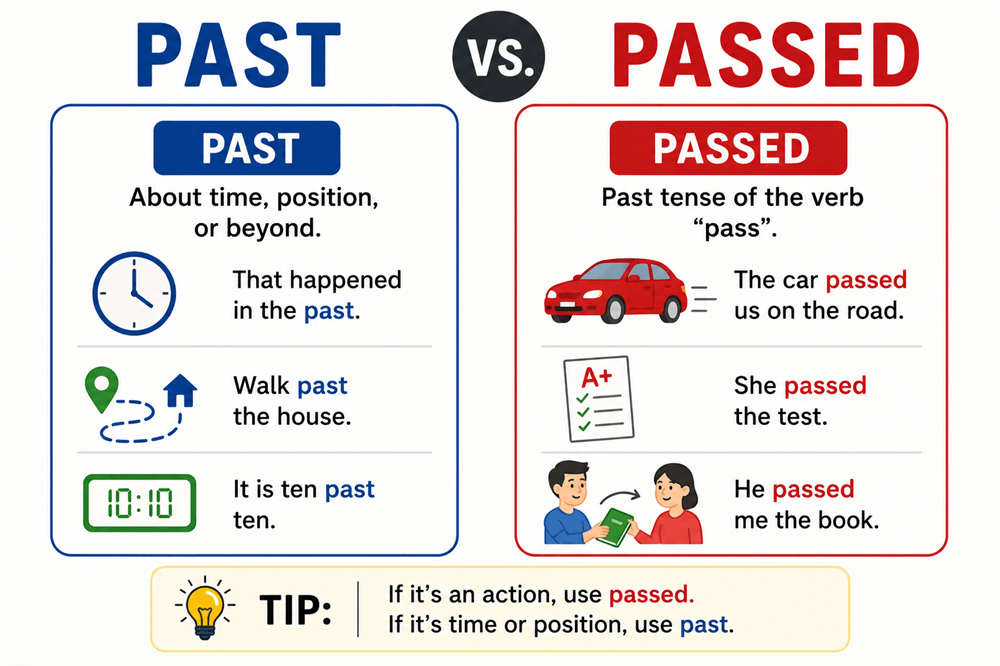
Past and passed are both correct words, but they are used differently. Use past when talking about time before now, movement beyond something, or a position farther than something. Use passed as the past tense of pass. The easiest rule is: passed is usually an action, while past is usually about time, place, or direction.
Quick Answer
Use past when you mean before now, beyond, or after a certain point.
- She walked past the store.
- That happened in the past.
- It is half past six.
Use passed when you need the past tense of the verb pass.
- She passed the store on her way home.
- He passed the exam.
- The car passed us on the road.
The simple rule is: past is not a verb. Passed is the past tense of the verb pass.
Past or Passed: What Is the Difference?
The difference between past and passed is grammar. They can sound the same, but they do not do the same job in a sentence.
Past can be a noun, adjective, adverb, or preposition. It usually has to do with time before now, something beyond a place, or movement by a point.
Passed is a verb. It is the simple past tense and past participle of pass. It describes an action that already happened.
| Word | Grammar | Main Meaning | Example |
|---|---|---|---|
| Past | Noun, adjective, adverb, or preposition | Before now, beyond, or after a point | We drove past the school. |
| Passed | Verb | Went by, succeeded, handed over, or approved | We passed the school. |
If the word is doing an action, use passed. If the word is describing time, direction, location, or a point beyond something, use past.
What Does Past Mean?
Past often refers to time before the present. It can mean earlier, former, previous, or no longer happening.
Examples:
- That happened in the past.
- She does not like talking about her past.
- The past year was difficult.
- In past meetings, the team discussed the same issue.
Past can also mean beyond a place or point.
- The library is just past the bank.
- He ran past the finish line.
- We walked past the old theater.
In these examples, past does not show an action by itself. It shows time, position, or direction.
What Does Passed Mean?
Passed is the past tense of pass. It means went by, moved beyond, handed something to someone, succeeded in a test, approved a rule, or came to an end.
Examples:
- She passed me the salt.
- The truck passed us on the highway.
- He passed the final exam.
- The city council passed a new law.
- Several hours passed before they returned.
In each example, passed describes an action. Someone passed something, a vehicle passed someone, time passed, or a person passed a test.
Past as a Noun
Past can be a noun when it means earlier time or previous events.
Examples:
- The past cannot be changed.
- She learned from her past.
- They wanted to leave the past behind.
- His past shaped the person he became.
When past is a noun, it usually has a word like the, her, his, my, or their before it.
Past as an Adjective
Past can be an adjective when it describes a noun. In this use, it means previous, former, or already finished.
Examples:
- The past month has been busy.
- Her past experience helped her get the job.
- In past years, the event was smaller.
- The past mistakes taught him a lesson.
In these sentences, past describes a month, experience, years, or mistakes. It tells you those things belong to an earlier time.
Past as a Preposition
Past can be a preposition when it means beyond or farther than something.
Examples:
- The cafe is past the post office.
- She walked past my house.
- The dog ran past the gate.
- Drive past the school and turn left.
In these sentences, past shows position or direction. It tells where someone or something went in relation to another place.
Passed as a Verb
Passed is always connected to the verb pass. If you can change the sentence to present tense with pass or passes, then passed is probably correct.
Examples:
- She passed the note. → She passes the note.
- The car passed us. → The car passes us.
- He passed the test. → He passes the test.
This test is helpful because past cannot work as a verb. You would not say she past the note or he past the test.
Walked Past or Passed?
Both walked past and passed can be correct, but the grammar is different.
Use walked past when walked is the verb and past shows direction.
- She walked past the store.
- He walked past me without speaking.
Use passed when passed itself is the verb.
- She passed the store.
- He passed me without speaking.
The meaning can be similar, but the sentence structure changes. In walked past, the action word is walked. In passed, the action word is passed.
Past Due or Passed Due?
The correct phrase is past due, not passed due.
Past due means late, overdue, or beyond the expected payment date.
Correct:
- The bill is past due.
- Your payment is now past due.
- The account has a past-due balance.
Incorrect:
- The bill is passed due.
Use past here because the due date is already behind you in time.
Passed Away or Past Away?
The correct phrase is passed away.
Passed away is a gentle way to say someone died.
Correct:
- Her grandfather passed away last year.
- He passed away peacefully.
Incorrect:
- Her grandfather past away last year.
Use passed because the phrase comes from the verb pass.
Past Tense or Passed Tense?
The correct phrase is past tense.
Past tense refers to a verb form that shows an action happened before now.
Correct:
- Passed is the past tense of pass.
- Use the past tense for events that already happened.
Incorrect:
- Use the passed tense for events that already happened.
Use past because the phrase describes a type of tense connected to earlier time.
Examples of Past in Sentences
Here are natural examples of past used correctly:
- The store is just past the traffic light.
- She looked back on the past with mixed feelings.
- It is ten past nine.
- The dog ran past the fence.
- He has changed a lot in the past year.
- They moved past the old argument.
- The problem is now in the past.
- The deadline is past.
These examples are about time, direction, position, or earlier events.
Examples of Passed in Sentences
Here are natural examples of passed used correctly:
- She passed the exam on her first try.
- The runner passed the finish line.
- He passed the message to his friend.
- The law was passed last month.
- Three weeks passed before they replied.
- The bus passed our stop.
- She passed him in the hallway.
- The storm passed during the night.
These examples all use passed as a verb form.
Common Mistakes to Avoid
The most common mistake is using past when the sentence needs the verb passed.
Incorrect:
- She past the test.
- The car past us.
- He past me the phone.
Correct:
- She passed the test.
- The car passed us.
- He passed me the phone.
Another mistake is using passed in fixed phrases that need past.
Incorrect:
- The payment is passed due.
- That happened in the passed.
- Use the passed tense.
Correct:
- The payment is past due.
- That happened in the past.
- Use the past tense.
How to Remember Past or Passed
Here is an easy way to remember the difference:
Passed has -ed because it is a past-tense verb.
Past is usually about time, place, or direction.
- Passed = did the action of passing
- Past = earlier time, beyond, or after a point
You can also remember this sentence:
She passed the store and walked past the door.
In that sentence, passed is the action, and past shows direction.
Final Answer
Past and passed are both correct, but they are not interchangeable. Use past for earlier time, beyond a place, after a point, or phrases like past due and past tense. Use passed as the past tense of pass, as in passed the test, passed the store, or passed away. Remember: passed is a verb, while past is usually about time, place, or direction.