Tons or Tonnes: What’s the Difference and When to Use Each?
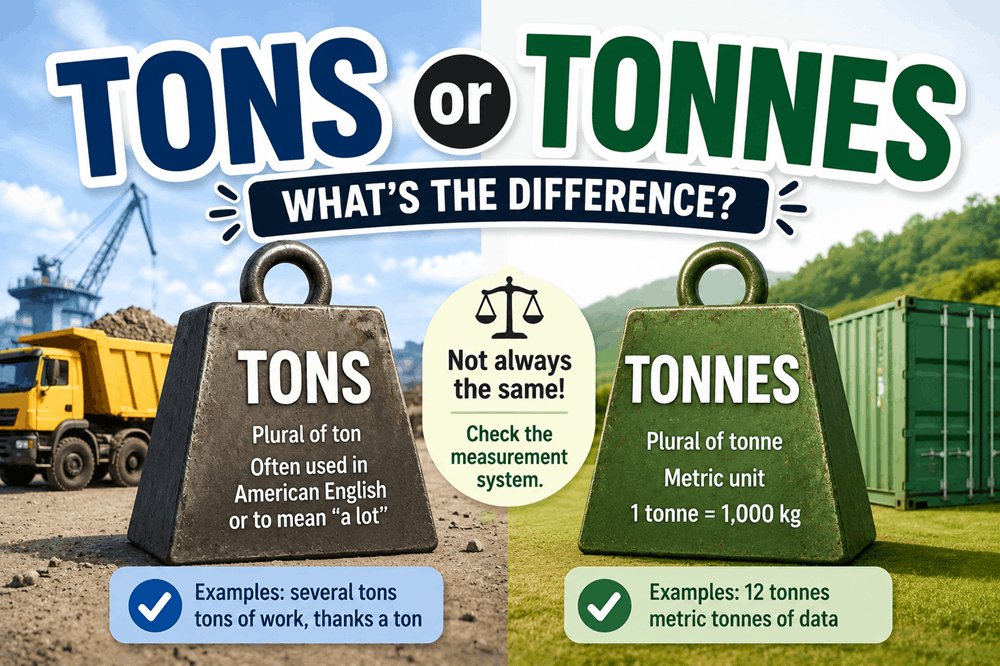
Tons and tonnes are both correct, but they are not always used the same way. Use tons for the plural of ton, especially in American English or casual phrases like “tons of work.” Use tonnes when you mean metric tonnes, especially in British, Australian, Canadian, or international writing.
In U.S. technical writing, you may also see metric tons instead of tonnes. Both can refer to the same metric amount: 1,000 kilograms.
Tons or Tonnes: Simple Examples
- Correct: The truck carried several tons of gravel.
- Correct: The shipment weighed 12 tonnes.
- Correct: The shipment weighed 12 metric tons.
- Correct: I have tons of emails to answer.
If you mean “a lot,” use tons. If you mean a metric weight, use tonnes or metric tons, depending on your audience.
What Does Tons Mean?
Tons is the plural of ton. A ton is a large unit of weight, but its exact meaning can depend on the measurement system.
In American English, a ton often means a short ton, which is 2,000 pounds. You may see this use in shipping, construction, vehicles, farming, and everyday U.S. writing.
- The machine weighs three tons.
- The company ordered five tons of steel.
- The truck carried two tons of sand.
Tons is also common in casual speech. In this use, it means “a lot,” not an exact weight.
- I have tons of homework tonight.
- She has tons of ideas for the project.
- Thanks a ton for your help.
What Does Tonnes Mean?
Tonnes is the plural of tonne. A tonne is a metric unit equal to 1,000 kilograms. It is also called a metric ton.
- The factory produced 50 tonnes of steel.
- The report measured emissions in tonnes of carbon dioxide.
- The ship carried thousands of tonnes of grain.
- The project removed 10 tonnes of waste from the site.
Tonnes is common in British English and many international contexts. In American English, metric tons is often clearer for U.S. readers.
Tons vs Tonnes: Quick Comparison
| Word | Main Meaning | Common Use |
|---|---|---|
| tons | More than one ton, or casually “a lot” | American English, everyday writing, informal phrases |
| tonnes | More than one metric tonne | British English, international writing, metric measurements |
| metric tons | The same metric amount as tonnes | U.S. technical or formal writing |
When to Use Tons
Use tons when you are writing in American English, using non-metric weight, or speaking casually.
- The bridge can hold several tons.
- They moved two tons of rock.
- We had tons of fun at the party.
For casual phrases, tons is the normal choice:
- tons of time
- tons of work
- tons of people
- thanks a ton
When to Use Tonnes
Use tonnes when you mean metric tonnes. This is useful in formal, scientific, environmental, shipping, farming, mining, and international writing.
- The country exported 2 million tonnes of wheat.
- The plant reduced emissions by 800 tonnes.
- The load limit is 20 tonnes.
If you are writing for mostly U.S. readers, metric tons may be easier to understand than tonnes.
Common Mistake
The common mistake is using tons and tonnes as if they always mean the same thing.
In casual writing, this may not matter much. But in shipping, science, climate reports, construction, farming, or business, the difference can matter. If exact weight is important, check whether the source means tons, short tons, long tons, tonnes, or metric tons.
Memory Tip for Tons or Tonnes
Think of tonnes as the metric word. It has an extra ne, and it points to the metric tonne: 1,000 kilograms.
Think of tons as the everyday word. It works for normal phrases like tons of work, tons of people, and thanks a ton.
Final Reminder
Use tons for the plural of ton or for casual phrases meaning “a lot.” Use tonnes for metric tonnes. For U.S. readers, metric tons may be clearer than tonnes when exact metric weight matters.