Breathe or Breath: Correct Meaning, Difference, Pronunciation, Usage, and Examples Clearly Explained
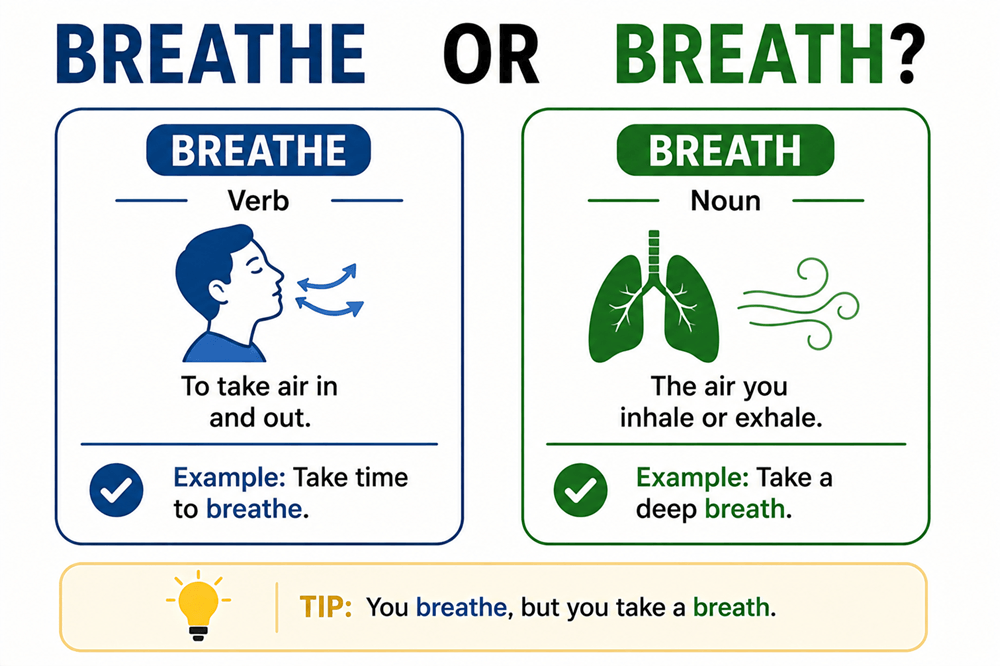
Breathe and breath are both correct words, but they are used differently. Breathe is a verb that means to take air into the lungs and let it out again. Breath is a noun that means the air you inhale or exhale. The easiest rule is simple: you breathe, but you take a breath.
Quick Answer
Use breathe when you need a verb, meaning the action of inhaling and exhaling.
- Correct: Remember to breathe slowly.
- Correct: She could barely breathe after running.
- Correct: The doctor told him to breathe deeply.
Use breath when you need a noun, meaning the air taken in or released.
- Correct: Take a deep breath.
- Correct: His breath was visible in the cold air.
- Correct: She held her breath underwater.
The simple rule is this: breathe is the action, and breath is the thing.
Breathe or Breath: What Is the Difference?
The difference between breathe and breath is grammar and pronunciation. Breathe is a verb. It describes an action. Breath is a noun. It names the air that moves in or out of the lungs.
If someone is doing something with air, use breathe. If you are talking about the air itself, use breath.
| Word | Part of Speech | Meaning | Example |
|---|---|---|---|
| Breathe | Verb | To inhale and exhale | Try to breathe slowly. |
| Breath | Noun | Air taken in or let out | Take a slow breath. |
These words are often confused because they look almost the same. The final e changes both the word’s job and its sound. Breathe ends with a voiced th sound, like the sound in bathe. Breath ends with a sharper th sound, like the sound in bath.
What Does Breathe Mean?
Breathe means to take air into the lungs and let it out. It is a verb, so it shows an action. People breathe, animals breathe, and in a figurative sense, even places or situations can “breathe” when they feel open, calm, or alive.
Examples:
- She stopped to breathe after climbing the stairs.
- The nurse asked him to breathe in and out.
- It was hard to breathe in the smoky room.
- He tried to breathe calmly before the speech.
In each sentence, breathe describes the action of inhaling and exhaling. It tells what someone is doing.
Breathe can also be used in a less literal way. When someone says they can finally breathe, they may mean they feel relieved, free, or less stressed.
- After the exam ended, she could finally breathe.
- The weekend gave him space to breathe.
- The room felt easier to breathe in after the windows were opened.
Whether the meaning is literal or figurative, breathe remains the verb.
What Does Breath Mean?
Breath means the air that is taken into or released from the lungs. It is a noun, so it names something. You can take a breath, hold your breath, catch your breath, lose your breath, or feel someone’s breath.
Examples:
- Take a deep breath before you answer.
- His breath smelled like mint.
- She held her breath while waiting for the results.
- The cold air made every breath visible.
In each sentence, breath is the thing being taken, held, smelled, or seen. It does not describe the action itself.
Breath also appears in many common expressions.
- out of breath
- short of breath
- bad breath
- a breath of fresh air
- catch your breath
- hold your breath
In all of these phrases, the correct word is breath, not breathe.
Breathe vs Breath Pronunciation
Breathe and breath are pronounced differently. The final sound is the key.
- Breathe sounds like “breeth.”
- Breath sounds like “breth.”
Breathe has a longer vowel sound and a softer final sound. Breath has a shorter vowel sound and a sharper ending.
A helpful comparison is:
- Breathe rhymes with seethe.
- Breath rhymes with death.
The spelling difference helps signal the pronunciation difference. The final e in breathe changes the sound and marks the word as a verb.
When to Use Breathe
Use breathe when the sentence needs a verb. If someone or something is doing the action of inhaling and exhaling, breathe is correct.
Examples:
- Try to breathe through your nose.
- The baby began to breathe normally.
- He could not breathe well during the allergy attack.
- She reminded herself to breathe before speaking.
- The yoga teacher told the class to breathe deeply.
Use breathe in phrases like:
- breathe in
- breathe out
- breathe deeply
- breathe slowly
- breathe easily
- can’t breathe
- learn to breathe
- remember to breathe
If the word is something a person can do, the correct spelling is usually breathe.
When to Use Breath
Use breath when the sentence needs a noun. If you are talking about the air itself, or one cycle of inhaling and exhaling, use breath.
Examples:
- Take one deep breath.
- She paused for a breath before continuing.
- He was out of breath after the race.
- The dog’s breath fogged the window.
- His breath came quickly after the long run.
Use breath in phrases like:
- deep breath
- bad breath
- fresh breath
- shortness of breath
- hold your breath
- catch your breath
- take a breath
- out of breath
If you can place a, the, my, your, or his before the word, you probably need the noun breath.
Take a Breath or Take a Breathe?
The correct phrase is take a breath.
Correct:
- Take a breath before you answer.
- She took a breath and opened the door.
- He took one last breath before diving underwater.
Incorrect:
- Take a breathe before you answer.
- She took a breathe and opened the door.
- He took one last breathe before diving underwater.
After take a, you need a noun. Since breath is the noun, take a breath is correct.
Can’t Breathe or Can’t Breath?
The correct phrase is can’t breathe.
Correct:
- I can’t breathe in this tight mask.
- He said he couldn’t breathe after running so hard.
- She opened the window because she could barely breathe.
Incorrect:
- I can’t breath in this tight mask.
- He said he couldn’t breath after running so hard.
- She opened the window because she could barely breath.
After can, can’t, could, or couldn’t, you need the base form of a verb. Since the verb is breathe, the correct phrase is can’t breathe.
Out of Breath or Out of Breathe?
The correct phrase is out of breath.
Correct:
- She was out of breath after climbing the hill.
- He arrived late and out of breath.
- The children were out of breath from laughing.
Incorrect:
- She was out of breathe after climbing the hill.
- He arrived late and out of breathe.
- The children were out of breathe from laughing.
Out of breath describes the state of not having enough air after effort, stress, laughing, running, or excitement. Since breath is the noun, it is the correct word in this phrase.
Hold Your Breath or Hold Your Breathe?
The correct phrase is hold your breath.
Correct:
- Hold your breath while swimming underwater.
- She held her breath during the scary scene.
- The crowd held its breath before the final shot.
Incorrect:
- Hold your breathe while swimming underwater.
- She held her breathe during the scary scene.
- The crowd held its breathe before the final shot.
In this phrase, breath is the thing being held. That makes it a noun.
Breathe In or Breath In?
The correct phrase is breathe in when you mean inhale.
Correct:
- Breathe in slowly through your nose.
- The instructor told the class to breathe in and relax.
- Breathe in for four seconds, then breathe out.
Incorrect:
- Breath in slowly through your nose.
- The instructor told the class to breath in and relax.
Breathe in is an action, so it needs the verb breathe. The opposite phrase is breathe out.
Deep Breath or Deep Breathe?
The correct phrase is deep breath.
Correct:
- Take a deep breath.
- He took a deep breath before speaking.
- A deep breath helped her calm down.
Incorrect:
- Take a deep breathe.
- He took a deep breathe before speaking.
- A deep breathe helped her calm down.
Deep describes the noun breath. Since the phrase names a thing, use breath.
Breath as a Countable and Uncountable Noun
Breath can be countable or uncountable depending on the sentence. When you talk about one inhale-exhale cycle, it can be counted.
- Take three slow breaths.
- She took a breath before answering.
- His final breath was quiet.
When you talk about breath more generally, it can be uncountable.
- His breath smelled like coffee.
- The cold made her breath visible.
- Fresh breath matters before an interview.
The plural form is breaths, not breathes. Breathes is a verb form, as in she breathes quietly.
Breathes vs Breaths
Breathes and breaths are also easy to confuse. Breathes is a verb. Breaths is a plural noun.
| Word | Part of Speech | Example |
|---|---|---|
| Breathes | Verb | She breathes slowly. |
| Breaths | Plural noun | She took three slow breaths. |
Examples:
- Correct: The baby breathes quietly.
- Correct: Take two deep breaths.
- Correct: He breathes through his mouth when he sleeps.
- Correct: Her breaths became slower as she relaxed.
If the word shows an action, use breathes. If it means more than one breath, use breaths.
Common Mistakes With Breathe and Breath
The most common mistake is using breath when the sentence needs the verb breathe.
Incorrect:
- Try to breath slowly.
- I cannot breath in this room.
- She needs to breath before continuing.
Correct:
- Try to breathe slowly.
- I cannot breathe in this room.
- She needs to breathe before continuing.
Another common mistake is using breathe when the sentence needs the noun breath.
Incorrect:
- Take a deep breathe.
- He was short of breathe.
- She held her breathe underwater.
Correct:
- Take a deep breath.
- He was short of breath.
- She held her breath underwater.
To avoid confusion, ask whether the sentence needs an action or a thing. An action needs breathe. A thing needs breath.
Examples of Breathe in Sentences
Here are examples of breathe used correctly:
- Remember to breathe before answering.
- She could breathe more easily after opening the window.
- The doctor asked him to breathe deeply.
- It was difficult to breathe in the thick smoke.
- He stopped running and tried to breathe slowly.
- The yoga teacher told everyone to breathe in and breathe out.
- After the stressful week ended, she could finally breathe.
- Plants do not breathe the same way humans do.
In each sentence, breathe is a verb. It describes the action of taking air in and letting it out.
Examples of Breath in Sentences
Here are examples of breath used correctly:
- Take a breath and try again.
- His breath was warm in the cold air.
- She held her breath while waiting for the answer.
- The climb left him out of breath.
- A fresh breath of air came through the window.
- He paused to catch his breath.
- The dog’s breath smelled terrible.
- Her breath became steady as she relaxed.
In each sentence, breath is a noun. It names the air, the act of taking in air, or the state connected with breathing.
How to Remember Breathe or Breath
A simple way to remember the difference is this:
- Breathe = verb
- Breath = noun
You can also remember this sentence:
You breathe when you take a breath.
That sentence uses both words correctly. Breathe is what you do. Breath is what you take.
Another helpful trick is to look for the final e. The word breathe has an e, and exercise also has an e. Breathing is something you do, especially during exercise. That final e can remind you that breathe is the action word.
Final Answer
Breathe is a verb that means to inhale and exhale. Use it when describing the action of taking air in and letting it out, as in breathe deeply, breathe slowly, can’t breathe, and breathe in.
Breath is a noun that means the air you take in or let out. Use it in phrases like take a breath, deep breath, hold your breath, bad breath, and out of breath. The easiest rule is simple: you breathe, but you take a breath.