Inquire or Enquire: Which Word Should You Use?
Inquire and enquire are both correct words. They usually mean the same thing: to ask for information.
The main difference is regional and stylistic.
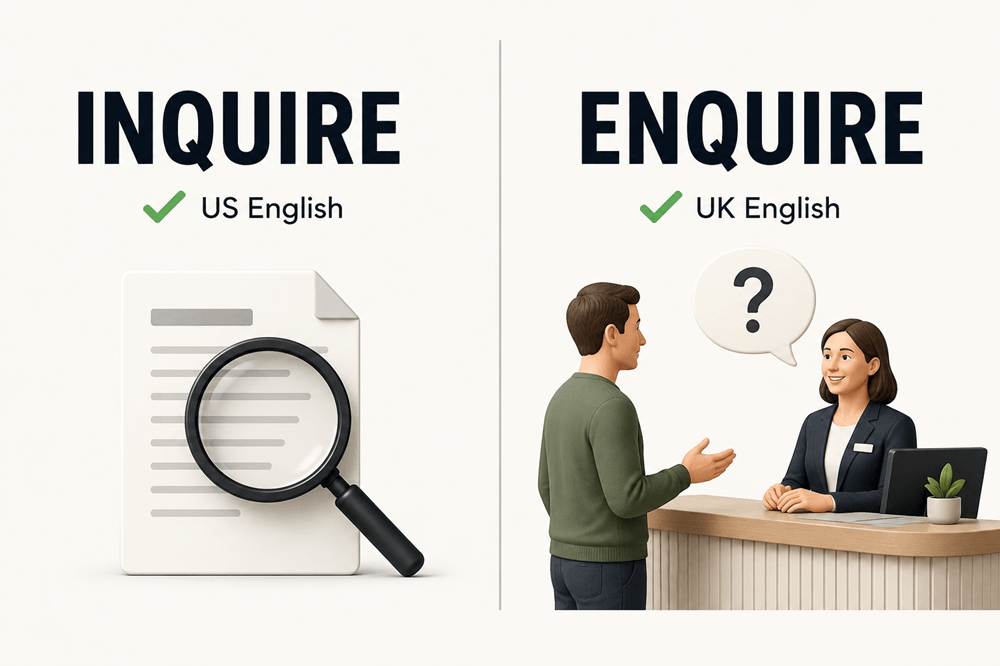
In American English, use inquire for almost all situations.
In British English, enquire is often used for general questions, while inquire is often used for formal investigations.
Examples:
- American English: I want to inquire about the job opening.
- British English: I want to enquire about the job opening.
- Formal use: The committee will inquire into the complaint.
So, if you are writing for a U.S. audience, inquire is usually the safest choice. If you are writing for a U.K. audience, enquire may sound more natural for everyday questions.
Quick Answer
Use inquire in American English.
Use enquire in British English for ordinary questions.
Use inquire for formal investigations, especially in legal, official, or serious contexts.
Examples:
- I called to inquire about the price.
- She emailed to enquire about the course.
- The police will inquire into the matter.
Both words are correct, but they do not always feel the same in every region.
What Does Inquire Mean?
Inquire means to ask for information. It can be used in everyday writing, business writing, or formal writing.
Examples:
- I am writing to inquire about your services.
- He called to inquire whether the room was available.
- Visitors may inquire at the front desk.
- The manager will inquire into the missing funds.
In American English, inquire is the standard spelling for both ordinary questions and formal investigations.
That means an American writer would usually use inquire in both of these sentences:
- I want to inquire about delivery times.
- Officials will inquire into the accident.
The same spelling works for both meanings.
What Does Enquire Mean?
Enquire also means to ask for information.
It is more common in British English, especially when the meaning is simple and everyday.
Examples:
- I called to enquire about train times.
- She went to the desk to enquire about tickets.
- Please enquire before making a booking.
- He emailed to enquire about the position.
In British English, enquire often feels natural when you mean “ask a question.” It is common in customer service, travel, booking, and general communication.
However, enquire is less common in American English. Many American readers may understand it, but it can look British or unusual.
Inquire vs Enquire: The Main Difference
The main difference is usage.
Inquire is the standard American spelling.
Enquire is a common British spelling for general questions.
In British English, there is also a useful distinction:
Enquire often means to ask a simple question.
Inquire often means to investigate formally.
For example:
- I will enquire about the hotel room.
- The government will inquire into the scandal.
The first sentence is about asking for information. The second sentence is about an official investigation.
This difference is not always followed perfectly, but it is a helpful guide.
Inquiry or Enquiry?
The same difference appears with the noun forms: inquiry and enquiry.
In American English, use inquiry.
Examples:
- Thank you for your inquiry.
- We received your inquiry about the product.
- The police opened an inquiry.
In British English, enquiry is often used for a general question, while inquiry is often used for a formal investigation.
Examples:
- Thank you for your enquiry about the course.
- A public inquiry was held after the incident.
So the pattern is similar:
Enquiry = general question, especially in British English
Inquiry = formal investigation, or the standard American form
Is Enquire Wrong?
No. Enquire is not wrong.
It is a standard word, especially in British English. It is often used in phrases like:
- enquire within
- enquire at reception
- enquire about availability
- customer enquiries
However, if you are writing for an American audience, enquire may look less familiar. In the U.S., inquire and inquiry are much more common in standard writing.
For American English, it is better to write:
- Please inquire at the front desk.
- Thank you for your inquiry.
For British English, you may write:
- Please enquire at reception.
- Thank you for your enquiry.
Is Inquire Wrong in British English?
No. Inquire is also correct in British English.
British writers often use inquire when the meaning is more formal, official, or investigative.
Examples:
- The judge will inquire into the evidence.
- Officials launched an inquiry into the accident.
- The committee was asked to inquire into the claims.
In everyday British English, enquire may feel softer or more ordinary. But inquire is still correct, especially when the context is serious.
How to Remember the Difference
A simple memory trick:
Enquire starts with en, like everyday.
So you can remember:
enquire = everyday question
Example:
- I want to enquire about the opening hours.
Inquire starts with in, like investigate.
So you can remember:
inquire = investigation
Example:
- The committee will inquire into the problem.
This trick works especially well for British English.
For American English, the rule is even simpler:
Use inquire for both meanings.
Spelling Structure
The two words are almost identical.
Inquire is spelled:
i-n-q-u-i-r-e
Enquire is spelled:
e-n-q-u-i-r-e
The only difference is the first letter:
- inquire starts with i
- enquire starts with e
That first letter can help you remember the meaning:
i in inquire can remind you of investigate.
e in enquire can remind you of everyday question.
This is not a strict rule everywhere, but it is useful for remembering the British distinction.
Common Mistakes
Mistake 1: Thinking enquire is incorrect
Incorrect idea:
- Enquire is a misspelling of inquire.
Correct idea:
- Enquire is correct, especially in British English.
Example:
- Please enquire at the front desk.
This sentence is natural in British English.
Mistake 2: Using enquire in formal American writing
Less natural in American English:
- I am writing to enquire about the position.
Better for American English:
- I am writing to inquire about the position.
American readers usually expect inquire.
Mistake 3: Forgetting the formal investigation use
Less precise in British English:
- The government will enquire into the incident.
More formal:
- The government will inquire into the incident.
For official investigations, inquire is often the better choice.
Example Sentences
American English:
- I called to inquire about the schedule.
- She wrote to inquire about the job.
- The board will inquire into the complaint.
- Thank you for your inquiry.
British English:
- I called to enquire about the schedule.
- She wrote to enquire about the job.
- The board will inquire into the complaint.
- Thank you for your enquiry.
Formal investigation:
- Officials will inquire into the cause of the fire.
- The school opened an inquiry into the incident.
Final Answer: Inquire or Enquire?
Inquire and enquire are both correct.
Use inquire in American English.
Use enquire in British English for general questions.
Use inquire for formal investigations, especially in official or legal contexts.
The easiest way to remember the difference is:
Enquire = everyday question
Inquire = investigation
For most U.S. writing, choose inquire. For British writing, use enquire for ordinary questions and inquire for formal investigations.