Manuel or Manual: Which Spelling Is Correct?
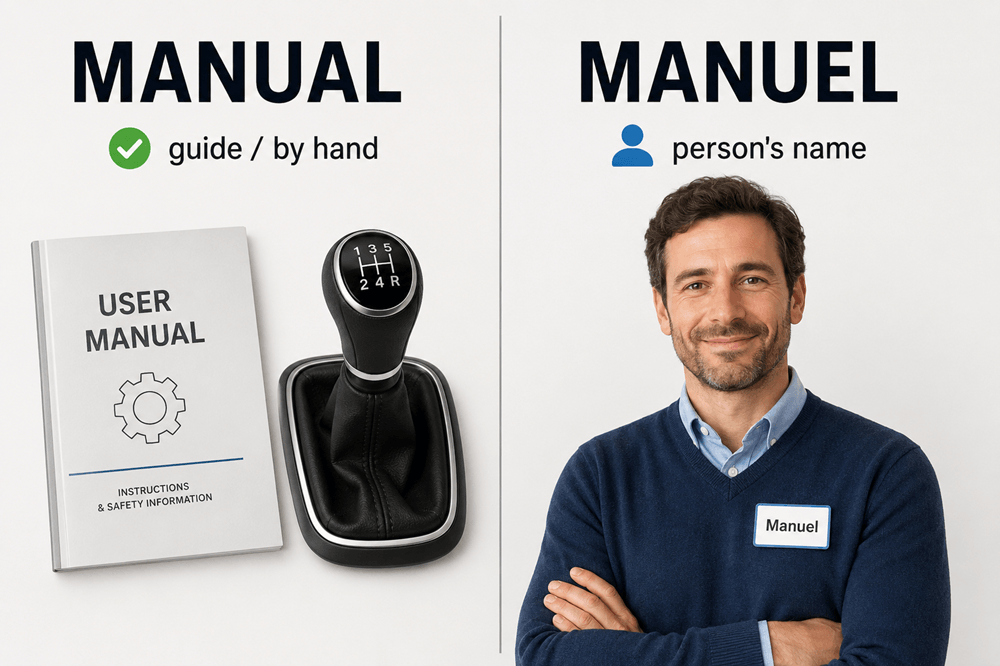
Manual and Manuel are both real words, but they mean very different things.
Use manual when you mean a handbook, guide, or something done by hand.
Use Manuel only as a person’s name.
Examples:
- Read the instruction manual before using the machine.
- This car has a manual transmission.
- The job requires manual labor.
- Manuel is coming to the meeting at noon.
The most common mistake is writing Manuel when you mean manual. If you are not talking about a person’s name, the correct word is almost always manual.
Quick Answer
Use manual for a guide, handbook, or hand-operated action.
Use Manuel as a proper name.
Correct:
- I lost the user manual.
Incorrect:
- I lost the user Manuel.
Correct as a name:
- Manuel gave me the user manual.
That sentence works because Manuel is a person, and manual is the guide.
What Does Manual Mean?
Manual can be a noun or an adjective.
As a noun, manual means a book or guide that gives instructions.
Examples:
- The phone came with a user manual.
- Please check the training manual.
- The repair manual explains how to fix the engine.
- I followed the instruction manual carefully.
As an adjective, manual can mean done by hand or controlled by hand.
Examples:
- The factory still uses some manual processes.
- This is a manual coffee grinder.
- He prefers a manual transmission.
- The job involves manual labor.
In all of these examples, the correct spelling is manual, not Manuel.
What Does Manuel Mean?
Manuel is a proper name. It is commonly used as a male given name in several languages, including Spanish and Portuguese.
Examples:
- Manuel is my neighbor.
- I sent the file to Manuel.
- Manuel works in the design department.
- We met Manuel at the conference.
Because it is a name, Manuel should usually be capitalized.
You would not use Manuel to mean an instruction book, a hand-operated machine, or work done by hand.
Incorrect:
- The machine came with a Manuel.
Correct:
- The machine came with a manual.
Manual vs Manuel: The Main Difference
The difference is simple:
Manual = guide, handbook, or done by hand
Manuel = a person’s name
They may look similar, but they are not interchangeable.
A manual can sit in a box, explain a product, or describe a process.
Manuel is a person.
Examples:
- The printer manual explains how to change the ink.
- Manuel changed the ink in the printer.
The first sentence talks about a guide. The second sentence talks about a person.
Why People Confuse Manuel and Manual
People often confuse these words because they have the same letters except for the ending order.
Manual ends in -ual.
Manuel ends in -uel.
The difference is small, so it is easy to type the wrong one quickly.
Another reason is pronunciation. Depending on accent and context, the words may sound somewhat similar. But in writing, the meaning is very different.
If the sentence is about instructions, a machine, labor, or doing something by hand, use manual.
If the sentence is about a person, use Manuel.
How to Remember the Difference
A simple memory trick:
Manual has manu, which comes from the idea of “hand.”
That connects to meanings like:
- manual labor
- manual work
- manual tools
- manual control
So remember:
manual = hand or handbook
Another trick:
Manuel looks like a name because it starts with a capital letter.
Think:
Manuel is a man’s name.
Manual is a guide or hand-related word.
The ending can also help:
manual ends with -al, like many adjectives:
- physical
- natural
- practical
- manual
So when describing something hand-operated or done by hand, manual is the spelling you want.
Spelling Structure
The correct spelling for the guide or hand-related word is:
m-a-n-u-a-l
The name is spelled:
M-a-n-u-e-l
The key difference is near the end:
manual = u-a-l
Manuel = u-e-l
If you mean a handbook, remember the a before the final l:
manual
Not:
manuel
Common Mistakes
Mistake 1: Using Manuel for an instruction book
Incorrect:
- The washing machine came with a Manuel.
Correct:
- The washing machine came with a manual.
A washing machine comes with a guide, not a person.
Mistake 2: Using manual as a person’s name
Incorrect:
- I talked to manual yesterday.
Correct:
- I talked to Manuel yesterday.
A person’s name should be spelled and capitalized as Manuel.
Mistake 3: Forgetting manual can be an adjective
Correct:
- This car has a manual transmission.
- The job requires manual labor.
- The door has a manual lock.
In these sentences, manual describes the noun after it.
Example Sentences With Manual
- The camera manual explains every setting.
- I downloaded the user manual from the website.
- The company updated its employee manual.
- She prefers a manual toothbrush.
- The machine has both automatic and manual modes.
- He does a lot of manual work on the farm.
- The repair manual was easy to follow.
Example Sentences With Manuel
- Manuel helped us set up the printer.
- I gave the report to Manuel.
- Manuel forgot his notebook.
- The email was from Manuel.
- We invited Manuel to the meeting.
Notice that Manuel is always a person in these examples.
Final Answer: Manuel or Manual?
Use manual when you mean an instruction book, a guide, something done by hand, or something controlled by hand.
Use Manuel only when you mean a person’s name.
The easiest way to remember it is:
manual = handbook or hand-related
Manuel = a name
So if you are writing about instructions, labor, tools, machines, or hand-operated controls, the correct spelling is:
manual
Not:
manuel