Advice or Advise: Correct Meaning, Difference, Pronunciation, and Examples Clearly Explained
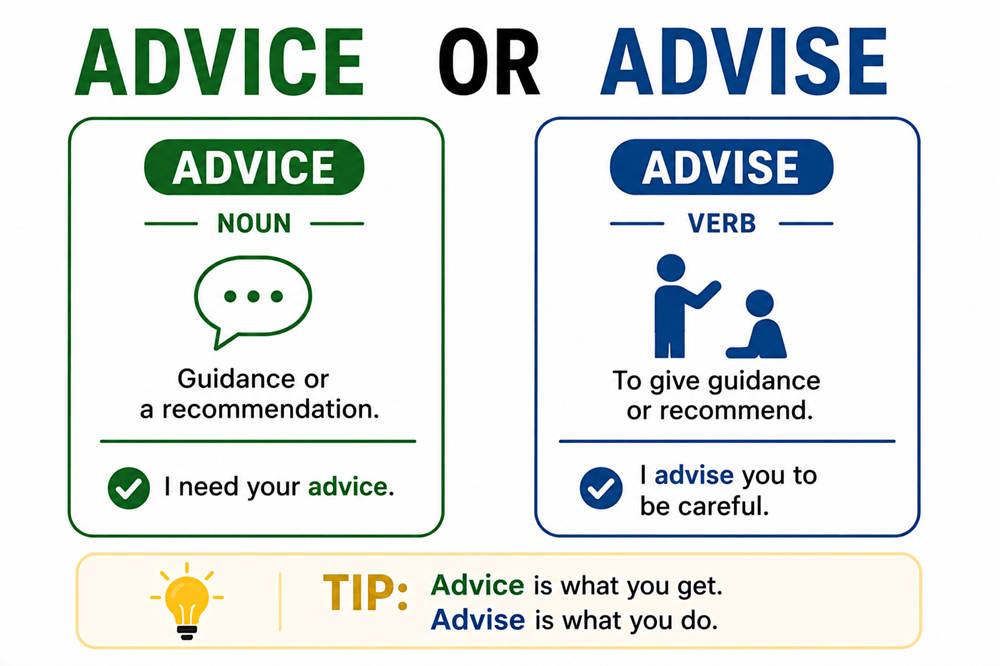
Advice and advise are both correct words, but they are used differently. Advice is a noun that means guidance, suggestions, or recommendations. Advise is a verb that means to give guidance, suggest something, or recommend a course of action. The easiest rule is simple: you give advice, but you advise someone.
Quick Answer
Use advice when you mean the guidance or suggestion itself.
- Correct: She gave me helpful advice.
- Correct: I need advice about my resume.
- Correct: His advice helped me make a better decision.
Use advise when you mean the action of giving advice.
- Correct: She will advise me on my resume.
- Correct: The doctor advised him to rest.
- Correct: I advise you to read the instructions carefully.
The simple rule is this: advice is a thing. Advise is an action.
Advice or Advise: What Is the Difference?
The difference between advice and advise is grammar. Advice is a noun, so it names something. Advise is a verb, so it shows an action.
If someone gives you a suggestion, that suggestion is advice. If someone gives you that suggestion, they advise you.
| Word | Part of Speech | Meaning | Example |
|---|---|---|---|
| Advice | Noun | Guidance or a suggestion | Her advice was useful. |
| Advise | Verb | To give guidance or suggest | She will advise the team. |
These words are closely related, so the confusion makes sense. They look similar, sound similar, and often appear in the same kinds of sentences. Still, they are not interchangeable. If the sentence needs a noun, use advice. If the sentence needs a verb, use advise.
What Does Advice Mean?
Advice means guidance, suggestions, recommendations, or useful opinions given to help someone decide what to do. It is a noun, which means it names the help, idea, or recommendation being offered.
Examples:
- I need advice about buying a car.
- Her advice helped me feel more confident.
- The teacher gave useful advice before the exam.
- He ignored everyone’s advice and made the mistake anyway.
In each sentence, advice is the thing being given, needed, followed, or ignored. You can receive advice, give advice, ask for advice, follow advice, ignore advice, or offer advice.
Advice is usually uncountable in standard English. That means you normally do not say an advice or advices. Instead, you can say:
- a piece of advice
- some advice
- a bit of advice
- a few pieces of advice
For example:
- Incorrect: She gave me an advice.
- Correct: She gave me a piece of advice.
What Does Advise Mean?
Advise means to give advice, recommend something, suggest a course of action, or inform someone formally. It is a verb, which means it describes what someone does.
Examples:
- The lawyer will advise us before we sign the contract.
- The doctor advised her to drink more water.
- I advise you to check the details before submitting the form.
- The counselor advised the student to apply early.
In these sentences, someone is giving guidance or making a recommendation. That action is advise.
Advise can also mean to inform someone officially or formally.
- Please advise us of any changes.
- The office advised customers of the new policy.
- We were advised that the meeting had been canceled.
This use is common in business, legal, customer service, and official communication. It still works as a verb.
Advice vs Advise Pronunciation
Advice and advise are pronounced differently. The final sound changes.
- Advice ends with an s sound.
- Advise ends with a z sound.
A helpful way to hear the difference is:
- Advice sounds like “ad-VICE.”
- Advise sounds like “ad-VIZE.”
This sound difference matches another familiar pair: device and devise.
- A device is a thing.
- To devise means to create or plan.
In the same way, advice is a thing, while advise is an action.
When to Use Advice
Use advice when you are naming the recommendation, suggestion, or guidance itself. It often follows verbs like give, get, need, ask for, follow, take, ignore, or offer.
Examples:
- Can I get your advice?
- She gave me honest advice.
- He followed his father’s advice.
- I ignored the advice and regretted it later.
- The article offers practical advice for beginners.
Use advice in common phrases like:
- good advice
- bad advice
- helpful advice
- legal advice
- medical advice
- financial advice
- career advice
- relationship advice
If you can put words like good, helpful, or bad before it, you probably need the noun advice.
When to Use Advise
Use advise when the sentence is about the act of giving guidance, suggesting something, recommending something, or informing someone. It often comes after a subject, such as I, we, they, the teacher, the doctor, or the lawyer.
Examples:
- I advise you to save a copy.
- The doctor advised rest and fluids.
- The teacher advised us to study the review sheet.
- Experts advise drivers to slow down during heavy rain.
- The company advised customers to update their passwords.
Use advise in phrases like:
- advise someone
- advise against something
- advise someone to do something
- be advised
- please advise
- strongly advise
If the sentence describes someone doing the act of recommending or informing, use advise.
Give Advice or Give Advise?
The correct phrase is give advice.
Correct:
- She gave me good advice.
- Can you give me advice about this problem?
- He gave advice to new employees.
Incorrect:
- She gave me good advise.
- Can you give me advise about this problem?
- He gave advise to new employees.
After give, you need a noun. Since advice is the noun, give advice is correct.
Please Advise or Please Advice?
The correct phrase is please advise.
Correct:
- Please advise if you need more information.
- Please advise us of any changes.
- Please advise on the next steps.
Incorrect:
- Please advice if you need more information.
- Please advice us of any changes.
- Please advice on the next steps.
In this phrase, you are asking someone to do something. Since the sentence needs a verb, advise is correct.
Please advise can sound formal or businesslike. In casual writing, you might use simpler wording:
- Please let me know.
- What should I do next?
- Can you tell me how to proceed?
Need Advice or Need Advise?
The correct phrase is need advice.
Correct:
- I need advice about my job interview.
- She needs advice before making a decision.
- They need legal advice.
Incorrect:
- I need advise about my job interview.
- She needs advise before making a decision.
- They need legal advise.
After need, the sentence usually requires a noun. Since advice is the noun, need advice is correct.
Can You Advise or Can You Advice?
The correct phrase is can you advise.
Correct:
- Can you advise me on this issue?
- Can you advise us about the next step?
- Can you advise whether this form is complete?
Incorrect:
- Can you advice me on this issue?
- Can you advice us about the next step?
- Can you advice whether this form is complete?
After can you, you need a verb. Since advise is the verb, can you advise is correct.
Take Advice or Take Advise?
The correct phrase is take advice.
Correct:
- You should take her advice.
- He rarely takes advice from anyone.
- I wish I had taken your advice sooner.
Incorrect:
- You should take her advise.
- He rarely takes advise from anyone.
- I wish I had taken your advise sooner.
In this phrase, advice is the suggestion being accepted or followed. That makes it a noun.
Advise Someone or Advice Someone?
The correct phrase is advise someone.
Correct:
- The coach advised the players before the game.
- The lawyer advised her client carefully.
- I advised him to wait before responding.
Incorrect:
- The coach adviced the players before the game.
- The lawyer advice her client carefully.
- I advice him to wait before responding.
When someone is doing the action of giving guidance, use advise. The past tense is advised, not adviced.
Advice Is Uncountable
One important rule is that advice is usually uncountable. That means you do not normally say an advice or many advices in standard English.
Incorrect:
- She gave me an advice.
- I received many advices from my friends.
Correct:
- She gave me advice.
- She gave me a piece of advice.
- I received a lot of advice from my friends.
- I received several pieces of advice from my friends.
This rule is useful because many writers who are learning English try to make advice plural. In standard English, advice usually stays the same whether you receive a little or a lot of it.
Advice vs Suggestion
Advice and suggestion are similar, but they are not exactly the same. Advice often sounds more serious, helpful, or guiding. A suggestion can be lighter, more optional, or simply one idea among many.
Examples:
- Advice: You should speak with a lawyer before signing the contract.
- Suggestion: You could try the blue design instead of the green one.
Advice often helps someone make a decision or avoid a problem. A suggestion may simply offer an option.
Advice vs Recommendation
Advice and recommendation can also overlap. A recommendation usually points someone toward a specific choice, product, action, or option. Advice can be broader and may include reasoning, warnings, or guidance.
Examples:
- Advice: Save money before you quit your job.
- Recommendation: Try this budgeting app.
A recommendation can be part of advice. If someone gives you advice about saving money, they may also recommend a tool, plan, or method.
Common Mistakes With Advice and Advise
The most common mistake is using advise when the sentence needs the noun advice.
Incorrect:
- Thank you for your advise.
- I need some advise.
- That was helpful advise.
- She gave me great advise.
Correct:
- Thank you for your advice.
- I need some advice.
- That was helpful advice.
- She gave me great advice.
Another mistake is using advice when the sentence needs the verb advise.
Incorrect:
- Please advice me.
- The doctor will advice him.
- I advice you to wait.
Correct:
- Please advise me.
- The doctor will advise him.
- I advise you to wait.
A final mistake is spelling the past tense as adviced. The correct past tense is advised.
- Incorrect: The teacher adviced us to study.
- Correct: The teacher advised us to study.
Examples of Advice in Sentences
Here are examples of advice used correctly:
- My mother gave me good advice.
- I need advice about choosing a college.
- His advice was simple but useful.
- She asked for advice before accepting the job.
- The article offers advice for first-time renters.
- He ignored the advice and made the same mistake again.
- That was the best advice I ever received.
- Always get professional advice before making a major financial decision.
In each sentence, advice is a noun. It names the guidance, recommendation, or suggestion.
Examples of Advise in Sentences
Here are examples of advise used correctly:
- I advise you to read the agreement carefully.
- The doctor advised him to rest for a few days.
- The teacher will advise students about their course options.
- Experts advise people to save emergency money.
- The lawyer advised her not to sign too quickly.
- Please advise us if your address changes.
- The guide advised tourists to arrive early.
- We were advised to bring extra copies of the form.
In each sentence, advise is a verb. It describes the action of giving guidance, recommending, or informing.
How to Remember Advice or Advise
A simple way to remember the difference is this:
- Advice = noun
- Advise = verb
You can also remember the pronunciation:
- Advice has an s sound, like ice.
- Advise has a z sound, like rise.
Another helpful memory trick is:
You give advice, but you advise someone.
If the word is the thing being given, use advice. If the word is the action of giving guidance, use advise.
Final Answer
Advice and advise are both correct, but they have different jobs. Advice is a noun that means guidance, suggestions, or recommendations. Use it in phrases like good advice, legal advice, give advice, need advice, and take advice.
Advise is a verb that means to give guidance, recommend, suggest, or inform. Use it in phrases like please advise, advise someone, advise against, and I advise you. The easiest rule is simple: advice is the guidance, and advise is the action of giving it.