Girlie or Girly: Correct Spelling, Meaning, Difference, and Examples for Clear Writing
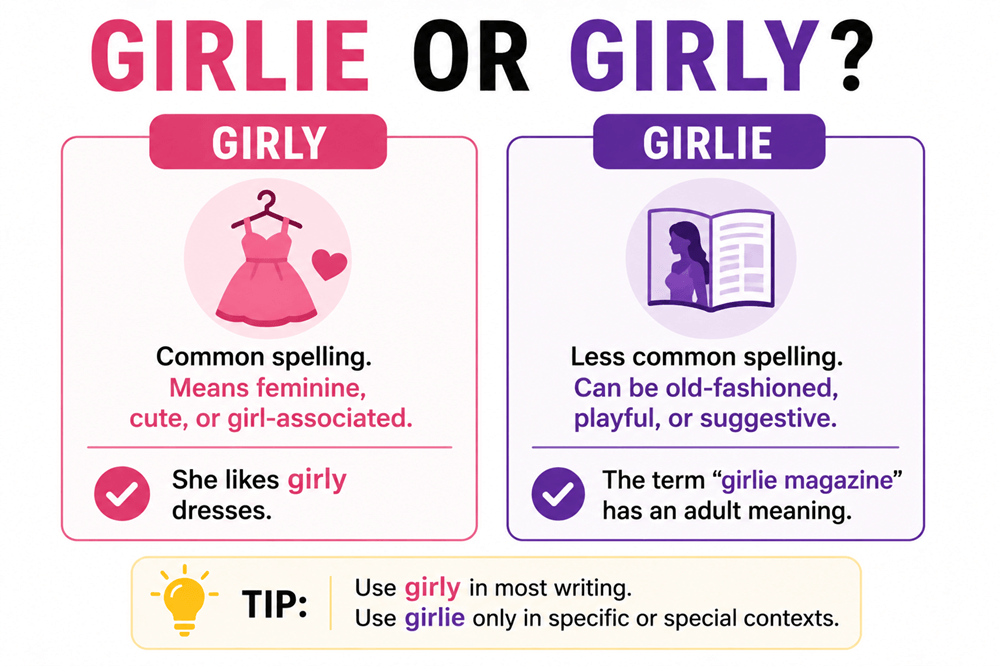
Girly and girlie are both real spellings, but they are not always used the same way. Use girly as the more common modern spelling when you mean traditionally feminine, playful, pretty, or associated with girls. Girlie is a less common variant and can sometimes sound old-fashioned, childish, or connected to adult entertainment. The safest spelling for most everyday writing is girly.
Quick Answer
Use girly when you mean something has a feminine, cute, soft, playful, or traditionally girl-associated style.
- Correct: She likes girly dresses with floral prints.
- Correct: The room had a girly pink-and-white theme.
- Correct: He teased her for liking girly movies, but she ignored him.
Girlie is also a word, but it is less common in modern standard writing. It may appear as an informal spelling, a noun, a term of address, or in phrases like girlie magazine.
- Less common: She likes girlie dresses with floral prints.
- More common: She likes girly dresses with floral prints.
The simple rule is this: girly is the better everyday spelling. Girlie is more limited and can carry a different tone.
Girlie or Girly: What Is the Difference?
The difference between girlie and girly is mostly spelling, tone, and context. Both can describe something associated with girls or traditional femininity, but girly is the form most readers expect in modern writing.
Girly is usually an adjective. It describes things like clothing, colors, hobbies, decor, handwriting, style, behavior, or interests that are considered feminine in a casual or stereotypical way.
Girlie can also work as an adjective, but it is less common. It may sound more dated, cute, playful, or childish. In some contexts, especially older phrases, girlie can also suggest sexualized images or entertainment aimed at men, as in girlie magazine. Because of that, it is not always the best neutral spelling.
| Word | Main Use | Example |
|---|---|---|
| Girly | Common modern adjective meaning feminine or girl-associated | She wore a girly dress. |
| Girlie | Less common variant; sometimes dated, playful, or suggestive | The phrase “girlie magazine” has an adult meaning. |
If you are writing a normal sentence and simply mean feminine or girl-like, choose girly.
What Does Girly Mean?
Girly means associated with girls, girlhood, or traditional ideas of femininity. It can describe a style that feels soft, pretty, delicate, sweet, playful, romantic, or feminine.
Examples:
- The birthday party had a girly theme with flowers and pastel colors.
- She prefers girly perfumes with sweet, fruity scents.
- The notebook had a girly cover with hearts and glitter.
- They decorated the nursery in a girly style.
In these sentences, girly describes a look, mood, or style. It does not necessarily mean anything negative. It can be affectionate, descriptive, playful, or neutral, depending on context.
However, girly can also sound dismissive if it is used to mock someone’s taste or personality. For example, calling something “too girly” may imply that feminine things are less serious, less strong, or less valuable. Because of that, the tone matters.
- Neutral: She likes girly colors and floral patterns.
- Dismissive: That hobby is too girly for you.
The word itself is common, but it should be used thoughtfully.
What Does Girlie Mean?
Girlie can mean girl-like, feminine, or cute, but it is less common than girly. It may appear in older writing, informal speech, playful language, names, branding, or certain fixed expressions.
Examples:
- The shop used a girlie logo with bows and sparkles.
- She called the puppy “girlie” in a playful voice.
- The costume had a very girlie look.
These examples are understandable, but many modern readers would expect girly instead:
- The shop used a girly logo with bows and sparkles.
- The costume had a very girly look.
Girlie can also work as a noun in informal speech, sometimes as a casual or affectionate term for a girl or woman. This use can sound playful, but it can also sound patronizing depending on who says it and how.
- Hey, girlie, how are you?
- The little girlie ran across the yard.
Because girlie has several possible tones, it is usually not the safest spelling if you simply mean “feminine in style.”
Why Girly Is Usually the Better Spelling
Girly is usually the better spelling because it is more common, more modern, and more straightforward. It follows the familiar pattern of adding -y to a noun to create an adjective.
Examples:
- cloud → cloudy
- rain → rainy
- fun → funny
- girl → girly
English does not always follow simple patterns perfectly, but girly is the form that became standard for this adjective. It looks natural in phrases like:
- girly clothes
- girly style
- girly room
- girly handwriting
- girly colors
- girly personality
Girlie may still be understood, but it can pull attention away from the sentence because it looks less typical. If you want readers to focus on your meaning rather than the spelling, use girly.
Is Girlie Wrong?
Girlie is not always wrong, but it is not the best choice in most ordinary sentences. It is better to think of it as a less common variant with special tones and uses.
If you write “a girlie dress,” people will probably understand that you mean a feminine or girl-like dress. Still, many readers may expect “a girly dress” instead. The spelling girly looks more current and standard.
Compare these examples:
- Less common: She bought a girlie pink backpack.
- More common: She bought a girly pink backpack.
- Less common: The invitation had a girlie design.
- More common: The invitation had a girly design.
- Less common: He said the movie was too girlie.
- More common: He said the movie was too girly.
For general writing, girly is the safer and cleaner spelling.
When to Use Girly
Use girly when you want to describe something that feels feminine, cute, soft, pretty, playful, or associated with girls in a casual way.
Use it for fashion:
- She wore a girly blouse with lace sleeves.
- The shoes looked girly but comfortable.
- Her style is a mix of sporty and girly.
Use it for decor or design:
- The bedroom had a girly pastel theme.
- The logo looked bright, girly, and playful.
- They wanted a girly cake with flowers on top.
Use it for interests, behavior, or tone, but be careful with judgment:
- She enjoys girly movies and romantic comedies.
- The song has a girly pop sound.
- He used the word girly in a teasing way.
Girly works best when the tone is casual and descriptive. If the tone could sound insulting, choose a more specific word like feminine, delicate, pretty, romantic, soft, or playful.
When to Use Girlie
Use girlie only when that spelling is intentional. It may work in names, playful dialogue, older-style writing, or fixed phrases.
Examples:
- The boutique used “Girlie” in its brand name.
- “Come here, girlie,” she said jokingly to her dog.
- The article discussed old girlie magazines from the 1950s.
The phrase girlie magazine is one reason to be careful with this spelling. In that context, girlie often refers to magazines with sexually suggestive pictures of women. That meaning is very different from simply calling a dress girly.
Because of this possible association, girlie can sometimes feel less neutral than girly. If you are writing for a general audience and do not want that tone, choose girly.
Girly vs Feminine
Girly and feminine are related, but they do not have exactly the same tone. Feminine is more neutral, mature, and polished. Girly is more casual and can sound younger, cuter, or more playful.
Examples:
- Casual: The dress has a girly style.
- More polished: The dress has a feminine style.
- Casual: She wanted a girly room with pink walls.
- More neutral: She wanted a feminine room with soft colors.
If you are writing a fashion article, product description, or casual caption, girly may fit. If you are writing in a more formal or respectful tone, feminine may be better.
Common Mistakes With Girlie and Girly
The most common mistake is using girlie when girly would look more natural.
Less common:
- She likes girlie accessories.
- The design feels too girlie for the brand.
- The dress is cute and girlie.
More common:
- She likes girly accessories.
- The design feels too girly for the brand.
- The dress is cute and girly.
Another mistake is using girly in a way that sounds insulting without meaning to. Since the word is tied to stereotypes about girls and femininity, it can sound dismissive in the wrong sentence.
For example:
- Potentially dismissive: That job is too girly.
- Better: That job is often stereotyped as feminine.
Use the word carefully when talking about people’s interests, abilities, jobs, or personalities. It is safest when describing style, design, fashion, or tone in a casual way.
Examples of Girly in Sentences
Here are examples of girly used naturally:
- The room looked girly with its pink curtains and flowered bedspread.
- She likes girly fashion, but she also wears simple jeans and sneakers.
- The invitation had a girly design with hearts and ribbons.
- He thought the notebook looked too girly for his taste.
- The movie has a girly, nostalgic charm.
- Her handwriting is neat, rounded, and a little girly.
- The brand uses girly colors without looking childish.
- The song has a bright, girly pop feeling.
In each sentence, girly describes a style, mood, or quality associated with traditional femininity.
Examples of Girlie in Sentences
Here are examples of girlie used in more limited contexts:
- The old poster used the word girlie in a playful way.
- She called her friend “girlie” as a joke.
- The historian studied how girlie magazines were marketed decades ago.
- The shop spelled its name “Girlie Boutique.”
These examples show that girlie can be correct when the spelling is intentional. Still, it is not the best default for most modern sentences.
How to Remember Girlie or Girly
A simple way to remember the difference is this:
- Girly = common modern adjective
- Girlie = less common, more specialized, or stylistic
You can also remember that girly is shorter and more direct. It is the spelling most people expect in phrases like girly dress, girly room, and girly style.
If you are writing about a normal feminine style, choose girly. If you are using a proper name, an old-fashioned tone, a playful term of address, or a fixed phrase like girlie magazine, girlie may be intentional.
Final Answer
Girly is the more common and standard spelling when you mean feminine, girl-like, cute, playful, or associated with girls. Use girly in most everyday writing, especially in phrases like girly clothes, girly room, girly style, and girly design.
Girlie is a less common variant that can sound old-fashioned, playful, childish, or sometimes suggestive depending on the context. The easiest rule is simple: use girly for most modern writing, and use girlie only when that specific spelling is intentional.