Madam or Madame: Correct Meaning, Spelling, Formal Usage, and Clear Examples Explained
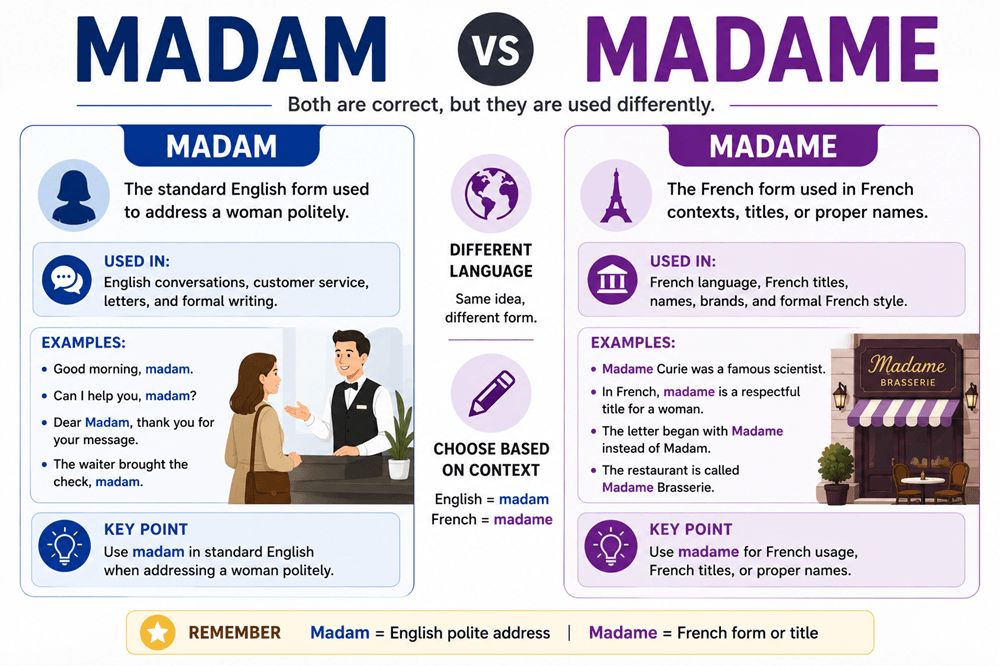
Madam and madame are both correct words, but they are used differently. Madam is the standard English form used as a polite way to address a woman, especially in formal writing or service situations. Madame is the French form and is usually used in French-speaking contexts, names, titles, or when a more distinctly French tone is intended.
Quick Answer
Use madam in standard English when politely addressing a woman.
- Good morning, madam.
- Can I help you, madam?
- Dear Madam, thank you for your message.
Use madame when you are using the French form, referring to a French title, or writing a proper name that includes Madame.
- Madame Curie was a famous scientist.
- The letter began with Madame instead of Madam.
- In French, madame is used as a respectful title for a woman.
The simple rule is: madam is the usual English word, while madame is the French form.
Madam or Madame: What Is the Difference?
The difference between madam and madame is mainly language and context. Both words can be used as respectful forms of address for a woman, but they do not feel the same in English.
Madam is the common English spelling. It is formal, polite, and somewhat traditional. You may see it in business letters, customer service language, formal greetings, official correspondence, and phrases such as Dear Madam.
Madame is the French spelling. In English, it usually appears when referring to French-speaking settings, French women, French titles, historical names, or brands and institutions that use the French form. It can also appear in stylized writing when the writer wants a French or elegant tone.
| Word | Main Use | Example |
|---|---|---|
| Madam | Standard English polite address | May I help you, madam? |
| Madame | French form, title, or proper-name style | Madame Curie won two Nobel Prizes. |
If you are writing ordinary English, madam is usually the safer choice. If you are referring to a French title, a French-speaking woman, or a proper name that uses Madame, keep the spelling madame.
What Does Madam Mean?
Madam is a formal English word used to address a woman politely. It is similar to sir, but used for a woman. It can sound respectful, official, old-fashioned, or service-oriented depending on the situation.
Examples:
- Good evening, madam.
- This way, madam.
- Would you like a receipt, madam?
- I am sorry, madam, but the office is closed.
- Please wait here, madam.
In these sentences, madam is used as a polite form of address. It is not a personal name. It is a respectful title used when speaking to a woman, especially when the speaker does not know her name.
Madam in Letters and Emails
Madam is also used in formal letters and emails. You may see it in greetings such as Dear Madam or Dear Sir or Madam.
Examples:
- Dear Madam, I am writing to ask about your services.
- Dear Sir or Madam, please find my application attached.
- Thank you, Madam, for your quick reply.
In modern writing, many people prefer more specific or neutral greetings when possible, such as Dear Hiring Manager, Hello Customer Support Team, or the person’s actual name. Still, Dear Madam remains a recognized formal expression.
What Does Madame Mean?
Madame is the French form of madam. In English, it is often used when the context is French, historical, cultural, or formal in a French way.
Examples:
- Madame Curie is one of the most famous scientists in history.
- The guest was introduced as Madame Laurent.
- In French class, the teacher explained when to use madame.
- The sign on the door said Madame Dubois.
In English writing, Madame is often capitalized when it appears before a name, just like Mr., Mrs., Ms., or Dr.
Madame in Proper Names
Use Madame when it is part of a proper name, title, brand, institution, or famous reference.
Examples:
- Madame Curie
- Madame Tussauds
- Madame Bovary
- Madame Butterfly
In these examples, you should not change Madame to Madam unless the official title actually uses that spelling. Proper names should keep their established spelling.
Is Madam Correct?
Yes, madam is correct. It is the normal English spelling when addressing a woman politely.
Use madam in sentences like these:
- Excuse me, madam, you dropped your keys.
- Can I carry that for you, madam?
- The receptionist said, “Please sign here, madam.”
This word is formal and polite, but it may sound stiff or old-fashioned in casual conversation. In everyday speech, many people use ma’am, a name, or no title at all.
Is Madame Correct?
Yes, madame is also correct, but it is not the usual English spelling for ordinary polite address. It is mainly the French form.
Use madame when the French spelling is intended:
- The waiter greeted her with Madame in a French restaurant.
- In French, madame is a polite title for a woman.
- The invitation used the formal title Madame.
If you are writing standard English and you simply mean “ma’am” or a polite address for a woman, madam is usually better.
Madam, Madame, and Ma’am
Madam, madame, and ma’am are related, but they are not used in exactly the same way.
| Word | Use | Tone |
|---|---|---|
| Madam | English formal address | Polite, formal, traditional |
| Madame | French form or proper title | French, formal, elegant, cultural |
| Ma’am | Short form of madam | Polite, spoken, common in some regions |
Ma’am is a shortened form of madam. It is common in spoken English, especially in customer service, polite replies, military speech, and some regional forms of English.
Examples:
- Yes, ma’am.
- No, ma’am, I have not seen it.
- Thank you, ma’am.
For written formal English, madam may be preferred. For spoken polite address, ma’am often sounds more natural.
When to Capitalize Madam or Madame
Capitalize Madam or Madame when the word is used as part of a title, direct formal address, letter greeting, or proper name.
Examples:
- Dear Madam, thank you for your letter.
- Madam President, the committee is ready.
- Madame Curie was born in Warsaw.
- Madame Lefevre welcomed the guests.
Use lowercase when the word is used generally in the middle of a sentence and is not part of a name or formal title.
- The clerk politely called her madam.
- In French, madame is a respectful title.
Examples of Madam in Sentences
Here are natural examples of madam used correctly:
- May I take your coat, madam?
- The shop assistant said, “This size is available, madam.”
- Dear Madam, I am writing about my recent order.
- Good afternoon, madam. How may I help you?
- The officer addressed her as madam.
- Madam Chair, may I ask a question?
In these examples, madam is used as a respectful English form of address.
Examples of Madame in Sentences
Here are natural examples of madame used correctly:
- Madame Curie made important discoveries in science.
- The French teacher asked the students to say bonjour, madame.
- The hotel staff greeted her as Madame Renard.
- The novel Madame Bovary is a classic work of literature.
- The sign outside the shop used the name Madame Elise.
In these examples, madame fits because the context is French, cultural, literary, or part of a proper name.
Common Mistakes to Avoid
One common mistake is using madame in ordinary English when madam would be more natural.
Less natural in standard English:
- Can I help you, madame?
Better in standard English:
- Can I help you, madam?
Another mistake is changing a proper name from Madame to Madam.
Incorrect:
- Madam Curie was a famous scientist.
Correct:
- Madame Curie was a famous scientist.
You should also avoid using madam or madame too freely in casual writing. These words can sound formal, old-fashioned, or theatrical if the context does not call for them.
How to Remember Madam or Madame
Here is an easy way to remember the difference:
Madam is the English form.
Madame is the French form.
You can also remember it this way:
- Madam = English polite address
- Madame = French title or proper-name style
If you are writing ordinary English, choose madam. If you are writing a French title, a French phrase, or an established proper name, use madame.
Final Answer
Madam and madame are both correct, but they are used differently. Madam is the standard English word for politely addressing a woman, especially in formal or service situations. Madame is the French form and is usually used in French contexts, proper names, titles, literature, or stylized writing. For everyday English, use madam. For French names and titles, use madame.