Anyway or Anyways: Correct Usage, Meaning, Formality, and Everyday Examples Explained Clearly
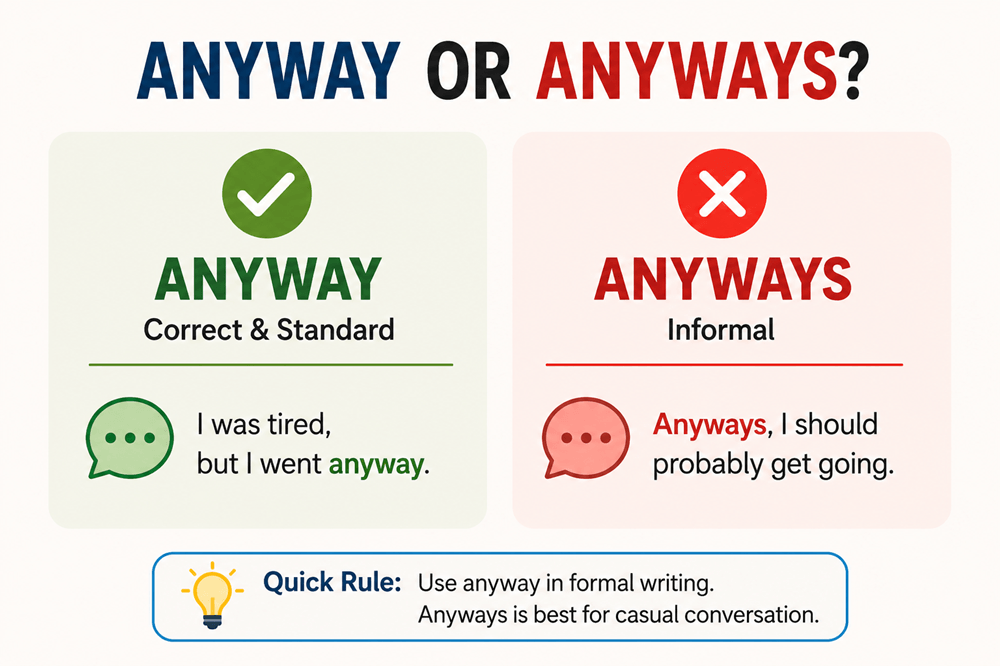
Anyway and anyways are often used to mean the same thing, but they are not equally accepted in standard writing. Use anyway in formal, professional, academic, or polished everyday writing. Anyways is informal and conversational, and many readers consider it nonstandard. The easiest rule is: when you want the safe choice, write anyway.
Quick Answer
Use anyway when you mean “in any case,” “regardless,” “despite that,” or “to return to the main point.”
- Correct: I was tired, but I went anyway.
- Correct: Anyway, let’s get back to the topic.
- Correct: It may rain, but we are leaving anyway.
Anyways is informal. It is common in casual speech, texting, and relaxed conversation, but it is usually not the best choice for careful writing.
- Informal: Anyways, I forgot what I was saying.
- Informal: I did not like the movie anyways.
The simple rule is: anyway is standard. Anyways is casual.
Anyway or Anyways: What Is the Difference?
The difference between anyway and anyways is mostly about formality. Both words are used when you want to move past something, return to a point, or say that something happens regardless of another fact. However, anyway is the standard form, while anyways is more informal.
You can use anyway almost anywhere: in emails, essays, articles, business writing, school assignments, and everyday messages. It sounds natural without looking too casual.
Anyways can sound friendly, relaxed, or conversational, but it can also look careless if the writing is supposed to be polished. That is why many grammar guides and editors prefer anyway.
| Word | Main Use | Example |
|---|---|---|
| Anyway | Standard form meaning in any case or regardless | I was nervous, but I tried anyway. |
| Anyways | Informal or conversational version | Anyways, what were you saying? |
If you are unsure which one to use, choose anyway.
What Does Anyway Mean?
Anyway is an adverb. It usually means “in any case,” “regardless,” “despite that,” or “even so.” It helps connect ideas when something happens despite another fact.
Examples:
- I did not feel prepared, but I gave the speech anyway.
- She knew the road was long, but she kept walking anyway.
- The instructions were confusing, but he finished the project anyway.
- It was late, but they decided to call anyway.
In these sentences, anyway shows that the action still happened. There may have been a problem, doubt, reason to stop, or reason to hesitate, but the action continued.
Anyway can also help shift the conversation back to the main point.
- Anyway, let’s talk about the schedule.
- Anyway, that is why I wanted to ask you.
- Anyway, back to the original question.
In this use, anyway works like a conversational bridge. It helps you move from one idea to another without making the sentence feel abrupt.
What Does Anyways Mean?
Anyways usually means the same thing as anyway, but it is informal. You may hear it often in casual speech, especially when someone is changing the subject or returning to a previous point.
Examples:
- Anyways, I should probably get going.
- Anyways, what happened after that?
- I was not planning to go anyways.
- She said no, but I asked anyways.
These sentences may sound normal in casual conversation, but in standard writing, anyway would usually be better:
- Anyway, I should probably get going.
- Anyway, what happened after that?
- I was not planning to go anyway.
- She said no, but I asked anyway.
The meaning does not change much, but the tone does. Anyway sounds cleaner and more accepted. Anyways sounds more relaxed and conversational.
Is Anyways Wrong?
Anyways is not usually the best choice in standard writing. Many people treat it as informal or nonstandard. That does not mean no one uses it. It appears often in speech, dialogue, texting, social media posts, and casual conversation.
The problem is not that readers will misunderstand anyways. The meaning is usually clear. The problem is that some readers may notice it and judge the writing as less polished. If you are writing for school, work, a client, a website article, or any professional situation, anyway is the safer choice.
For example:
- Less formal: Anyways, the meeting starts at noon.
- Better: Anyway, the meeting starts at noon.
- Less formal: I was going to email you anyways.
- Better: I was going to email you anyway.
In casual speech, anyways may fit a person’s natural voice. In edited writing, anyway is usually stronger.
When to Use Anyway
Use anyway when you want your sentence to sound standard, clear, and correct. It works in almost every situation.
Use anyway when something happens despite a reason it might not happen:
- The store was closing soon, but we went anyway.
- He was not invited, but he showed up anyway.
- The answer seemed obvious, but she checked anyway.
Use anyway when you are returning to a topic:
- Anyway, here is what I wanted to say.
- Anyway, let’s continue with the lesson.
- Anyway, that brings us to the next point.
Use anyway when you are dismissing something as not important enough to change the result:
- It does not matter anyway.
- I did not need it anyway.
- They were leaving anyway.
In all of these uses, anyway is the clean and standard choice.
When to Use Anyways
Use anyways only when the tone is intentionally informal. It can work in dialogue, casual narration, personal texts, or writing that is meant to sound like relaxed speech.
Examples:
- “Anyways, I told her I would think about it.”
- “I was bored anyways, so I went with them.”
- “Anyways, that is not the point.”
These examples sound conversational. That may be useful if you are writing dialogue or trying to capture someone’s casual voice. But if you are writing an article, essay, report, formal email, or professional message, anyway will usually look better.
Think of anyways as a spoken-style word. It is not the form you need most of the time.
Anyway at the Beginning of a Sentence
Anyway can appear at the beginning of a sentence when you are changing direction, returning to the subject, or moving past a detail.
Examples:
- Anyway, we decided to leave early.
- Anyway, the main issue is the deadline.
- Anyway, thank you for helping.
- Anyway, I wanted to ask you something.
A comma usually follows anyway when it starts a sentence this way. The comma gives the sentence a natural pause.
Without the comma, the sentence may still be understandable, but the comma makes the structure clearer:
- Clear: Anyway, we should start now.
- Less polished: Anyway we should start now.
This beginning-of-sentence use is common in both speech and writing. Just remember that anyway is the better standard form.
Anyway at the End of a Sentence
Anyway can also appear at the end of a sentence. In this position, it often means “regardless” or “despite that.”
Examples:
- I was tired, but I went anyway.
- She did not agree, but she listened anyway.
- The weather was bad, but they played anyway.
- He knew it might fail, but he tried anyway.
When anyway comes at the end, it usually does not need a comma before it unless the sentence structure requires one for another reason.
This is one of the most natural uses of the word. It shows that something happened even though there was a reason it might not have happened.
Common Mistakes With Anyway and Anyways
The most common mistake is using anyways in writing that should sound formal or polished.
Informal:
- Anyways, please send the file by Friday.
- The result would have been the same anyways.
- I wanted to check anyways.
Better:
- Anyway, please send the file by Friday.
- The result would have been the same anyway.
- I wanted to check anyway.
Another common mistake is overusing anyway at the beginning of sentences. It is helpful when you need to shift the conversation, but too many sentences starting with anyway can make writing feel loose or repetitive.
For example:
- Repetitive: Anyway, we left the house. Anyway, we got to the station. Anyway, the train was late.
- Better: We left the house and got to the station, but the train was late.
Use anyway when it adds meaning or helps the flow. Do not use it as filler in every sentence.
Examples of Anyway in Sentences
Here are natural examples of anyway used correctly:
- I did not understand the instructions, but I started anyway.
- She was nervous, but she introduced herself anyway.
- The office was almost empty, but he stayed anyway.
- I already knew the answer, but I asked anyway.
- Anyway, let’s move on to the next question.
- Anyway, that is what happened.
- The plan was risky, but they followed it anyway.
- It was probably too late, but we called anyway.
In each sentence, anyway sounds natural and standard. It can show contrast, return to a point, or move the sentence forward.
Examples of Anyways in Sentences
Here are examples of anyways in casual or conversational sentences:
- Anyways, I should head home.
- Anyways, tell me what happened next.
- I did not want to go anyways.
- She was going to call you anyways.
- Anyways, that is beside the point.
These sentences are understandable, but they are informal. In more careful writing, change anyways to anyway.
- Anyway, I should head home.
- Anyway, tell me what happened next.
- I did not want to go anyway.
- She was going to call you anyway.
- Anyway, that is beside the point.
This simple change makes the sentence cleaner without changing the meaning.
How to Remember Anyway or Anyways
Here is an easy way to remember the difference:
Anyway is the standard way.
That sentence works because anyway already contains the word way. You do not need to add an s for normal standard writing.
- Anyway = standard
- Anyways = informal
You can also test the sentence by asking what kind of writing you are doing. If it is for school, work, a website, an article, or a professional message, choose anyway. If it is casual dialogue or a relaxed text message, anyways may fit the tone, but it is still less standard.
When in doubt, remove the s. That usually gives you the better word.
Final Answer
Anyway and anyways have nearly the same meaning, but they are not equally formal. Use anyway in standard writing when you mean “in any case,” “regardless,” “despite that,” or “to return to the main point.” Use anyways only in casual speech, dialogue, or informal writing where a relaxed tone is acceptable.
The safest rule is simple: anyway is correct for almost every situation. Anyways may sound natural in conversation, but it can look too casual in polished writing.