Nosy or Nosey: Which Spelling Is Correct When Someone Is Too Curious?
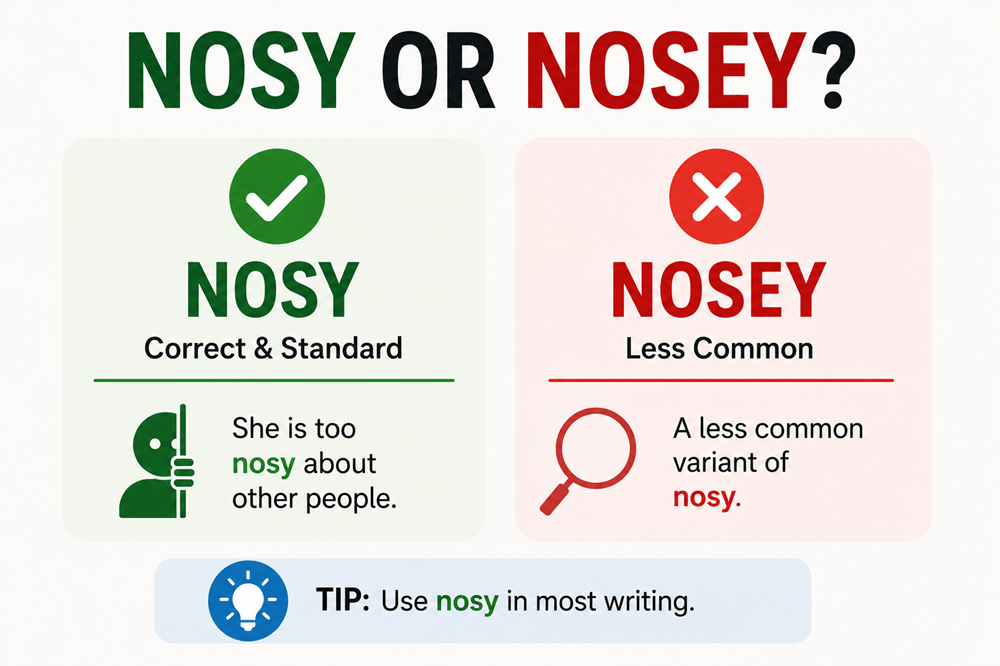
Nosy and nosey both describe someone who is overly curious about other people’s private business. The preferred spelling is nosy, especially in standard American English and polished writing. Nosey is a less common variant, and it may appear in informal writing or certain British expressions. If you want the safer choice, use nosy.
Quick Answer
Use nosy when you mean someone is too interested in things that do not concern them.
- Correct: Your neighbor is nosy about everyone’s business.
- Correct: Try not to sound nosy when you ask.
- Correct: That was a nosy question.
Nosey is also seen sometimes, but it is less common. In most everyday writing, especially if you want your sentence to look clean and standard, nosy is the better spelling.
- Less common: Your neighbor is nosey.
- Preferred: Your neighbor is nosy.
Nosy or Nosey: What Is the Difference?
The difference between nosy and nosey is mostly spelling preference. Both words have the same basic meaning. They describe a person who asks too many questions, watches too closely, or tries to learn private details that are not really their concern.
The spelling nosy is the standard and more widely preferred form. It looks cleaner in modern writing, and it is the form most readers expect to see. You can use it in articles, school writing, emails, captions, stories, and professional writing when the tone allows the word.
Nosey is a variant spelling. It is not impossible to understand, and many people will still know exactly what you mean. However, it can look less polished because it is not the usual spelling in most edited writing.
| Word | Meaning | Best Use |
|---|---|---|
| Nosy | Too curious about other people’s private matters | Standard spelling for most writing |
| Nosey | A variant spelling of nosy | Informal, less common, or used in certain expressions |
If you are not sure which spelling to choose, use nosy.
What Does Nosy Mean?
Nosy means overly curious, intrusive, or too interested in private information. A nosy person does not simply show normal interest. They push beyond what feels polite or appropriate.
For example, asking a friend how their day went is usually not nosy. Asking how much money they make, why their relationship ended, what they were arguing about, or what was inside a private letter may feel nosy.
Examples:
- Your coworker asked a nosy question about your salary.
- The landlord seemed nosy about your personal life.
- You do not want to seem nosy, but you are curious.
- That neighbor is always watching from the window and acting nosy.
The word often has a negative tone. It suggests that someone is crossing a social boundary. A nosy person may not always mean harm, but their curiosity can feel uncomfortable, rude, or invasive.
What Does Nosey Mean?
Nosey means the same thing as nosy. It describes someone who is too curious or too involved in other people’s private matters. The only real difference is that nosey is a less common spelling.
Examples:
- She is always asking nosey questions.
- He can be a little nosey about family drama.
- The kids got nosey and opened the drawer.
These sentences are understandable, but many editors would change nosey to nosy. The shorter spelling is more standard and less likely to distract the reader.
You may see nosey in casual writing, character dialogue, usernames, names of businesses, or older-style expressions. It may also appear when a writer wants the word to look more connected to the word nose. Since nosy behavior is often imagined as someone “sticking their nose” into someone else’s business, the spelling nosey can feel logical. Still, nosy is the better everyday choice.
Why Nosy Is the Better Spelling
Nosy is the better spelling because it is shorter, more common, and more accepted in modern standard English. It follows the same pattern as many adjectives that end in -y. Even though the word comes from nose, the final e is usually dropped before adding y.
This spelling pattern appears in other English words too:
- grease becomes greasy
- smoke becomes smoky
- shine becomes shiny
- nose becomes nosy
English spelling is not perfectly predictable, but in this case, nosy is the form that became standard. That is why “nosy neighbor,” “nosy question,” and “nosy coworker” look more natural than “nosey neighbor,” “nosey question,” and “nosey coworker.”
Is Nosey Wrong?
Nosey is not completely wrong, but it is not the preferred spelling. It is better to think of it as a variant. A variant spelling can exist and still be less suitable for most writing.
If you use nosey in a casual text message, most people will understand you. If you use it in dialogue, it may also feel natural, especially if you are trying to capture a relaxed voice. But if you are writing a blog post, article, essay, professional email, or anything meant to look edited, nosy is usually the stronger choice.
For example:
- Less polished: Stop being so nosey.
- Preferred: Stop being so nosy.
- Less polished: That was a nosey thing to ask.
- Preferred: That was a nosy thing to ask.
The meaning is the same, but nosy looks more standard.
How to Use Nosy in a Sentence
You can use nosy before a noun, after a linking verb, or as part of a casual expression.
Before a noun:
- That was a nosy question.
- Your nosy neighbor keeps watching the driveway.
- A nosy child opened the cabinet.
After a linking verb:
- She is nosy about everyone’s relationships.
- He seems nosy, but he may just be friendly.
- You sound nosy when you ask it that way.
In everyday expressions:
- Do not be so nosy.
- You are being nosy again.
- That is none of your business, so stop being nosy.
The word is direct and slightly critical. Because of that, it can sound rude if you use it carelessly. Calling someone nosy usually means they have crossed a line.
Nosy vs Curious
Nosy and curious are related, but they do not have the same tone. Curious can be positive or neutral. It often means someone wants to learn, understand, or explore. Nosy is more negative. It means someone is curious in a way that feels intrusive.
Examples:
- Curious: You are curious about how the machine works.
- Nosy: You are nosy about your friend’s private messages.
- Curious: A curious student asks thoughtful questions.
- Nosy: A nosy student tries to read another person’s notes.
The difference is the boundary. Curiosity respects the situation. Nosiness pushes into private space.
Common Mistakes With Nosy and Nosey
The most common mistake is using nosey when nosy would look better. Because nosey contains the word nose, it feels logical. But standard spelling does not always follow what looks logical at first glance.
Incorrect or less preferred:
- My aunt is very nosey about my dating life.
- That was a nosey question.
- Stop being so nosey.
Preferred:
- My aunt is very nosy about my dating life.
- That was a nosy question.
- Stop being so nosy.
Another mistake is using nosy when you really mean curious. If someone is asking a fair question or showing healthy interest, curious may be kinder and more accurate.
- Too harsh: The child was nosy about the stars.
- Better: The child was curious about the stars.
Use nosy only when the curiosity feels too personal, intrusive, or unwanted.
How to Remember Nosy or Nosey
A simple way to remember the difference is this: nosy is the normal spelling, and nosey has an extra letter you usually do not need.
You can also connect nosy with the phrase “sticking your nose where it does not belong.” The meaning comes from the idea of someone pushing their “nose” into someone else’s business, but the adjective usually drops the e.
- Nose + y = nosy
- Nosy = standard
- Nosey = less common variant
When in doubt, choose the shorter spelling. Nosy is the word most readers expect.
Final Answer
Use nosy as the standard spelling when describing someone who is too curious about private matters. Nosey is a less common variant, and it may appear in informal writing or certain expressions, but it is not the best choice for most polished writing.
The easiest rule is simple: if you are writing for school, work, a website, or any edited context, choose nosy. It is clear, standard, and widely accepted.