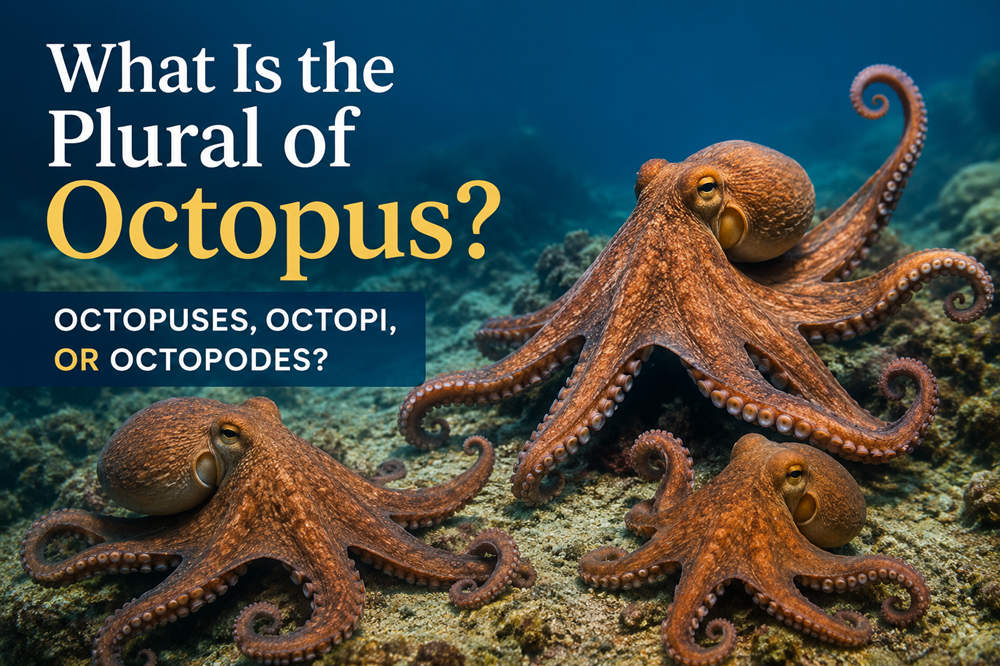
What Is the Plural of Octopus? Octopuses, Octopi, or Octopodes?
The standard plural of octopus is octopuses. It is the clearest choice for everyday conversation, schoolwork, professional writing, and published articles.
You may also see octopi and octopodes. Both have been used in English, but they come from different ways of interpreting the word’s history.
What Is the Plural of Octopus?
Use octopuses when referring to more than one octopus.
| Singular | Standard Plural | Alternative Plurals |
|---|---|---|
| octopus | octopuses | octopi, octopodes |
For example:
- An octopus was hiding beneath the rock.
- Two octopuses moved across the seabed.
Although the spelling may look slightly awkward, octopuses follows a normal English plural pattern.
Why Is the Plural Octopuses?
Once a borrowed word becomes part of English, it can usually follow English grammar rules. Nouns ending in an “s” sound commonly form their plurals by adding -es.
| Singular | Plural |
|---|---|
| bus | buses |
| walrus | walruses |
| octopus | octopuses |
There is no need to give octopus a foreign plural ending simply because the word entered English from another language. Using octopuses treats it like an ordinary English noun.
Is Octopi Correct?
Octopi is an established alternative plural, and many English speakers use it. However, it was formed by treating octopus like certain Latin nouns that change from -us to -i.
Examples of that Latin pattern include:
- alumnus → alumni
- stimulus → stimuli
- syllabus → syllabi
The same rule does not fit octopus neatly because the word ultimately comes from Greek. Even so, octopi has been used in English for a long time and is included in major dictionaries.
A sentence such as “The aquarium houses several octopi” is understandable and not generally considered a serious error. However, octopuses remains the more straightforward choice in modern writing.
What About Octopodes?
Octopodes is based on the Greek origin of octopus. The word comes from Greek elements meaning “eight” and “foot,” so a Greek-style plural produces octopodes.
Despite reflecting the word’s Greek roots, this form is uncommon in modern English. It is most likely to appear in discussions about etymology, unusual plurals, or language history.
The history of the word octopus helps explain why English developed three competing plural forms.
Octopuses, Octopi, and Octopodes Compared
| Plural | How It Was Formed | Modern Usage |
|---|---|---|
| octopuses | Regular English plural | Standard and widely preferred |
| octopi | Latin-style plural | Established and recognizable |
| octopodes | Greek-style plural | Rare outside discussions of language |
All three forms have appeared in English, but octopuses is the clearest option for most readers.
Example Sentences With Octopus and Octopuses
- The diver spotted an octopus beneath a ledge.
- Several octopuses were living near the reef.
- Young octopuses must avoid many ocean predators.
- Different species of octopus live throughout the world’s oceans.
In the phrase species of octopus, the singular form identifies the type of animal rather than counting individual creatures.
Octopus can also be an uncountable food term:
- We ordered grilled octopus for dinner.
Here, the word refers to food rather than a number of living animals.
Which Plural Should You Use?
Use octopuses in nearly every situation. It is the standard English plural and sounds natural in both formal and informal writing.
Octopi is a recognized alternative, but it is based on a Latin-style formation. Octopodes reflects the Greek origin more closely, although it is rarely used in ordinary conversation.
The easiest rule to remember is simple: one octopus, two octopuses.